
Why Traditional Security Models Are No Longer Enough
For years, cybersecurity relied on a simple idea: build a strong wall around your network, keep attackers outside, and trust everything inside. This approach, often called the “castle-and-moat” security model, worked when companies had limited systems, employees worked from office locations, and data stayed within physical boundaries.
However, the modern digital environment has completely changed. Businesses now operate through cloud platforms, remote work systems, mobile devices, third-party applications, and connected technologies. Employees, customers, and partners access sensitive information from different locations and devices. Because of this shift, the traditional approach of automatically trusting users or devices inside a network has become a major security weakness.
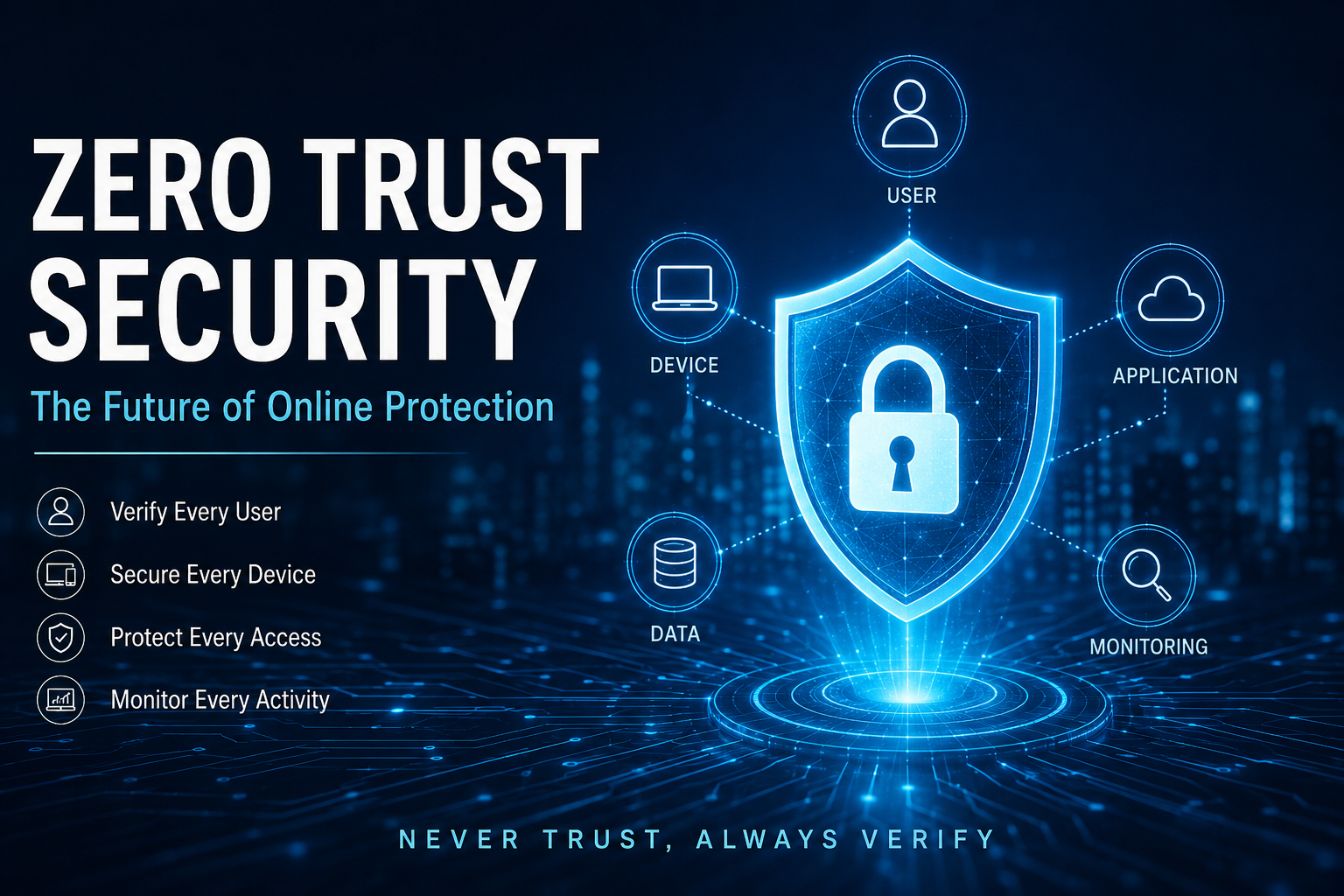
This is where Zero Trust Security has emerged as a modern cybersecurity strategy. Instead of assuming that everything inside a network is safe, Zero Trust follows a simple principle: never trust, always verify. Every user, device, application, and connection must prove its identity and authorization before accessing resources.
Zero Trust is not just a technology solution; it is a complete security mindset designed for today’s complex digital world.
What Is Zero Trust Security?
Zero Trust Security is a cybersecurity framework that removes the concept of automatic trust from networks. Under this model, no user or device receives permanent access simply because it is connected to a company’s network.
Every access request is continuously evaluated based on multiple factors such as user identity, device health, location, security policies, and the sensitivity of the requested data.
For example, in a traditional security system, an employee who successfully enters the company network may gain access to multiple internal resources. In a Zero Trust environment, that same employee must continuously prove that they have permission to access specific applications or information.
The goal is to reduce security risks by limiting unnecessary access and preventing attackers from moving freely inside a network after gaining entry.
The Core Principles Behind Zero Trust Security
Zero Trust is built around several important security principles that help organizations create stronger protection systems.
The foundation of Zero Trust is continuous verification. Every access request is treated as potentially risky until it is verified.
A user logging in from a recognized device does not automatically receive unlimited access. The system checks whether the user has the correct permissions and whether the request matches normal behavior.
This approach helps prevent unauthorized access even when login credentials are stolen.
One of the biggest security problems in organizations is excessive access. Many employees have permissions they do not actually need, increasing the damage attackers can cause if an account is compromised.
Zero Trust follows the principle of least privilege, meaning users receive only the access required to complete their tasks.
For example, a marketing employee may need access to campaign tools but should not have access to financial records or confidential customer databases.
By reducing unnecessary permissions, companies can minimize internal and external security risks.
Traditional security systems often verify users only during login. Zero Trust takes a continuous approach.
The system constantly monitors activities, device behavior, and access patterns to identify suspicious actions.
If an employee suddenly tries to access sensitive files from an unusual location or device, the system can request additional verification or block the activity.
This real-time monitoring helps organizations respond quickly to potential threats.
Zero Trust divides networks into smaller security zones through a process called micro-segmentation.
Instead of allowing users or attackers to move freely across an entire network, access is restricted between different sections.
For example, if a hacker compromises one application, micro-segmentation prevents them from automatically reaching other critical systems.
This limits the impact of cyberattacks and creates stronger protection for important business assets.
Why Zero Trust Security Is Becoming More Important
The rise of digital transformation has increased the need for stronger cybersecurity strategies. Several major trends have made traditional security approaches less effective.
Remote Work and Hybrid Work Environments
Remote work has changed how organizations operate. Employees now connect to company systems from homes, shared workspaces, and different locations around the world.
Because users are no longer limited to office networks, companies need security models that protect access regardless of location.
Zero Trust allows organizations to secure remote connections by verifying every user and device before granting access.
Growth of Cloud Computing
Businesses increasingly depend on cloud platforms for storing data, running applications, and managing operations.
Cloud environments do not have traditional network boundaries, making older security methods less effective.
Zero Trust provides a security framework that works well with cloud-based systems by focusing on identity, permissions, and continuous verification.
Increasing Cyber Threats
Cybercriminals are becoming more advanced, using techniques such as phishing, ransomware, identity theft, and credential attacks.
Many successful attacks do not happen because security systems fail completely; they happen because attackers gain valid access through stolen credentials.
Zero Trust reduces the risk of these attacks by ensuring that having a password alone is not enough. Additional verification and access controls are required.
How Zero Trust Security Works in Practice
Implementing Zero Trust involves multiple technologies and security practices working together.
Identity and access management systems help verify users and control permissions. Multi-factor authentication adds an additional security layer by requiring users to confirm their identity through multiple methods.
Device security solutions check whether devices meet security requirements before allowing access. A device with outdated software or suspicious activity may be denied access.
Security analytics tools monitor behavior and identify unusual patterns. These systems use automation and artificial intelligence to detect possible threats faster.
Together, these components create a security environment where access decisions are based on real-time information rather than assumptions.
The Role of Artificial Intelligence in Zero Trust Security
Artificial intelligence is becoming an important part of modern Zero Trust strategies.
With thousands of access requests happening every day, manually reviewing every activity is impossible for large organizations. AI-powered security systems can analyze user behavior, detect anomalies, and identify potential threats automatically.
For example, if an account usually accesses systems during business hours but suddenly downloads large amounts of sensitive data at midnight, AI systems can recognize this unusual behavior and trigger security actions.
As cyber threats continue to evolve, AI will help organizations make faster and more accurate security decisions.
Benefits of Zero Trust Security for Businesses
Adopting a Zero Trust approach provides several advantages for organizations.
One major benefit is improved protection against data breaches. Since access is limited and continuously monitored, attackers have fewer opportunities to reach sensitive information.
Zero Trust also supports compliance requirements. Many industries handle confidential customer and financial data, requiring strong security controls. A Zero Trust framework helps organizations maintain better visibility and control over their digital assets.
Another advantage is improved visibility. Organizations gain a clearer understanding of who is accessing their systems, what resources they are using, and whether activities appear suspicious.
Zero Trust also supports modern business models by allowing secure access for remote employees, contractors, and partners.
Challenges of Implementing Zero Trust Security
Although Zero Trust offers stronger protection, implementing it can be challenging.
Many organizations still rely on older systems that were not designed for modern security models. Updating infrastructure and changing security processes requires time, planning, and investment.
Another challenge is managing user experience. If security controls become too complicated, employees may struggle with daily tasks. Businesses need to create a balance between strong protection and convenient access.
Successful Zero Trust implementation also requires organizational awareness. Security is not only the responsibility of IT teams; employees must understand safe digital practices and follow security policies.
Zero Trust Security and the Future of Cybersecurity
The future of cybersecurity will focus less on protecting a fixed network boundary and more on securing identities, devices, applications, and data wherever they exist.
As businesses continue adopting cloud services, artificial intelligence, Internet of Things devices, and remote work technologies, traditional security models will become increasingly limited.
Zero Trust represents a shift from “protect the network” to “protect every interaction.” This approach recognizes that threats can come from anywhere and that security must be active at every stage.
In the coming years, Zero Trust is expected to become a standard security strategy for organizations of all sizes, from startups to global enterprises.
Conclusion: A Smarter Approach to Digital Protection
Cybersecurity is no longer about building a single strong barrier around information. Modern threats require a security model that continuously verifies, monitors, and adapts.
Zero Trust Security provides a practical solution for today’s digital challenges by removing unnecessary trust and focusing on identity, access control, and continuous protection.
As technology continues to evolve, organizations that adopt Zero Trust principles will be better prepared to defend against cyber threats and protect valuable digital assets. The future of online protection is not based on trusting what is inside the network it is based on verifying everything, every time.

Software Developer & Writer
Hey, I'm Diva, a developer and writer blending code and creativity. I'm driven by a deep curiosity and a relentless pursuit of excellence. Join me as I craft digital solutions and captivating stories.



Leave A Comment