
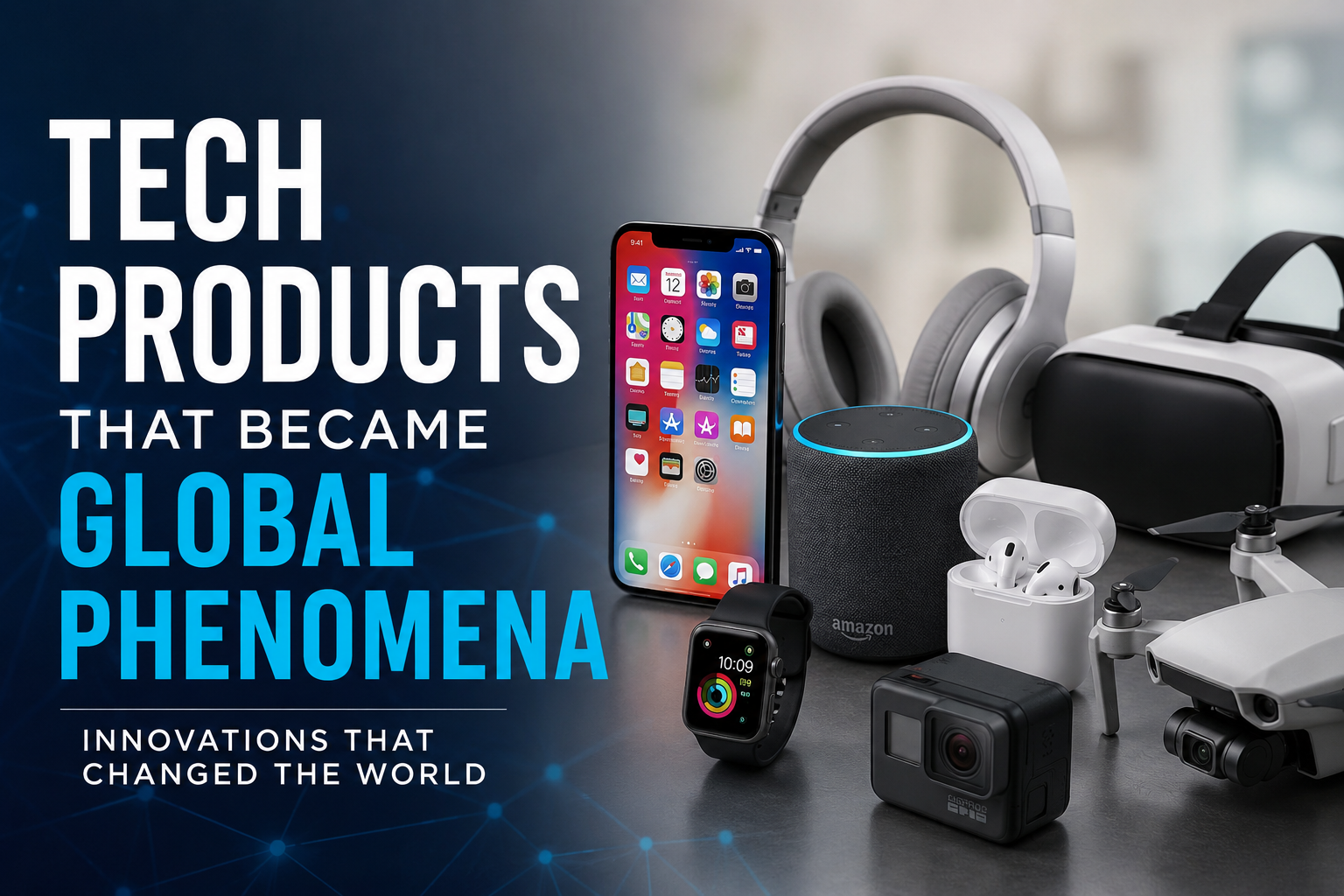
Tech Products That Became Global Phenomena: How Innovation Turned Everyday Gadgets into Cultural Icons
Technology has never evolved faster than it is today. Every year, thousands of new products enter the market, promising to change how we communicate, work, shop, travel, and entertain ourselves. Yet only a handful rise above the competition to become true global phenomena. These are the products that don’t just sell millions of units—they redefine industries, influence culture, and become essential parts of everyday life across continents.
From smartphones that transformed communication to AI-powered tools reshaping productivity, the world’s most successful tech products have one thing in common: they solved real problems while creating experiences people didn’t know they needed. Their influence extends far beyond technology, affecting business, education, healthcare, entertainment, and even social interactions.
As digital transformation accelerates worldwide, understanding what made these products successful offers valuable insight into the future of innovation. Here are some of the most influential tech products that became global phenomena and continue to shape the modern digital landscape.
Apple iPhone: The Smartphone That Changed Everything
When Apple introduced the iPhone in 2007, mobile phones were primarily communication devices. Internet browsing was slow, applications were limited, and touchscreens were considered experimental. The iPhone fundamentally changed those perceptions by combining an intuitive touchscreen interface, powerful computing capabilities, and an ecosystem of applications into one elegant device.
The launch of the App Store further accelerated its global success by enabling developers worldwide to create applications for virtually every need. Banking, shopping, gaming, education, photography, navigation, and healthcare all found new opportunities through mobile apps.
Today, the iPhone remains one of the world’s most recognizable consumer products. It has influenced countless competitors while setting standards for industrial design, mobile photography, privacy, software integration, and premium consumer electronics.
ChatGPT: Making Artificial Intelligence Mainstream
Artificial intelligence existed for decades before it entered mainstream conversations. That changed dramatically with the public release of ChatGPT, which introduced conversational AI to millions of users almost overnight.
Students began using it for learning, professionals adopted it for writing and brainstorming, developers integrated it into workflows, and businesses explored automation opportunities. Unlike previous AI systems that required technical expertise, ChatGPT offered a simple conversational interface that made advanced AI accessible to everyone.
Its rapid adoption sparked an industry-wide AI race, encouraging technology companies to integrate generative AI into search engines, office software, design platforms, customer support systems, and creative tools.
ChatGPT represents one of the fastest-growing technology products in history, demonstrating how user-friendly design can accelerate adoption of even the most complex innovations.
Tesla Model 3: Bringing Electric Vehicles into the Mainstream
Electric cars existed long before Tesla, but widespread consumer adoption remained limited due to high prices, limited driving range, and inadequate charging infrastructure.
The Tesla Model 3 changed public perception by delivering impressive performance, long-range capability, software-driven features, and over-the-air updates at a relatively accessible price point. The vehicle demonstrated that electric cars could compete directly with traditional gasoline-powered vehicles in both convenience and performance.
Tesla’s emphasis on software, autonomous driving capabilities, battery technology, and direct-to-consumer sales transformed expectations across the automotive industry. Today, nearly every major automaker has accelerated its electric vehicle strategy, influenced in part by Tesla’s success.
Apple AirPods: Redefining Wireless Audio
Wireless earbuds were available before AirPods, but none captured the market with the same combination of simplicity, design, and seamless integration.
Apple removed the complexity associated with Bluetooth pairing by enabling instant connection across its ecosystem. Their compact design, long battery life, and impressive sound quality quickly made them a global fashion and technology accessory.
Beyond music listening, AirPods became essential tools for remote work, virtual meetings, online education, podcast consumption, and voice assistants. Their popularity also encouraged competitors to launch premium wireless earbuds, expanding the entire market.
Today, wireless earbuds represent one of the fastest-growing consumer electronics categories worldwide.
Nintendo Switch: Reinventing Gaming Flexibility
Gaming consoles traditionally required players to choose between home gaming systems and portable handheld devices. Nintendo challenged this distinction with the Switch, offering a hybrid console that seamlessly transitioned between television and portable gaming.
Its flexibility appealed to families, casual gamers, and dedicated gaming enthusiasts alike. Combined with exclusive titles and innovative multiplayer experiences, the Nintendo Switch became a global bestseller.
The console proved that innovation does not always require greater processing power. Instead, understanding how consumers want to play can redefine an entire entertainment category.
Amazon Kindle: Transforming the Reading Experience
The publishing industry experienced one of its biggest digital shifts with the arrival of Amazon’s Kindle. By making thousands of books instantly accessible through a lightweight electronic device, Kindle changed reading habits across the world.
Readers gained the ability to carry entire libraries in a single device while authors benefited from simplified self-publishing opportunities through digital platforms.
Although printed books remain popular, Kindle accelerated the acceptance of digital reading, educational materials, newspapers, and magazines, creating entirely new publishing business models.
GoPro: Creating a New Category of Cameras
Before GoPro, capturing adventure sports required bulky cameras or professional equipment. GoPro introduced compact, durable, waterproof action cameras that enabled users to document activities such as surfing, skiing, cycling, skydiving, and travel with remarkable ease.
The rise of social media amplified GoPro’s popularity as users shared immersive first-person videos across YouTube, Instagram, and other platforms.
GoPro became more than a camera—it represented an active lifestyle and demonstrated how user-generated content could become one of the strongest forms of product marketing.
DJI Drones: Making Aerial Photography Accessible
Professional aerial photography was once limited to helicopters and expensive production equipment. DJI transformed this market by creating drones that combined intelligent flight systems, stabilization technology, GPS navigation, obstacle avoidance, and high-resolution cameras.
Content creators, filmmakers, surveyors, construction firms, farmers, emergency responders, and travel enthusiasts rapidly adopted drone technology.
Today, DJI dominates the global consumer drone market, while aerial content has become commonplace across advertising, journalism, tourism, and filmmaking.
Apple Watch: Expanding Wearable Technology
Smartwatches struggled to gain traction before Apple entered the market. The Apple Watch succeeded by positioning itself not merely as a gadget but as a health and wellness companion.
Heart-rate monitoring, ECG functionality, fitness tracking, sleep analysis, emergency SOS features, and integration with healthcare systems transformed consumer expectations.
Millions now use wearable devices to monitor physical activity, improve wellness, and detect potential health concerns earlier than ever before. The smartwatch category has since become one of the fastest-growing segments in consumer electronics.
Google Chromecast: Simplifying Home Entertainment
Streaming content from phones and laptops to televisions was once a complicated process requiring cables and expensive equipment. Chromecast simplified the experience with a small, affordable device that enabled seamless wireless streaming.
Its ease of use encouraged broader adoption of streaming platforms while reducing reliance on traditional television broadcasting.
The product played an important role in accelerating the shift toward digital entertainment and connected home ecosystems.
Oculus Quest: Bringing Virtual Reality Closer to Consumers
Virtual reality often required expensive computers, complicated sensors, and extensive setup procedures. Oculus Quest simplified VR by offering a standalone headset capable of delivering immersive experiences without external hardware.
Gaming remained a major driver of adoption, but education, fitness, workplace collaboration, training, healthcare, and virtual events soon expanded VR’s practical applications.
The success of standalone VR devices demonstrated growing consumer interest in immersive technologies that may shape the future of digital interaction.
Ring Video Doorbell: Making Smart Home Security Mainstream
Home security has evolved significantly with connected devices, and Ring helped accelerate this transformation through its smart video doorbell.
By allowing homeowners to monitor entrances remotely, communicate with visitors, receive motion alerts, and integrate security systems into smartphones, Ring introduced practical smart-home technology to millions of households.
Its popularity encouraged broader investment in connected security products including smart locks, cameras, lighting, and alarm systems.
Fitbit: Inspiring the Global Fitness Tracking Movement
Long before smartwatches dominated wearable technology, Fitbit introduced activity tracking to mainstream consumers.
Counting daily steps quickly became a global health trend. Over time, Fitbit expanded into sleep monitoring, heart-rate tracking, exercise analysis, stress management, and wellness insights.
The product encouraged millions to become more aware of their daily physical activity while inspiring healthcare providers and employers to explore preventive wellness initiatives.
Why These Tech Products Became Worldwide Success Stories
Although these products belong to different industries, they share several characteristics that explain their remarkable global success.
First, they solved genuine consumer problems rather than introducing technology for its own sake. Whether simplifying communication, improving health monitoring, enabling remote work, or enhancing entertainment, each product delivered clear everyday value.
Second, exceptional user experience played a central role. Consumers embraced products that required minimal learning while offering seamless functionality.
Third, strong ecosystems amplified long-term engagement. Mobile apps, cloud services, accessories, subscription models, developer communities, and software updates helped transform individual products into complete digital platforms.
Another major factor was timing. Many of these innovations entered the market precisely when supporting technologies such as faster internet, cloud computing, improved batteries, artificial intelligence, and mobile connectivity reached maturity.
Finally, powerful branding and community engagement turned customers into advocates. Social media, influencer marketing, user-generated content, and word-of-mouth recommendations accelerated adoption on a global scale.
The Future of Global Tech Phenomena
The next generation of globally influential technology products will likely emerge from fields such as artificial intelligence, robotics, extended reality, spatial computing, autonomous transportation, biotechnology, quantum computing, and sustainable energy solutions.
Consumers increasingly expect technology to be intelligent, personalized, environmentally responsible, and seamlessly integrated across multiple devices. Products that combine these qualities while solving meaningful everyday challenges are most likely to become tomorrow’s global success stories.
Innovation is no longer measured solely by hardware specifications. Instead, companies must create connected experiences that improve productivity, creativity, health, communication, and quality of life.
Conclusion
The world’s most successful tech products did more than achieve impressive sales figures—they transformed industries and permanently changed human behavior. From the iPhone revolutionizing smartphones to ChatGPT making artificial intelligence accessible and Tesla redefining electric mobility, each innovation reshaped expectations for what technology could accomplish.
As emerging technologies continue to evolve, future global phenomena will likely be defined by intelligence, connectivity, sustainability, and user-centric design. Businesses, entrepreneurs, and consumers alike can learn valuable lessons from these iconic products: lasting success comes from solving real-world problems through innovation that is both practical and accessible.
The next revolutionary tech product may already be in development today, waiting to become the next name recognized in homes, workplaces, and communities across the globe.

Software Developer & Writer
Hey, I'm Diva, a developer and writer blending code and creativity. I'm driven by a deep curiosity and a relentless pursuit of excellence. Join me as I craft digital solutions and captivating stories.




Leave A Comment