
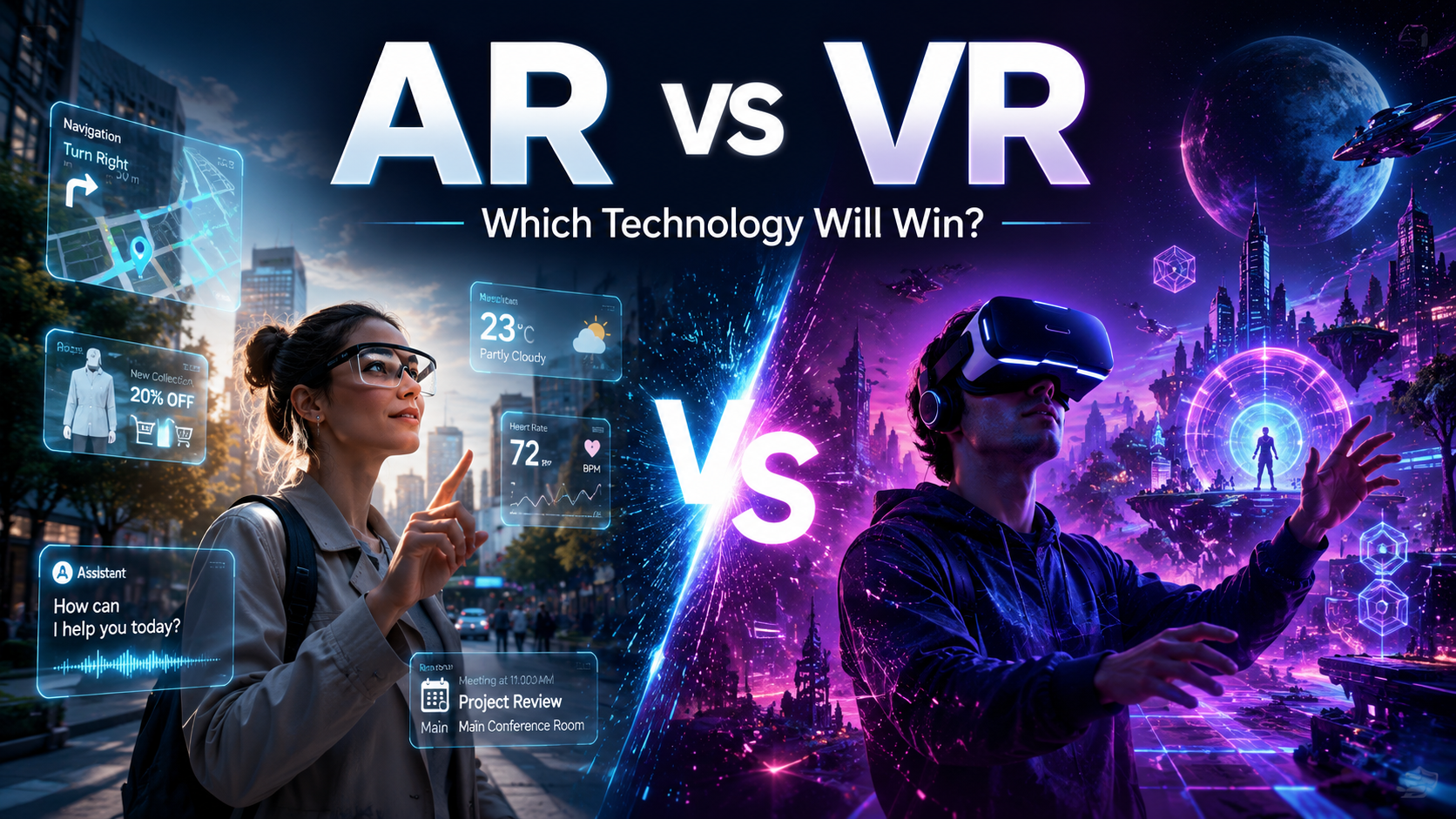
AR vs VR: Which Technology Will Win? The Future of Immersive Experiences Explained
Introduction
For years, Augmented Reality (AR) and Virtual Reality (VR) have been competing for attention as the technologies that could redefine how people work, learn, shop, play, and interact with the digital world. From immersive gaming headsets to smart glasses capable of overlaying digital information onto real-life environments, both technologies have evolved at an impressive pace. Major technology companies continue investing billions into research and development, making AR and VR central to the future of computing.
But one question continues to spark debate across the tech industry: Which technology will ultimately win AR or VR? While they share similar foundations, they solve very different problems and serve distinct purposes. Rather than being direct competitors, they are increasingly becoming complementary technologies that address different user needs.
As hardware becomes lighter, artificial intelligence grows smarter, and spatial computing enters the mainstream, understanding the strengths and limitations of AR and VR has become more important than ever. This article explores how both technologies work, where they excel, the industries driving adoption, and what the future may hold.
Understanding the Difference Between AR and VR
Although AR and VR are often mentioned together, they deliver entirely different experiences.
Augmented Reality (AR) enhances the real world by adding digital elements such as images, directions, animations, or interactive objects on top of what users already see. Smartphones, tablets, and smart glasses are common AR devices. Users remain aware of their physical surroundings while interacting with digital content.
Virtual Reality (VR), on the other hand, replaces the real world with a completely computer-generated environment. By wearing a VR headset, users become immersed inside a digital space where every object, sound, and interaction is simulated. This creates a highly engaging experience that feels separate from reality.
The key distinction is simple: AR adds digital information to reality, while VR creates an entirely new reality.
The Rapid Growth of Immersive Technologies
The market for immersive technologies has expanded dramatically over the past decade. Improvements in display quality, processing power, AI-powered object recognition, and cloud computing have made both AR and VR more practical for everyday use.
Consumers now experience AR through shopping apps, navigation systems, educational tools, and smartphone games. VR has become increasingly popular in gaming, fitness, virtual collaboration, and professional training.
Businesses have also embraced immersive technologies to improve productivity, reduce costs, and create engaging customer experiences. Manufacturing, healthcare, retail, architecture, and education are among the industries experiencing significant transformation.
Why Augmented Reality Is Gaining Momentum
Many technology experts believe AR has broader long-term potential because it integrates naturally into everyday life.
Unlike VR, AR doesn’t completely isolate users from their surroundings. Instead, it enhances daily activities without requiring people to disconnect from reality. This makes AR far easier to adopt in workplaces, schools, shopping centers, and homes.
Imagine walking through a city while navigation arrows appear directly on the road, trying on clothes without entering a fitting room, or repairing machinery with step-by-step holographic instructions floating beside the equipment.
These experiences save time, improve efficiency, and provide practical value beyond entertainment.
Another advantage is accessibility. Millions of people already own smartphones capable of running AR applications, eliminating the need for expensive dedicated hardware.
Why Virtual Reality Continues to Impress
Despite AR’s practical advantages, VR remains unmatched when complete immersion is required.
Virtual Reality creates experiences that simply cannot be replicated through traditional screens. Whether exploring ancient civilizations, attending virtual concerts, flying aircraft simulators, or participating in realistic medical training, VR transports users into entirely new environments.
Gaming remains the biggest driver of VR adoption. Modern VR games allow players to physically move, interact with objects, and communicate with others in highly realistic digital worlds.
However, VR’s influence extends far beyond entertainment.
Airlines use VR for pilot training. Medical schools simulate complex surgeries without risking patient safety. Military organizations prepare soldiers for dangerous scenarios. Companies conduct employee onboarding inside virtual workplaces.
As headset technology becomes lighter and more comfortable, VR is steadily becoming a valuable professional tool rather than just a gaming accessory.
AR vs VR in Gaming
Gaming is often considered the proving ground for emerging technologies, and VR currently dominates this category.
VR delivers an unmatched sense of presence. Players feel as though they are physically inside the game world rather than simply controlling characters on a screen. Motion tracking, hand controllers, eye tracking, and spatial audio combine to create deeply immersive experiences.
AR gaming, while popular through mobile experiences, focuses on blending gameplay with real-world environments. Instead of escaping reality, players interact with digital objects placed around them.
Both approaches attract different audiences. VR appeals to players seeking complete immersion, while AR offers casual, social experiences that fit naturally into everyday life.
As hardware improves, developers are increasingly creating games that combine both technologies.
The Impact on Healthcare
Healthcare represents one of the most promising applications for both AR and VR.
Doctors increasingly use AR to visualize patient anatomy during surgery, providing additional guidance without looking away from the operating field.
Medical students benefit from interactive 3D anatomy models that make complex structures easier to understand.
VR is transforming medical education by allowing students to practice surgeries repeatedly inside realistic simulations before operating on real patients.
Mental health professionals also use VR therapy to treat anxiety disorders, PTSD, and phobias by gradually exposing patients to controlled virtual environments.
The combination of AR precision and VR simulation is improving patient outcomes while reducing training costs.
Education Is Becoming More Interactive
Traditional classrooms are evolving with immersive learning technologies.
AR transforms textbooks into interactive educational experiences where students can view animated scientific models, historical landmarks, or engineering diagrams directly from printed pages.
VR allows students to explore the pyramids of Egypt, travel through the solar system, visit the ocean floor, or walk inside the human body without leaving the classroom.
These experiences increase engagement, improve memory retention, and encourage active participation.
Educational institutions worldwide are recognizing that immersive learning often delivers better results than passive reading or lectures alone.
Retail and E-Commerce Are Being Reinvented
Online shopping has always struggled to replicate the confidence of physical stores. AR is solving this challenge.
Consumers can now visualize furniture inside their homes, try on makeup virtually, preview clothing, or see how appliances fit within kitchens before purchasing.
These interactive experiences reduce product returns while increasing customer satisfaction.
VR, meanwhile, introduces virtual shopping malls where customers browse digital stores as avatars, interact with products, and receive personalized recommendations.
Luxury brands, automotive manufacturers, and real estate companies are increasingly adopting immersive showrooms to showcase products in entirely new ways.
Business Collaboration in the Spatial Era
Remote work accelerated demand for more engaging digital collaboration tools.
VR meeting spaces allow distributed teams to gather inside shared virtual offices, collaborate on 3D models, brainstorm ideas, and conduct presentations with greater engagement than traditional video conferencing.
AR supports field technicians, engineers, and maintenance workers by displaying instructions directly within their field of view while keeping both hands free.
Experts can remotely guide workers through repairs using shared AR visuals, reducing travel costs and minimizing downtime.
As businesses embrace hybrid work models, immersive collaboration is expected to become increasingly common.
Hardware Challenges Still Exist
Despite impressive progress, neither technology has fully overcome its hardware limitations.
VR headsets remain relatively bulky for extended daily use. Motion sickness affects some users, particularly during fast-moving virtual experiences.
Battery life, weight, heat generation, and display comfort continue to influence user adoption.
AR smart glasses face even greater engineering challenges. Developers must balance lightweight designs with powerful processors, high-quality displays, long battery life, and fashionable aesthetics.
Creating glasses that resemble ordinary eyewear while delivering advanced computing capabilities remains one of the industry’s biggest challenges.
As semiconductor technology advances, future devices are expected to become significantly smaller, lighter, and more comfortable.
Artificial Intelligence Is Accelerating Both Technologies
Artificial Intelligence is becoming the engine powering the next generation of AR and VR experiences.
AI enables real-time object recognition, environmental mapping, gesture tracking, language translation, voice interaction, and personalized recommendations.
In AR, AI understands surrounding environments, allowing digital objects to interact naturally with physical spaces.
In VR, AI generates smarter virtual characters, dynamic environments, adaptive training scenarios, and realistic conversations.
Generative AI is also reducing development time by automatically creating 3D environments, digital assets, and immersive experiences from simple text prompts.
The convergence of AI with immersive technologies is making digital worlds more intelligent, responsive, and personalized than ever before.
Will Mixed Reality Replace Both?
Increasingly, experts believe the future is not AR versus VR—but Mixed Reality (MR).
Mixed Reality combines elements of both technologies, allowing digital and physical objects to coexist and interact seamlessly.
Instead of choosing between complete immersion or simple overlays, users experience environments where virtual objects respond naturally to real-world surfaces, lighting, and movement.
Many of today’s advanced headsets already support both AR and VR modes, suggesting that future devices will integrate multiple immersive experiences within a single platform.
This convergence may eventually blur the distinctions that currently separate AR and VR.
So, Which Technology Will Win?
The answer depends on what “winning” actually means.
If success is measured by everyday consumer adoption, Augmented Reality appears to have the advantage. Its ability to enhance daily life without disconnecting users from reality makes it highly practical for shopping, navigation, education, healthcare, and workplace productivity.
If success is measured by deep immersion and transformative experiences, Virtual Reality remains unmatched. Training simulations, gaming, entertainment, therapy, and virtual collaboration continue to showcase VR’s extraordinary capabilities.
Rather than one technology replacing the other, they are likely to evolve together.
Consumers may use AR glasses throughout the day for productivity and communication, then switch to VR for gaming, education, fitness, entertainment, or professional training.
The future of computing may not involve choosing between AR and VR—but seamlessly moving between both whenever the situation demands.
Conclusion
The debate over AR vs VR has shifted dramatically in recent years. Instead of asking which technology is better, businesses and consumers are beginning to recognize that each serves unique purposes within the growing ecosystem of spatial computing.
Augmented Reality is transforming everyday interactions by making information instantly accessible within the real world. Virtual Reality continues redefining immersion by creating experiences impossible through conventional devices.
As artificial intelligence, cloud computing, advanced sensors, and wearable hardware continue evolving, the line between AR and VR will become increasingly blurred. Future devices are expected to offer flexible experiences that combine the strengths of both technologies while minimizing their limitations.
Ultimately, there may never be a single winner. Instead, AR and VR are likely to coexist, complement each other, and collectively shape the next generation of digital interaction. Together, they represent the future of immersive technology—one where the physical and digital worlds blend seamlessly, opening possibilities that were once confined to science fiction.

Software Developer & Writer
Hey, I'm Diva, a developer and writer blending code and creativity. I'm driven by a deep curiosity and a relentless pursuit of excellence. Join me as I craft digital solutions and captivating stories.




Leave A Comment