
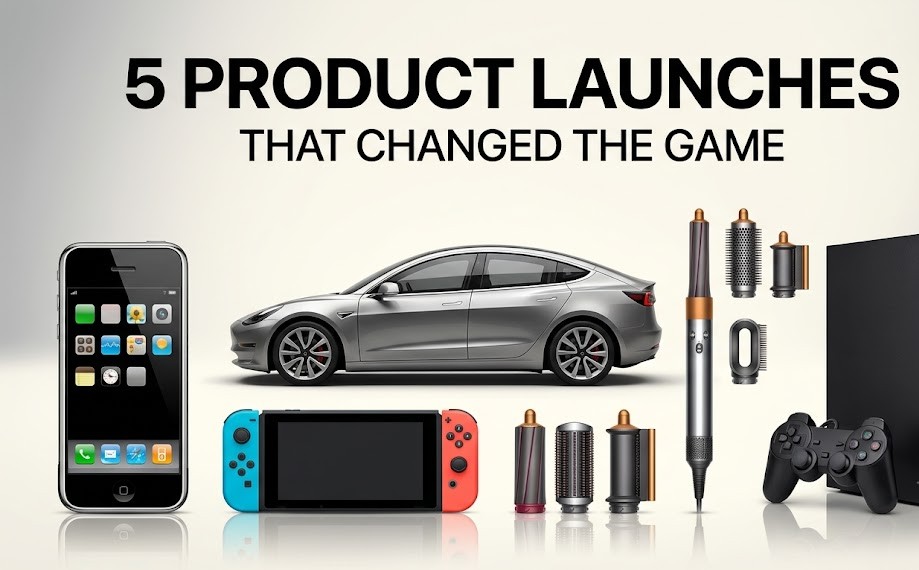
Top 5 Master Product Launches That Changed the Game: How Global Brands Turn Innovation Into Desire
From revolutionary smartphones to category-defining electric vehicles, discover five iconic product launches that reshaped consumer expectations, strengthened brand loyalty, and changed the way the world shops.
A successful product launch is about much more than introducing something new to the market. It is about creating anticipation, understanding consumer behaviour, and giving people a compelling reason to choose one product over every alternative. The most memorable global product launches do not simply announce a new item; they introduce a new possibility. They change how consumers communicate, travel, entertain themselves, or interact with everyday technology. For brands, these moments can become defining milestones that influence entire industries for years.
In today’s competitive marketplace, product quality alone rarely guarantees commercial success. Companies must combine innovation with thoughtful positioning, distinctive storytelling, effective distribution, and an understanding of what customers genuinely value. Some brands build anticipation through secretive announcements, while others transform familiar products into cultural symbols. Looking at five landmark product launches reveals how the right combination of timing, technology, design, and marketing can turn a new release into a global phenomenon.
When Apple introduced the original iPhone on January 9, 2007, the mobile phone industry was approaching a turning point. Consumers were accustomed to physical keypads, compact displays, and devices designed primarily for calling, texting, and basic internet access. Apple presented a different vision: a single handheld device that combined a mobile phone, a widescreen iPod, and an internet communications device. The launch was not simply about offering a new smartphone; it was about challenging consumers to rethink what a phone could accomplish. Apple’s announcement positioned the iPhone as a new kind of everyday technology, with a multi-touch interface that allowed users to navigate the screen directly with their fingers.
One of the most powerful aspects of the original iPhone launch was its simplicity. Rather than overwhelming the audience with a long list of technical specifications, Apple focused on the experience the device could deliver. Browsing the web, viewing photographs, listening to music, and communicating with others became parts of a unified digital experience. The product demonstration allowed people to understand the innovation visually, making unfamiliar technology feel intuitive. This approach established a valuable lesson in product launch marketing: customers often connect more strongly with the problem a product solves than with the technical details behind its development.
Apple also understood that a premium product requires a consistent brand experience. Its minimalist design, carefully staged keynote, controlled product presentation, and retail demonstrations reinforced the idea that the iPhone was not merely another electronic device. It was a desirable consumer product with a distinctive identity. When the first iPhone went on sale in the United States on June 29, 2007, Apple supported the launch through its retail stores, online channels, customer workshops, and personalised product assistance. This helped connect the initial excitement with the actual ownership experience.
The iPhone’s long-term influence extended beyond hardware. It helped establish the smartphone as a central platform for mobile computing, applications, digital payments, photography, entertainment, and online shopping. Its success also encouraged other technology companies to reconsider touchscreen design and mobile software experiences. Although the modern smartphone market has become far more competitive, Apple’s original launch remains a landmark example of how a brand can introduce a product by changing consumer expectations rather than simply improving an existing category.
The marketing lesson: Sell the transformation, not just the product. Apple’s approach demonstrates how a clear value proposition, memorable demonstrations, premium positioning, and a cohesive customer experience can turn an innovative device into a defining brand moment.
For years, electric vehicles faced a perception challenge. Many consumers associated them with limited driving range, niche environmental appeal, unfamiliar technology, or compromises in performance and convenience. Tesla sought to change that narrative by presenting electric mobility as desirable, technologically advanced, and relevant to a much broader audience. The Model 3 unveiling in March 2016 became a major milestone in this strategy because it represented a move beyond the company’s earlier premium vehicles towards a more accessible electric car. Instead of positioning electric driving as a sacrifice for environmentally conscious consumers, Tesla presented it as an exciting alternative to conventional motoring.
The Model 3’s launch strategy placed anticipation at the centre of the customer journey. The unveiling generated substantial public interest, while the reservation process allowed prospective buyers to express their interest before deliveries began. This approach helped transform the launch into a broader conversation about the future of transportation. Rather than relying exclusively on traditional advertising to explain the product, Tesla benefited from public demonstrations, media coverage, online discussion, and a community of technology enthusiasts who followed the company’s progress.
The product itself supported this positioning through a combination of electric performance, a minimalist interior, software-led features, and a design that looked closer to a modern premium sedan than an experimental environmental vehicle. The large central touchscreen reduced the number of conventional dashboard controls, while software updates reinforced the idea that the vehicle could evolve after purchase. For consumers, this created a different relationship with the automobile: a car was no longer only a mechanical product but also a connected technology platform.
Tesla’s approach also illustrates how a launch can influence an entire industry even when the company introducing the product faces operational challenges. Building vehicles at scale, maintaining quality, meeting delivery expectations, and expanding charging infrastructure are all essential to converting excitement into long-term satisfaction. A strong reveal can attract attention, but customers ultimately judge the brand on whether the finished product fulfils its promise. That distinction is particularly important in automotive marketing, where a purchase involves substantial financial commitment and an expectation of years of reliable use.
The Model 3 helped bring electric vehicles into mainstream consumer consideration and encouraged established automakers to accelerate their own electric-car programmes. It also demonstrated the commercial potential of combining digital-first marketing, a technology-oriented brand identity, and a product designed to appeal beyond a narrow early-adopter audience.
The marketing lesson: Build a movement around the product’s purpose. Tesla demonstrated how a company can make an emerging technology aspirational by connecting it to a larger consumer desire for better performance, modern design, convenience, and a different ownership experience.
The gaming industry has long been shaped by competition over graphics, processing power, exclusive games, and online features. Yet Nintendo approached the launch of the Switch with a different question: what if players did not have to choose between a home gaming console and a portable device? Released worldwide on March 3, 2017, the Nintendo Switch introduced a hybrid format that allowed players to move between television-based gaming and handheld play. Its detachable Joy-Con controllers added another dimension, enabling users to share a controller and play together without needing a separate set of equipment. The idea was straightforward, but its implications for the gaming experience were significant.
Nintendo’s launch strategy focused on demonstrating the product’s versatility rather than making technical specifications the centre of attention. Promotional material showed people playing at home, travelling, meeting friends, and enjoying games in different environments. This made the Switch’s main advantage immediately understandable. Consumers did not need to study a complex explanation of the hardware to appreciate its appeal; they could see how it might fit into their everyday lives. The launch also addressed a familiar consumer frustration by offering flexibility without requiring players to purchase two completely different systems.
Another important element was Nintendo’s emphasis on experiences that encouraged people to play together. The Joy-Con controllers helped communicate the idea that gaming could be social, spontaneous, and accessible. This was especially relevant for families and casual players who might not identify with the traditional image of a dedicated gamer. By presenting the console as both personal entertainment and a shared activity, Nintendo widened the situations in which the product could be useful. Its appeal extended beyond the technical performance of the device to the memories and experiences it could help create.
The early commercial response supported the strength of this positioning. Nintendo announced in December 2017 that worldwide sell-through had surpassed 10 million units as of December 10, less than a year after launch. The company attributed the system’s appeal to its distinctive features and the additional ways it allowed people to play.
The Switch subsequently developed into one of the most influential gaming platforms of its generation, supported by Nintendo’s recognisable franchises and a library of games designed around different play styles.
The larger lesson is that innovation does not always require inventing an entirely new category. Sometimes the most effective product strategy is to remove a limitation that consumers have accepted for years. Nintendo combined familiar gaming experiences with a more flexible format, giving customers a reason to reconsider how and where they played.
The marketing lesson: Demonstrate how a product fits into real life. Nintendo made its central benefit easy to understand through everyday scenarios, memorable product demonstrations, and a clear emphasis on flexibility and shared experiences.
The beauty industry is filled with products promising smoother hair, salon-inspired styling, and professional-looking results at home. Against this crowded background, Dyson introduced the Airwrap in 2018 with a distinctive proposition: a multi-styling tool that used controlled airflow to shape hair rather than relying solely on traditional high-heat styling methods. The launch brought Dyson’s engineering-led identity into personal beauty, a category where consumers often make purchasing decisions based on performance, aesthetics, convenience, and the results they expect to achieve. By combining several styling functions in one product, the company positioned the Airwrap as a sophisticated alternative to buying multiple individual tools.
The innovation was closely connected to Dyson’s existing expertise in airflow technology. Its engineering approach used the Coanda effect, in which an air stream follows a nearby curved surface, to help attract and wrap hair around the styling barrel. Dyson’s own account of the product’s development describes how the company adapted its engineering knowledge to create a different approach to drying and styling. The Airwrap’s original launch in New York on October 10, 2018, marked an expansion of the brand into a beauty category where technology could become a meaningful point of differentiation.
What made the product particularly interesting from a marketing perspective was the way its technology could be demonstrated visually. Traditional beauty products are often promoted through finished hairstyles and aspirational imagery, but the Airwrap also offered a compelling demonstration: hair being drawn around a barrel by airflow. That visual mechanism helped create curiosity and made the product easier to discuss across beauty tutorials, product reviews, and social media. Instead of asking consumers to trust a technical claim alone, the brand gave them something distinctive to see and understand.
Dyson also used premium design and a carefully presented collection of attachments to support the product’s perceived value. The Airwrap was positioned as a versatile beauty investment rather than an inexpensive styling accessory. Its premium price placed greater importance on communicating performance, convenience, and the potential to achieve multiple styles with one device. This strategy illustrates how brands can move beyond price competition when their product offers a recognisable combination of design, functionality, and engineering.
However, premium positioning also creates high expectations. Customers must feel that a product justifies its cost through meaningful everyday benefits, not simply an attractive appearance or an impressive demonstration. Dyson’s subsequent development of additional attachments and refinements shows how product launches can evolve into a longer-term platform for innovation rather than remaining isolated events. The company has continued to introduce styling options intended to address different hair types and consumer preferences.
The Airwrap demonstrates how technology can reshape a traditionally lifestyle-driven category. It created a conversation that connected beauty, engineering, convenience, and premium consumer electronics, giving the product a distinctive place in the market.
The marketing lesson: Make innovation visible and connect it to an everyday benefit. When customers can see how a product works and understand why it might improve their routine, technical differentiation becomes a much stronger reason to consider a premium purchase.
When Sony launched the PlayStation 2 in Japan on March 4, 2000, the gaming market was entering a new era of home entertainment. The console promised more advanced gaming experiences, but one of its most compelling features extended beyond video games: DVD playback. At a time when DVD players represented an additional purchase for many households, the PlayStation 2 combined gaming and movie watching in one device. It also supported original PlayStation games, giving existing customers a familiar reason to upgrade while preserving access to their previous game collections. Together, these features helped make the console attractive to both dedicated gamers and households looking for a versatile entertainment product.
Sony’s strategy illustrates the importance of understanding the broader context in which consumers evaluate a new product. A gaming console may compete with other consoles, but a device that also plays movies competes for a place in the household entertainment budget. By adding DVD functionality, Sony increased the perceived value of its product without requiring customers to think of themselves exclusively as gamers. This expanded the console’s appeal and gave families another reason to consider purchasing it.
Backward compatibility was equally important. Customers who had invested time and money in the original PlayStation library did not have to abandon those experiences when upgrading to the new generation. This reduced a potential barrier to adoption and rewarded existing customers for remaining within the PlayStation ecosystem. In modern marketing terms, Sony combined customer retention with new-customer acquisition: the product appealed to first-time buyers while giving loyal customers a clear upgrade path.
The PlayStation 2 also benefited from the strength of its gaming ecosystem. A console’s success depends not only on the hardware itself but also on the experiences available through its software library. Sony’s platform attracted ambitious game development, helped establish memorable franchises, and gave consumers reasons to continue using the device long after the initial excitement surrounding its launch had faded. This created a reinforcing cycle in which a growing audience encouraged more game development, while a stronger library made the console increasingly appealing to new buyers.
The commercial legacy was extraordinary. Sony’s official PlayStation history records more than 160 million PlayStation 2 consoles sold worldwide since 2000, making it one of the best-selling home gaming consoles of all time. Its success was supported by a combination of accessible entertainment features, an extensive game library, and a product proposition that appealed to a broad audience.
The PlayStation 2’s enduring relevance lies in how it demonstrated that a product can become more valuable by fitting into a wider ecosystem of consumer activities. It was not simply a gaming machine. It became part of how people played games, watched films, and spent time together at home.
The marketing lesson: Increase perceived value by solving more than one consumer need. Sony demonstrated how complementary features, backward compatibility, and a strong ecosystem can create a compelling reason to buy while encouraging long-term customer loyalty.
What These Five Master Product Launches Teach Modern Brands
The iPhone, Tesla Model 3, Nintendo Switch, Dyson Airwrap, and PlayStation 2 belong to different industries, yet their launch strategies reveal several shared principles. Each brand identified an opportunity to improve an existing experience, communicated its central benefit in a recognisable way, and gave consumers a compelling reason to pay attention. Their achievements were not based on innovation alone; they also depended on how that innovation was presented, experienced, and supported after the initial announcement.
The first principle is clarity of positioning. Apple made the iPhone’s multifunctional experience easy to understand, Nintendo showed how its console could move between different settings, and Dyson demonstrated how airflow technology could change hair styling. Each product had a central promise that consumers could remember. Brands introducing new products can apply the same principle by identifying the most meaningful customer benefit before building their campaign around technical specifications.
The second principle is creating anticipation without losing credibility. Tesla’s reservation-led approach and Apple’s carefully orchestrated product unveiling generated substantial public interest. However, excitement is only the beginning of a successful launch. Brands must ensure that availability, product quality, customer service, and the actual user experience support the expectations created by their marketing. A campaign may attract attention in the short term, but customer satisfaction determines whether that attention becomes sustained demand and positive word of mouth.
A third lesson is the importance of designing for the complete customer journey. The PlayStation 2 offered value through its compatibility and entertainment features, while Nintendo made its product’s flexibility part of the everyday ownership experience. Similarly, modern consumer brands can improve product adoption by considering what happens before, during, and after a purchase. Clear product information, accessible demonstrations, helpful onboarding, reliable support, and meaningful after-sales service can all strengthen the launch’s commercial impact.
Finally, the strongest product launches build an identity that extends beyond a single transaction. Consumers may purchase a smartphone for its features, a beauty device for its styling capabilities, or a gaming console for its entertainment value. Over time, however, their relationship with the brand can deepen through familiarity, community, trust, and the experiences associated with the product. This is where a well-executed launch becomes more than a marketing event: it becomes the starting point for a longer-term customer relationship.
The Final Takeaway
A master product launch does not necessarily introduce the most expensive, complicated, or technologically advanced product in its category. It introduces something that customers can understand, desire, and imagine using in their own lives. Apple’s iPhone changed expectations for mobile devices, Tesla’s Model 3 helped broaden the appeal of electric cars, Nintendo made gaming more flexible, Dyson brought engineering-led innovation into beauty, and Sony expanded the role of the home gaming console.
For brands preparing their next major product release, the opportunity is to combine a genuinely useful innovation with a clear story, memorable demonstrations, and a consistent customer experience. The most effective launch strategies do not merely tell consumers that a product is different. They show why that difference matters.
Editorial note: These five examples were selected for their lasting influence on product positioning, consumer behaviour, and launch strategy. They represent landmark launches rather than a ranking of the newest products released in 2026.

Software Developer & Writer
Hey, I'm Diva, a developer and writer blending code and creativity. I'm driven by a deep curiosity and a relentless pursuit of excellence. Join me as I craft digital solutions and captivating stories.



Leave A Comment