
The Wearable Tech Revolution: 5 Brands Quietly Redefining How We Live, Train and Perform
For years, wearable technology had one simple promise: measure more, so you can do more. Steps. Heart rate. Calories. Sleep. Workout duration. The numbers kept multiplying, while the devices themselves became smaller, smarter and easier to forget.
But something has changed.
The next generation of wearable technology is no longer competing simply to put another screen on your wrist. Instead, the most interesting companies are asking a more ambitious question: What if technology could understand your body without constantly demanding your attention?
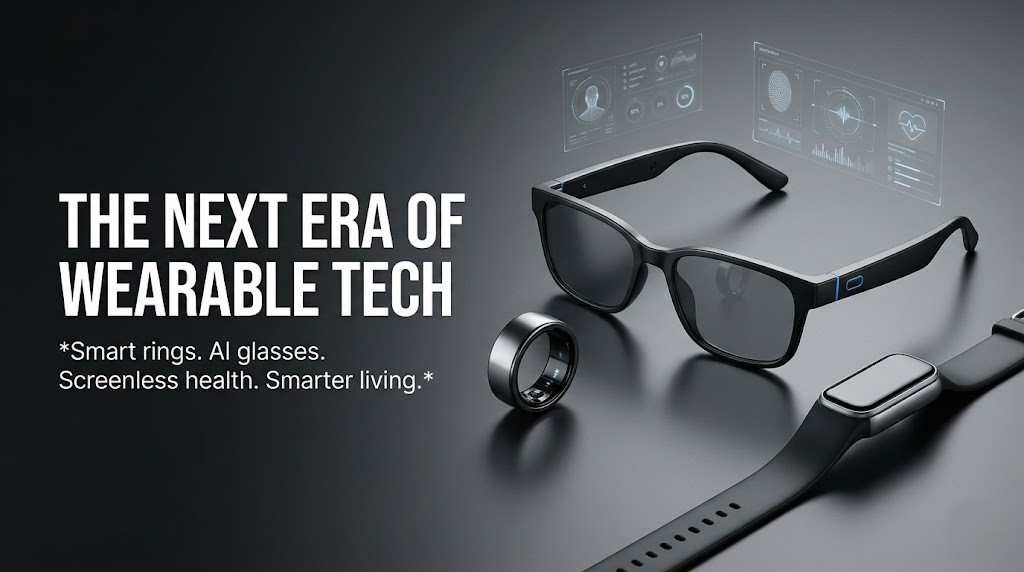
That shift is creating an entirely new category of consumer technology — one built around smart rings, AI-powered glasses, screenless health trackers and recovery-focused devices. These products aren’t necessarily designed to look futuristic. In fact, many of them are deliberately designed to disappear into everyday life.
And that may be what makes them so powerful.
The future of wearables could be less about checking a device and more about allowing the device to quietly understand you.
Oura has helped transform the smart ring from a niche gadget into one of the most recognizable categories in wearable technology.
The idea sounds almost deceptively simple: take sensors that traditionally live inside a smartwatch and place them inside something as familiar as a ring.
But the consumer appeal goes deeper than the form factor.
A smart ring can monitor aspects of sleep, recovery, activity and physiological signals without putting a bright screen on your wrist. You don’t need to constantly interact with it. The technology simply sits there, collecting information while you go about your day.
That creates a different relationship between human and device.
Instead of asking, “How many steps have I taken?”, the experience increasingly becomes, “What is my body telling me today?”
This is where wearable technology starts moving from fitness accessory to personal health intelligence.
Imagine waking up after a stressful week and having your device recognize that your recovery isn’t where it normally is. Instead of simply showing a number, the technology can encourage you to slow down, prioritize sleep or rethink your training intensity.
The real product isn’t the ring.
It’s the interpretation of your body.
WHOOP approaches wearable technology from another fascinating angle.
Traditional fitness technology often rewards activity. Run farther. Lift heavier. Burn more calories. Close another ring.
WHOOP helped popularize a different philosophy: performance isn’t only about how hard you train — it’s also about how well you recover.
That sounds obvious, but it changes the psychology of fitness technology.
Instead of treating rest as wasted time, recovery becomes part of the performance equation. Sleep, strain and physiological data become inputs into a bigger picture of how prepared you are for the next challenge.
This resonates far beyond professional athletes.
The modern consumer is increasingly balancing workouts with long workdays, travel, stress, poor sleep and digital overload. A wearable that tells you to push harder isn’t always useful. Sometimes the smarter recommendation is to recover.
That’s an important evolution in the wearable market.
The technology isn’t simply becoming better at counting what you did.
It’s becoming better at helping you understand what you should do next.
And that distinction could define the next decade of health technology.
Meta and Ray-Ban are pushing wearable technology in a completely different direction with AI-powered smart glasses.
For decades, glasses were almost entirely passive. They corrected vision, protected your eyes from the sun or completed an outfit.
Now they can become an interface.
The interesting part isn’t simply that smart glasses can capture photos or play audio. It’s the possibility of having AI integrated into something people already wear every day.
Think about the experience.
You’re walking through a new city. Instead of pulling your phone from your pocket, you can interact with information through your glasses. You see something unfamiliar. You want to capture a moment. You need information while keeping your attention on the world around you.
The smartphone traditionally sits between you and your environment.
Smart glasses have the potential to make technology feel more ambient and less interruptive.
That could be one of the biggest changes in consumer technology.
The smartphone taught us to look down.
AI-powered glasses could encourage us to look up again.
Of course, this category also raises important questions around privacy, social acceptance and responsible AI. But from a consumer perspective, the direction is difficult to ignore.
The next major wearable interface might not be something you hold.
It might be something you see through.
Samsung Electronics entering the smart-ring category is significant because mainstream adoption often happens when emerging technology moves beyond specialist brands.
The Galaxy Ring represents a broader shift in how major consumer electronics companies are thinking about personal technology.
Instead of making every product compete for attention individually, the goal is increasingly to create an ecosystem where devices work together.
Your phone knows where you are.
Your watch knows what you’re doing.
Your earbuds know what you’re listening to.
And a smart ring can potentially add another layer of continuous health and activity data without requiring another screen.
That matters because the biggest barrier to wearable adoption isn’t always technology.
Sometimes it’s friction.
People don’t want to charge five devices, maintain five apps and constantly remember which device is tracking what. The winning wearable ecosystems will likely be the ones that make data collection feel almost effortless.
The smart ring is particularly interesting because it doesn’t look like a traditional piece of technology.
It looks like jewellery.
And that may be exactly why it has mainstream potential.
Ultrahuman has also become part of the growing movement toward screenless wearable technology, particularly around metabolic health, recovery and performance.
Its approach reflects a broader consumer trend: people increasingly want better information about their bodies without necessarily spending more time staring at screens.
That’s an important contradiction at the heart of modern technology.
We have more health data than ever before, yet many people are also trying to reduce screen time.
The answer may not be fewer devices.
It may be better-designed devices that don’t constantly ask for our attention.
This is where screenless trackers become particularly compelling. They can collect information continuously while moving the interpretation into an app or another interface when you actually want to explore it.
The wearable becomes almost invisible.
And ironically, that could make it more useful.
The Bigger Story: Wearables Are Moving From Gadgets to Infrastructure
Look at these companies together and a bigger trend starts to emerge.
Oura is making the ring a health interface.
WHOOP is making recovery central to performance.
Ray-Ban Meta is bringing AI closer to our field of vision.
Samsung is pushing smart rings toward mainstream consumer ecosystems.
Ultrahuman is exploring what happens when health tracking becomes less dependent on screens.
Different products. Different strategies.
But they are all moving toward the same destination: technology that understands more while demanding less.
That is perhaps the most interesting development in wearable technology.
The first generation of wearables asked consumers to interact with technology more often. The next generation may do the opposite.
They want to operate quietly in the background.
That could fundamentally change consumer behavior.
Imagine a future where your wearable doesn’t just tell you that you slept badly. It understands how that sleep affects your energy, recommends adjustments to your schedule and learns from your patterns over time.
Imagine glasses that allow you to access AI assistance without opening an app.
Imagine a ring that knows your body well enough to recognize when something feels different from your normal baseline.
At that point, the wearable stops feeling like a gadget.
It starts feeling like personal infrastructure.
The Consumer Question Is No Longer “What Can It Track?”
This is where the wearable market gets particularly interesting.
Consumers have become accustomed to specifications.
How many sensors?
How accurate is the heart-rate monitoring?
How long does the battery last?
How many health metrics does it track?
But the next phase of competition may be less about the number of features and more about the quality of the experience and intelligence built around those features.
Because collecting data is no longer particularly impressive.
Everyone can collect data.
The difficult part is turning millions of tiny signals into something meaningful.
That’s where AI could become the invisible engine behind the wearable revolution.
Your device may collect information continuously, but the real value comes when technology can connect those signals and explain what they mean in context.
And that creates a much bigger opportunity for brands.
The winning wearable may not be the one with the most sensors.
It may be the one that makes the consumer feel like it understands them.
What Happens Next?
The wearable technology market is heading toward a fascinating convergence of AI, health, fashion, fitness and everyday computing.
The boundaries between these categories are beginning to disappear.
A ring can be a health device and a fashion accessory.
Glasses can be eyewear and an AI interface.
A fitness tracker can become a recovery coach.
And a screenless device can potentially become one of the most important pieces of technology you own precisely because you barely notice it.
That is the paradox of the next wearable revolution.
The best technology may be the technology you think about the least.
For consumers, this means more choice — but also a more important question to answer.
Do you really want another device competing for your attention?
Or do you want technology that quietly works in the background, learns your patterns and helps you make better decisions?
The companies that answer that question successfully may define the next era of personal technology.
Because the future of wearables isn’t simply about putting technology on your body.
It’s about making technology understand the person wearing it.
So, if you could choose just one today — a smart ring, AI glasses, a recovery tracker or a screenless health wearable — which one would actually become part of your everyday life? 👀

Software Developer & Writer
Hey, I'm Diva, a developer and writer blending code and creativity. I'm driven by a deep curiosity and a relentless pursuit of excellence. Join me as I craft digital solutions and captivating stories.




Leave A Comment