
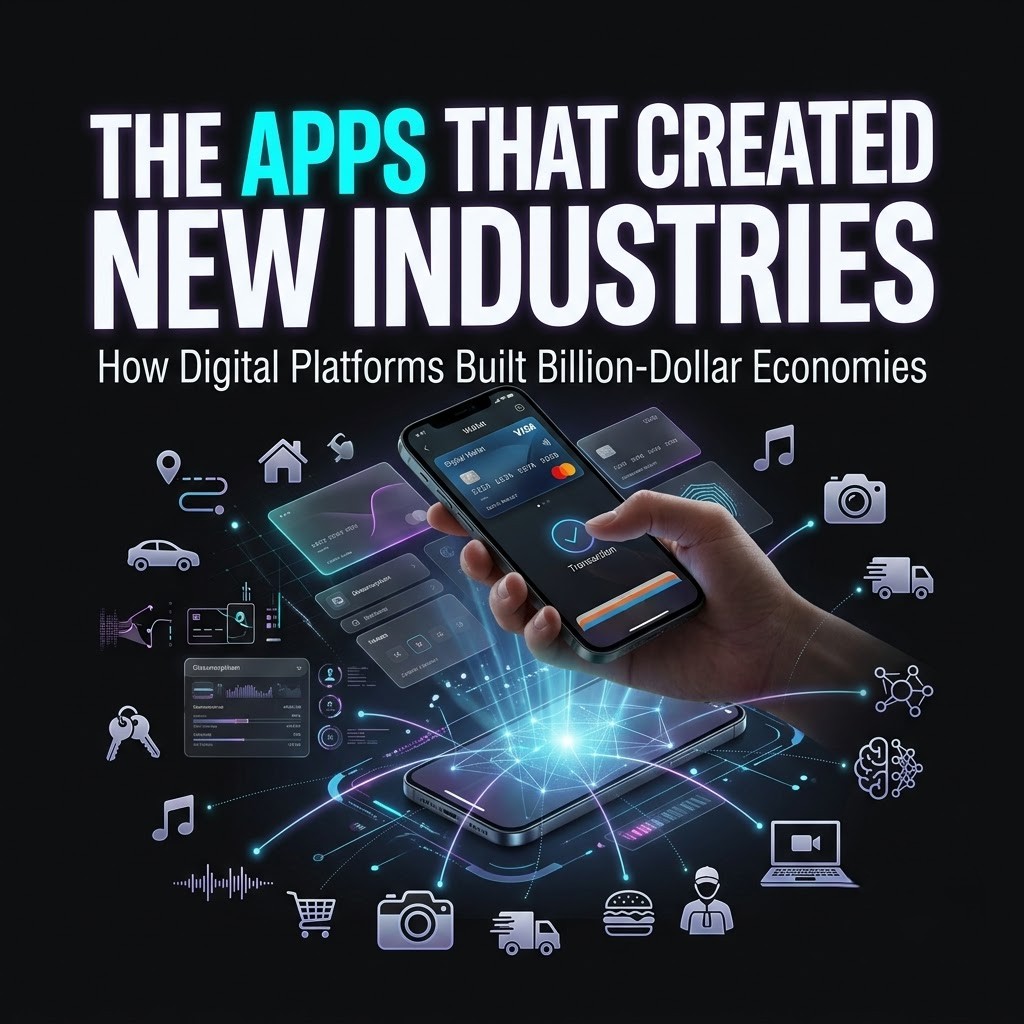
The Apps That Created New Industries: How Digital Platforms Built Entire Economies From Scratch
Introduction: When Apps Stopped Being Just Tools
The mobile app revolution did more than change how people communicate, shop, or consume entertainment. Some apps completely transformed existing habits and created entirely new industries that did not exist before. These companies did not simply compete in established markets; they built new categories, introduced new business models, and changed consumer expectations worldwide.
Before smartphones became a part of everyday life, many services were limited by geography, traditional business systems, and physical infrastructure. Today, an app can connect millions of people, create global marketplaces, and turn ordinary users into service providers, creators, sellers, or entrepreneurs.
From ride-sharing and food delivery to digital payments and short-form entertainment, these apps have become the foundation of new digital economies. They represent a new era where technology platforms are not just supporting industries they are creating them.
Before ride-sharing apps existed, transportation was dominated by traditional taxi companies, local cab operators, and car ownership. Finding a reliable ride often meant waiting on the street, calling a taxi service, or depending on limited public transportation options.
Uber changed this entire experience by creating a new industry: app-based transportation networks. Instead of owning a fleet of vehicles, Uber built a platform connecting passengers with independent drivers through smartphone technology.
The company introduced a marketplace model where anyone with a suitable vehicle could become a driver and earn income. This created the gig economy in transportation, allowing millions of people globally to participate in flexible work.
Uber’s biggest innovation was not simply booking a car through an app. The company transformed transportation by combining GPS technology, digital payments, driver ratings, real-time tracking, and demand-based pricing into one seamless experience.
The success of Uber also inspired thousands of similar platforms across different industries, proving that technology could transform traditional services into scalable digital marketplaces.
The hotel industry was traditionally controlled by large hospitality companies that invested billions in buildings, locations, and infrastructure. Travelers had limited options beyond hotels, hostels, or vacation rentals managed by professional agencies.
Airbnb created a completely new category: the peer-to-peer accommodation economy.
The idea was simple but revolutionary allow ordinary people to rent out their homes, apartments, or spare rooms to travelers. Airbnb transformed unused personal spaces into income-generating assets.
The platform changed the meaning of travel accommodation. A traveller no longer had to choose only between expensive hotels or basic lodging. They could stay in local homes, unique properties, luxury villas, or affordable apartments anywhere in the world.
Airbnb created a global community-driven hospitality market where trust became the foundation. User reviews, verified profiles, secure payments, and digital communication replaced traditional hotel guarantees.
The platform also influenced the rise of the creator economy by showing that individuals could monetize personal assets using technology.
The music industry experienced one of the biggest transformations in digital history. Before streaming platforms, people purchased physical albums, downloaded songs, or used digital music stores.
Spotify changed how the world consumes music by creating the streaming economy.
Instead of buying individual songs or albums, users gained access to millions of tracks through monthly subscriptions or free ad-supported listening. Spotify shifted music ownership into music access.
The platform created new opportunities not only for listeners but also for artists. Independent musicians could distribute their work globally without depending entirely on traditional record labels.
Spotify also created data-driven music discovery. Algorithms began influencing what people listened to, introducing users to new artists based on their preferences.
The success of music streaming changed the entire entertainment ecosystem, affecting record labels, artists, advertising companies, and consumer behavior worldwide.
Social media existed before Instagram, but the platform transformed online identity, visual communication, and digital influence.
Instagram created an entirely new industry around content creators, influencers, and personal brands.
Before platforms like Instagram, becoming a public figure usually required traditional media access through television, magazines, or professional networks. Instagram changed that by allowing anyone with creativity and consistency to build a global audience.
The platform introduced a new economy where creators could earn money through brand partnerships, sponsored content, affiliate marketing, product launches, and digital businesses.
Today, influencer marketing is a multi-billion-dollar industry, and many businesses consider creators as important marketing partners.
Instagram also changed how brands communicate with customers. Companies moved from traditional advertising campaigns toward community building, storytelling, and direct engagement.
Short videos existed before TikTok, but the platform turned short-form entertainment into one of the fastest-growing digital industries.
TikTok transformed content creation by making algorithm-driven discovery the center of entertainment.
Traditional social media platforms focused heavily on followers and existing networks. TikTok introduced a new model where content could go viral regardless of the creator’s audience size.
This created a new generation of digital creators, entertainers, educators, and businesses. Small creators could reach millions of people without traditional celebrity status.
TikTok also changed marketing strategies. Brands began creating native, entertaining content instead of relying only on polished advertisements.
The platform influenced industries including music, fashion, beauty, education, food, and ecommerce. Many trends now begin on TikTok before spreading across the internet.
Food delivery existed before mobile apps, but apps transformed it into a massive digital marketplace.
DoorDash created a technology-driven food delivery ecosystem connecting restaurants, customers, and delivery workers.
Traditional restaurants previously depended mostly on customers visiting physical locations. Food delivery apps allowed even small restaurants to reach a much larger audience without building their own delivery infrastructure.
These platforms created new opportunities for independent restaurants, delivery workers, and food entrepreneurs.
The industry expanded beyond simple meal delivery. Today, food delivery platforms offer groceries, convenience products, subscriptions, advertising solutions, and restaurant technology services.
The app-based model changed how consumers think about convenience, making almost any product accessible within minutes.
Ecommerce was once dominated by large companies with significant technology budgets. Small businesses often struggled to create professional online stores.
Shopify changed this by creating an industry around independent online entrepreneurship.
The platform allowed anyone to launch an ecommerce business without advanced technical knowledge. Entrepreneurs could create online stores, manage payments, track inventory, and sell products globally.
Shopify contributed to the rise of direct-to-consumer brands. Many modern fashion, beauty, and lifestyle companies grew by using Shopify as their digital foundation.
The platform transformed ecommerce from a corporate-only space into an accessible opportunity for individuals and small businesses.
Video conferencing existed before Zoom, but the platform made online communication simple, accessible, and mainstream.
Zoom Video Communications became a major force in creating the modern remote work ecosystem.
The platform changed how businesses, schools, healthcare providers, and communities communicate.
Remote work was once considered a limited workplace option. Zoom helped accelerate its adoption by making virtual meetings easy for millions of users.
The company contributed to the growth of remote collaboration tools, online education platforms, virtual events, and digital workplaces.
The Bigger Lesson: Platforms Create More Than Products
The biggest technology companies of the modern era succeeded because they created ecosystems rather than individual products.
Uber did not just create a taxi app. It created a transportation marketplace.
Airbnb did not just create a booking platform. It created a new hospitality model.
Instagram and TikTok did not just create social networks. They created the creator economy.
Shopify did not just create ecommerce software. It created opportunities for millions of entrepreneurs.
The common pattern behind these companies is their ability to identify human behavior changes and build platforms around them. They used technology to remove barriers, connect people, and unlock new possibilities.
Conclusion: The Future Will Be Built by Industry-Creating Apps
The next generation of successful apps will likely follow the same path. They will not simply improve existing services; they will create new markets and redefine how people work, shop, travel, communicate, and entertain themselves.
Artificial intelligence, robotics, digital health, financial technology, and virtual experiences are already creating opportunities for new industries.
The history of technology shows that the most powerful apps are not the ones that only solve existing problems. They are the ones that make people imagine a completely new way of living.

Software Developer & Writer
Hey, I'm Diva, a developer and writer blending code and creativity. I'm driven by a deep curiosity and a relentless pursuit of excellence. Join me as I craft digital solutions and captivating stories.

Leave A Comment