
The Four AI Agents Being Built Right Now — And Why They Could Redefine How We Work
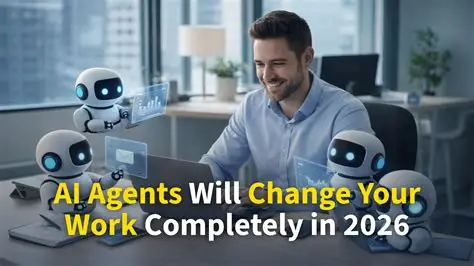
Artificial intelligence is moving into a new phase. The conversation is no longer limited to chatbots that answer questions, generate images, or summarize documents. The more significant shift is toward AI agents that can understand a goal, plan a sequence of actions, use digital tools, and continue working until a task is completed. In 2026, this transition is becoming increasingly visible across research, sales, software development, and everyday personal productivity. OpenAI, for example, describes agentic AI as a move from short interactions toward delegated, long-horizon tasks that can run for minutes or hours.
That distinction matters. A traditional AI assistant largely waits for instructions and produces an answer. An agent is designed to take responsibility for a workflow. It might search multiple sources, compare information, write a report, update a system, test its own work, or return later with a result. The emerging AI economy is increasingly being built around this idea of delegating digital work rather than simply asking AI questions.
Among the most interesting developments are four categories of AI agents being built and deployed today: research agents, sales agents, coding agents, and personal AI operators. Each addresses a different type of work, but together they point toward a larger transformation: software may increasingly become something that works on our behalf rather than something we constantly operate ourselves.
Research has traditionally been one of the most time-consuming knowledge-work activities. Finding reliable sources, opening dozens of pages, comparing conflicting information, extracting relevant facts, organizing findings, and turning them into a coherent report can consume hours. Search engines made information easier to find, but they did not eliminate the work of interpreting and connecting it.
Research agents are designed to take the next step.
Instead of simply returning a list of links, an AI research agent can receive a broader objective and break it into smaller questions. It can browse sources, collect evidence, compare information, identify patterns, and produce a structured result. This makes the technology particularly relevant to analysts, marketers, consultants, journalists, students, investors, product teams, and business researchers who regularly deal with large volumes of information.
The significance is not just speed. It is the possibility of turning research into a delegated workflow. A person could provide a question such as understanding a market, comparing competitors, monitoring an industry trend, or investigating a new technology. The agent can then work through multiple stages rather than requiring the user to manually guide every search.
This is part of the broader movement from conversational AI toward agentic workflows. Current AI agent research increasingly evaluates systems across browsing, reasoning, tool use, planning, error recovery, and end-to-end task completion rather than judging them only on the quality of a single response.
However, research agents also highlight one of the most important limitations of autonomous AI: finding information is not the same as knowing that information is correct. Agents can encounter outdated sources, contradictory claims, manipulated information, or pages that confidently present inaccurate facts. For serious research, human verification remains essential.
The future of research therefore may not be “AI replaces researchers.” It may be closer to AI handles the information-heavy first layer while humans concentrate on judgment, interpretation, and decisions. That distinction could make research agents valuable across almost every knowledge-based industry.
Sales is another field where AI agents are beginning to move beyond simple assistance. Traditional sales automation can already send emails, schedule follow-ups, update CRM records, and score leads. But an AI sales agent aims to connect these individual functions into a more autonomous process.
Imagine an agent receiving a sales objective rather than a single instruction. It could research prospective companies, identify relevant decision-makers, personalize outreach, monitor responses, determine when a follow-up is appropriate, qualify prospects, and update the CRM. Instead of merely helping a salesperson complete individual tasks, the agent becomes part of the sales workflow itself.
This is particularly interesting because sales involve repetitive digital activities alongside human judgment. Researching prospects and preparing personalized messages can be automated relatively easily, while negotiation, relationship building, complex objections, and high-value closing still benefit from human involvement.
The result could be a new division of labour. AI handles the repetitive volume; humans handle the moments where trust and judgment matter.
The growing adoption of AI agents in businesses suggests that this is moving beyond experimentation. A 2026 survey of more than 1,300 professionals by Lang Chain found that 57% of respondents had agents in production, while quality was cited as a major barrier to successful deployment. That last point is particularly important for sales. A sales agent that sends thousands of poorly targeted messages may create more problems than opportunities.
The strongest sales agents, therefore, are unlikely to be the ones that simply automate the greatest number of actions. They will be the ones capable of understanding context, respecting brand voice, recognizing when not to contact someone, and knowing when a human should take over.
For businesses, this could eventually make AI-powered sales development less about replacing sales teams and more about expanding what a small team can accomplish.
Perhaps nowhere is the transition from AI assistant to AI agent more visible than software development.
Earlier coding assistants were primarily autocomplete systems. Developers wrote code while AI suggested the next line or generated small snippets. Modern coding agents operate at a much larger scale. They can inspect repositories, understand project structures, modify multiple files, execute commands, run tests, debug errors, and iterate toward a working solution.
That changes the nature of the interaction.
A developer can increasingly describe an outcome rather than manually specify every implementation step. The agent can investigate the codebase, determine where changes are needed, implement them, run tests, discover failures, and revise its approach. The developer remains responsible for defining the goal and reviewing the result, but the agent performs much of the intermediate execution.
OpenAI’s 2026 research on Codex illustrates how quickly this category has expanded. The company reported that by May 2026, more than 70% of sampled users had made at least one request estimated to require more than an hour of human work, while non-developer adoption was growing especially rapidly.
That last development may be the more consequential one. Coding agents are no longer exclusively relevant to professional programmers. As agentic systems become capable of handling automation, data transformation, debugging, tooling, and structured technical tasks, people outside traditional engineering roles can also use them to execute technical work.
Yet coding agents reveal an important lesson about autonomy. The challenge is no longer simply whether an AI can produce code. It is whether people can understand, verify, steer, and trust what the agent produces. Recent research on human-cantered coding agents argues that task alignment, verifiability, steerability, and adaptability are becoming critical as autonomous coding capabilities improve.
The future developer may therefore spend less time typing every line and more time defining architecture, reviewing changes, testing systems, and directing multiple AI coding agents.
The most ambitious category may be the personal AI operator.
Research agents primarily work with information. Sales agents work with commercial workflows. Coding agents work with software. A personal AI operator attempts to connect many different parts of a person’s digital life.
The idea is simple but powerful: instead of opening individual applications and manually moving information between them, you give an AI a goal and allow it to coordinate the necessary tools.
A personal operator could potentially organize a calendar, prepare emails, research travel options, monitor subscriptions, summarize important information, manage routine digital administration, or keep track of ongoing tasks. The important distinction is persistence. Rather than answering once and disappearing, an always-on agent can continue monitoring a task and act when conditions change.
This is one reason personal agents have become such a significant battleground for major technology companies. Recent developments from companies including OpenAI and Meta show the industry moving toward AI systems that can interact more deeply with users’ digital environments and perform tasks on their behalf.
But the personal AI operator also introduces the biggest trust problem.
The more capable an agent becomes, the more access it needs. Email, calendars, documents, shopping accounts, financial information, communications, and other personal data can make an agent significantly more useful—but also significantly more sensitive. Giving an AI permission to draft an email is one thing. Giving it authority to send messages, make purchases, change appointments, or access financial systems is another.
That means the winning personal AI operator may not simply be the smartest one. It may be the one that provides the best combination of intelligence, transparency, permissions, privacy, and user control.
The Bigger Shift: From AI Tools to AI Workforce
These four categories may appear different, but they are connected by one fundamental idea: delegation.
A research agent delegates information gathering. A sales agent delegates parts of customer acquisition. A coding agent delegates software execution. A personal operator delegates everyday digital administration.
Together, they represent a transition from AI as a tool we operate to AI as a system that can operate tools for us.
That is why the current AI agent boom feels different from the chatbot boom. A chatbot primarily improves the speed at which a person can perform a task. An agent can potentially change who—or what—is performing the task in the first place.
Businesses are already confronting this shift. Research into agent deployment shows that organizations are increasingly focused not merely on building agents but on making them reliable enough to operate in production. Quality, observability, evaluation, cost, and multi-model infrastructure have become practical concerns as experimentation turns into deployment.
The implications could stretch across the modern workplace. A marketing manager may supervise research and content agents. A developer may coordinate several coding agents. A sales leader may manage AI-driven prospecting workflows. An executive could have a personal operator handling routine digital administration.
The human role does not necessarily disappear. Instead, it moves upward.
People become responsible for setting objectives, defining boundaries, reviewing outcomes, handling exceptions, and making decisions where context matters. AI takes on more of the repetitive execution between those decisions.
What Comes Next?
The next stage of AI may not be defined by a single “super-agent.” It may be defined by networks of specialized agents working together.
A research agent could investigate a market. A sales agent could identify prospects within that market. A coding agent could build the required digital product. A personal or business operator could coordinate the workflow and keep track of the results.
That possibility changes the question businesses and individuals should be asking. Instead of asking, “What can AI generate for me?” the more useful question becomes, “What recurring work can I safely delegate to AI?”
The answer will depend on the quality of the agent, the tools it can access, the boundaries placed around its actions, and the level of human oversight available. Current evidence suggests that agentic AI is already moving into longer, more complex workflows, but reliability and control remain central challenges.
The AI agent era, in other words, is not simply about making machines smarter. It is about making software more proactive, persistent, and capable of execution.
Research agents could change how we discover knowledge. Sales agents could reshape how businesses find customers. Coding agents could redefine software development. Personal AI operators could change how we interact with the digital world itself.
The most important transformation may ultimately be psychological. We have spent decades learning how to use software. The emerging generation of AI agents is asking us to learn something very different: how to delegate to software, supervise it, and decide what it should be trusted to do.
And that may be the real beginning of the agentic era.

Software Developer & Writer
Hey, I'm Diva, a developer and writer blending code and creativity. I'm driven by a deep curiosity and a relentless pursuit of excellence. Join me as I craft digital solutions and captivating stories.

Leave A Comment