
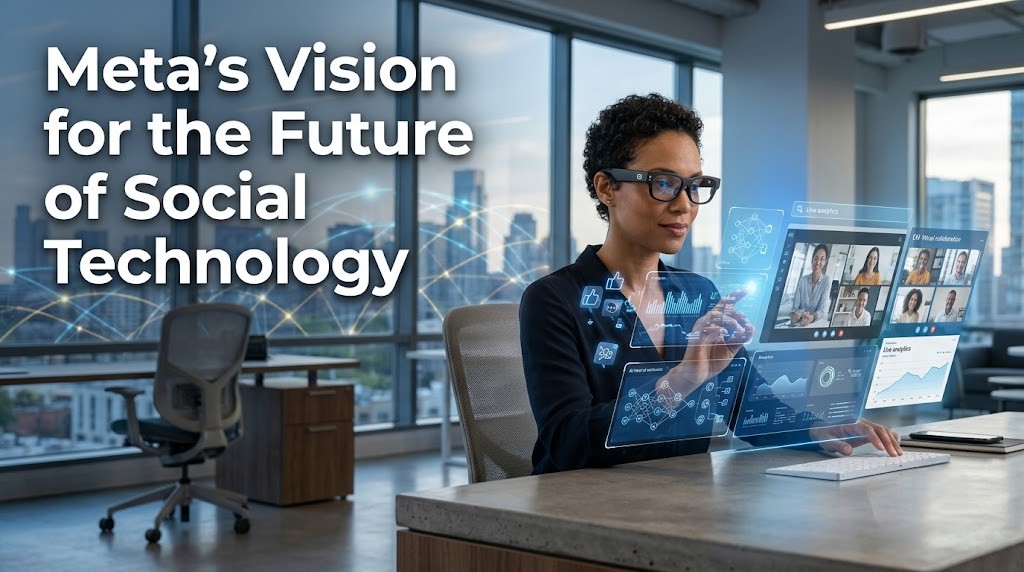
Meta’s Vision for the Future of Social Technology: Building the Next Digital Era
Introduction
The way people connect online has changed dramatically over the past two decades. What began as simple social networking platforms has evolved into immersive digital ecosystems where communication, entertainment, commerce, education, and work seamlessly intersect. At the center of this transformation is Meta, the technology company behind Facebook, Instagram, WhatsApp, Threads, and Reality Labs. More than just operating social media platforms, Meta has positioned itself as a company shaping the future of how humans interact with technology.
Meta’s vision extends far beyond traditional social networking. The company believes that the next chapter of digital communication will be powered by artificial intelligence, augmented reality, virtual reality, wearable devices, and immersive virtual environments collectively known as the metaverse. While social media today primarily revolves around text, photos, and videos, Meta imagines a future where people interact through digital avatars, intelligent AI assistants, holographic meetings, and mixed reality experiences.
This ambitious roadmap represents one of the most significant technological shifts since the birth of smartphones. Although challenges remain including privacy concerns, regulatory scrutiny, and public skepticism Meta continues investing billions of dollars into technologies that could redefine social interaction for decades to come.
From Social Media Company to Technology Ecosystem
Meta’s transformation began in 2021 when Facebook officially changed its corporate identity to Meta. The rebranding symbolized a strategic shift away from being viewed solely as a social media company toward becoming a broader technology innovator.
Today, Meta manages one of the world’s largest digital ecosystems. Facebook continues to connect billions of users worldwide, Instagram dominates visual storytelling and creator culture, WhatsApp remains one of the most popular messaging platforms globally, and Threads has emerged as a major player in text-based social conversations. Together, these platforms form an interconnected network that serves personal communication, businesses, creators, advertisers, and communities.
Rather than focusing only on improving existing apps, Meta aims to integrate artificial intelligence, immersive computing, and wearable technologies into everyday digital experiences. The company believes future social interactions will become more natural, personalized, and interactive than current mobile-first experiences.
Artificial Intelligence at the Core of Meta’s Strategy
Artificial intelligence has become the foundation of Meta’s long-term vision. Instead of simply recommending content, AI is increasingly responsible for helping users discover communities, create content, communicate efficiently, and interact with digital assistants.
Meta has introduced advanced AI capabilities across its ecosystem. Personalized content recommendations now rely on sophisticated machine learning models that better understand user preferences. AI-powered creative tools assist users in editing photos, generating images, writing captions, translating languages, and improving communication across different regions.
The company’s AI ambitions also extend to conversational assistants that can answer questions, provide recommendations, assist businesses, and support creators in content production. These assistants aim to become digital companions capable of handling everyday tasks while maintaining personalized interactions.
For businesses, AI offers powerful marketing opportunities. Automated campaign optimization, intelligent customer support, predictive analytics, and personalized advertising are helping brands reach audiences more effectively while improving customer experiences. As AI technology matures, Meta envisions platforms becoming increasingly proactive rather than merely reactive.
The Metaverse: A New Digital Frontier
Perhaps Meta’s most ambitious initiative is the development of the metaverse. Unlike today’s internet, where users primarily scroll through content on flat screens, the metaverse envisions interconnected virtual environments where people experience digital spaces almost as naturally as physical ones.
In Meta’s vision, users could attend virtual concerts with friends from different countries, collaborate inside immersive offices, shop in interactive digital stores, attend university classes, participate in gaming tournaments, or explore entirely new virtual worlds using realistic digital avatars.
The concept goes beyond gaming or entertainment. Meta believes the metaverse will transform remote work, education, healthcare, tourism, fitness, and retail. Instead of video calls, colleagues could meet inside realistic virtual conference rooms. Students might conduct science experiments in virtual laboratories. Designers could collaborate on three-dimensional prototypes regardless of geographical location.
Although widespread adoption may still take years, Meta continues investing heavily in building the infrastructure necessary for this next-generation internet.
Virtual Reality and Mixed Reality Experiences
Virtual Reality (VR) and Mixed Reality (MR) technologies are central to Meta’s roadmap. Through its Reality Labs division, the company has developed advanced headsets that allow users to immerse themselves in virtual environments while also interacting with digital objects within their physical surroundings.
Mixed reality combines the digital and physical worlds, enabling users to place virtual screens, collaborate with digital objects, or interact with AI-powered assistants directly within their living or working environments.
Meta envisions these devices eventually replacing many traditional computing tasks. Instead of carrying laptops or multiple monitors, users could work using virtual displays floating around them. Entertainment, gaming, social gatherings, education, and productivity could all happen inside immersive digital workspaces.
As hardware becomes lighter, more affordable, and technologically advanced, Meta expects adoption to expand beyond early enthusiasts into mainstream consumers.
Smart Glasses and Wearable Technology
Wearable technology represents another major pillar of Meta’s future strategy. Smart glasses are expected to become one of the company’s most influential innovations over the next decade.
Unlike smartphones that require users to constantly look down at screens, smart glasses aim to integrate digital information directly into everyday life. Future devices may display navigation directions, translate conversations in real time, identify landmarks, capture photos hands-free, and provide contextual information through augmented reality overlays.
Artificial intelligence will play an important role by making these devices conversational rather than screen-dependent. Instead of opening multiple apps, users may simply speak naturally to receive assistance, schedule meetings, answer messages, or retrieve information.
Meta believes wearable computing will gradually reduce dependence on smartphones, creating more intuitive and seamless digital interactions throughout the day.
Redefining Social Interaction
Meta’s long-term vision focuses on making digital communication feel more human. Today’s social media often lacks emotional presence because interactions occur through text messages, images, or video calls.
Future technologies aim to bridge this gap through realistic avatars, facial expression tracking, gesture recognition, spatial audio, and immersive environments. Friends separated by thousands of miles may eventually feel as though they are sharing the same physical room.
Digital avatars are expected to become increasingly expressive and customizable, allowing users to maintain personal identities across multiple virtual platforms. Meetings, celebrations, family gatherings, and entertainment events could all become richer social experiences through immersive technologies.
Rather than replacing physical interactions, Meta argues these innovations will strengthen long-distance relationships by creating stronger emotional connections online.
Empowering the Creator Economy
Creators remain one of Meta’s highest priorities. Influencers, educators, artists, entrepreneurs, and digital storytellers have become essential to modern social platforms, and Meta continues expanding monetization opportunities.
Artificial intelligence is helping creators generate ideas, edit videos, design graphics, write captions, translate content, and optimize audience engagement more efficiently. Advanced recommendation algorithms allow creators to reach highly targeted audiences based on interests rather than simply follower counts.
The future may include entirely virtual creators, AI-assisted content production, immersive live events, virtual merchandise, digital fashion, and new monetization models within the metaverse.
As digital economies continue growing, Meta expects creators to play an increasingly important role in shaping online communities and cultural trends.
Business, Commerce, and Digital Shopping
Meta’s future social technology extends beyond communication into digital commerce. Social platforms are evolving into shopping destinations where discovery, product research, customer support, and purchasing happen without leaving the application.
Artificial intelligence enhances personalized product recommendations, while augmented reality enables virtual product try-ons for clothing, eyewear, makeup, furniture, and home décor. Businesses can create immersive storefronts where customers explore products in three-dimensional environments before making purchases.
In the metaverse, shopping may become an interactive social experience where friends browse digital stores together, attend virtual product launches, or purchase both physical and digital goods.
For brands, these innovations offer opportunities to build deeper customer engagement while reducing friction throughout the purchasing journey.
Privacy, Safety, and Ethical Challenges
Despite its ambitious vision, Meta faces significant challenges regarding privacy, security, misinformation, and ethical AI development. Collecting large amounts of user data has attracted regulatory scrutiny across multiple countries, making responsible innovation increasingly important.
Future technologies involving biometric data, facial recognition, eye tracking, voice interactions, and immersive environments introduce new privacy considerations. Users expect greater transparency regarding how personal information is collected, stored, and utilized.
Meta has emphasized investments in responsible AI development, content moderation, digital safety tools, parental controls, and privacy-enhancing technologies. Building public trust will remain essential if immersive technologies are to achieve mainstream adoption.
The company must balance technological innovation with ethical responsibility while complying with evolving global regulations.
The Competitive Landscape
Meta is not pursuing the future of social technology alone. Competition has intensified as major technology companies invest heavily in artificial intelligence, spatial computing, wearable devices, and next-generation digital experiences.
Rapid advancements across the technology industry continue pushing innovation forward. Companies are competing to develop smarter AI assistants, more powerful augmented reality devices, improved virtual reality hardware, and integrated digital ecosystems.
This competitive environment benefits consumers by accelerating innovation while encouraging companies to improve privacy protections, product quality, accessibility, and affordability.
Meta’s success will depend not only on technological leadership but also on its ability to deliver meaningful experiences that people genuinely value in everyday life.
Opportunities for Businesses and Marketers
For businesses, Meta’s evolving vision creates new opportunities to engage customers. AI-powered advertising, immersive brand experiences, conversational commerce, virtual events, and personalized customer journeys are reshaping digital marketing strategies.
Brands that embrace emerging technologies early may gain competitive advantages by creating memorable experiences that go beyond traditional advertising. Interactive storytelling, virtual showrooms, AI customer support, and creator collaborations are becoming increasingly valuable marketing tools.
Marketing professionals must also adapt by learning AI-driven content creation, data analytics, immersive experience design, and community management within evolving digital ecosystems.
As consumer expectations change, businesses that prioritize personalization, authenticity, and meaningful engagement will likely outperform competitors relying solely on conventional social media strategies.
The Road Ahead
Meta’s vision represents more than technological innovation it reflects an attempt to redefine how society communicates, collaborates, learns, works, and entertains itself in an increasingly digital world. Artificial intelligence, wearable computing, augmented reality, virtual reality, and immersive virtual environments are expected to work together rather than exist as separate technologies.
Although widespread adoption will require improvements in affordability, infrastructure, privacy protections, and user acceptance, many elements of this vision are already becoming reality. AI assistants, smart glasses, immersive collaboration tools, and intelligent recommendation systems are gradually transforming everyday digital experiences.
Whether the metaverse becomes as revolutionary as smartphones remains uncertain, but Meta’s investments demonstrate confidence that the future of social technology will extend far beyond today’s mobile applications. The next generation of digital interaction is likely to be more intelligent, immersive, personalized, and interconnected than ever before.
Conclusion
Meta’s vision for the future of social technology is both ambitious and transformative. By combining artificial intelligence, immersive computing, wearable devices, creator-focused innovation, and next-generation communication platforms, the company seeks to redefine the relationship between people and technology.
Success will depend on more than innovation alone. Privacy, transparency, accessibility, and ethical AI development will play equally important roles in determining whether users embrace this new digital era. If Meta can successfully balance technological advancement with responsible innovation, it may help shape the future of human connection for generations to come.
For businesses, creators, and everyday users, understanding Meta’s long-term strategy is no longer optional it is essential. As digital experiences become increasingly immersive and AI-driven, the evolution of social technology promises to reshape not only how we communicate but also how we live, work, learn, and connect in the decades ahead.

Software Developer & Writer
Hey, I'm Diva, a developer and writer blending code and creativity. I'm driven by a deep curiosity and a relentless pursuit of excellence. Join me as I craft digital solutions and captivating stories.




Leave A Comment