
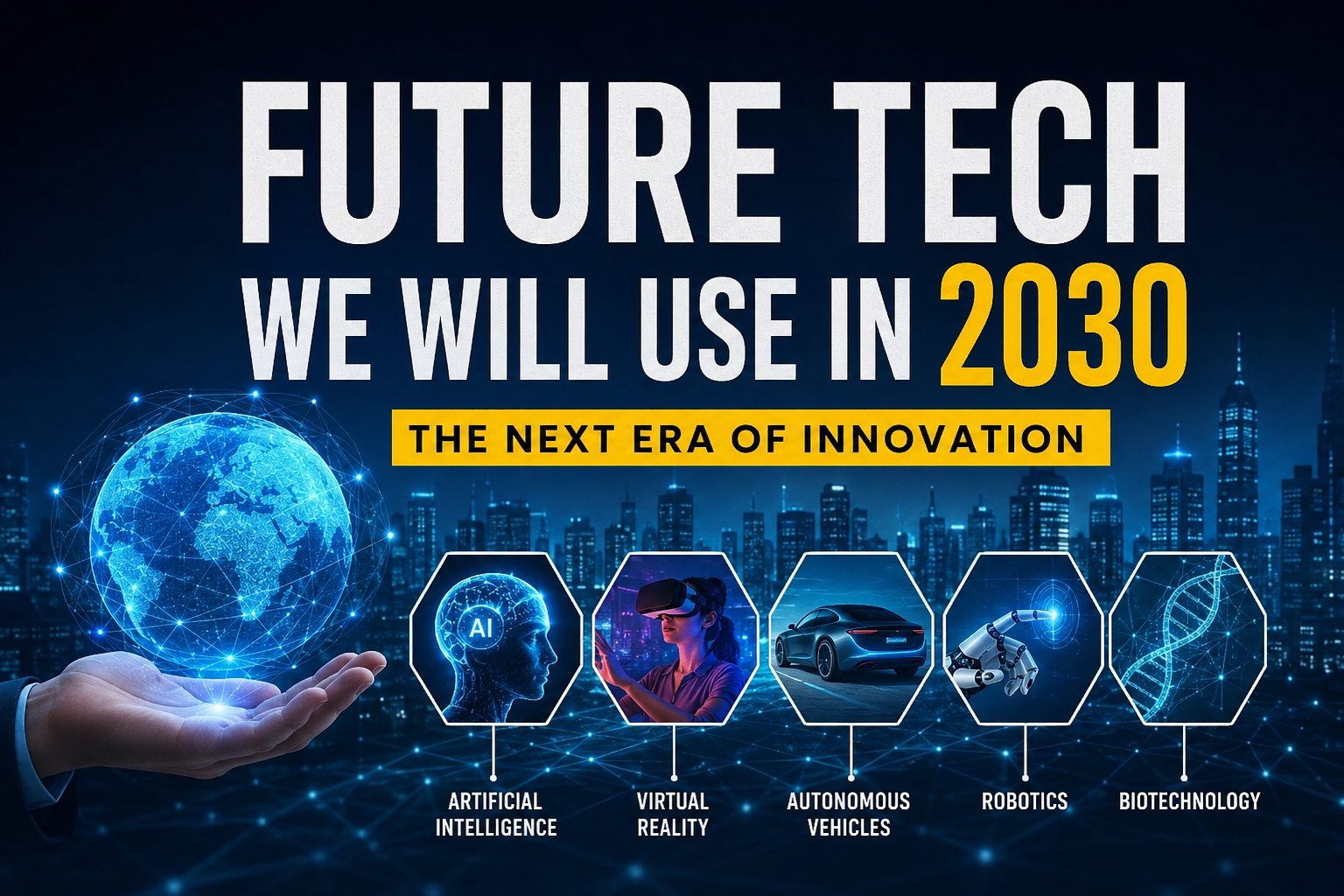
Future Tech We Will Use in 2030: A Glimpse into the Next Digital Era
Technology in 2030 will not feel like an extension of today it will feel like an entirely different reality stitched into everyday life. The shift will not just be about faster devices or smarter apps, but about how deeply technology integrates with human behavior, decision-making, health, mobility, and even creativity. What we now consider “advanced” AI tools, smart gadgets, or automation systems will become invisible layers running silently in the background of our lives.
As we move toward 2030, the world is expected to experience a convergence of artificial intelligence, quantum computing, immersive digital environments, and biological enhancements. These innovations will not exist separately; instead, they will interact, overlap, and reinforce each other to build a highly intelligent global ecosystem.
This article explores the most transformative technologies that will define how we live, work, communicate, and evolve by 2030.
Artificial Intelligence Will Become Truly Autonomous
Artificial Intelligence today is powerful, but still largely dependent on human instructions, datasets, and supervision. By 2030, AI is expected to evolve into highly autonomous systems capable of self-learning, self-correction, and independent decision-making in controlled environments.
We will see AI move far beyond chatbots and recommendation engines. Entire business operations, logistics networks, financial planning systems, and even parts of governance will rely on AI-driven decision frameworks. These systems will not only analyse data but also predict outcomes with near-human intuition, reducing uncertainty in complex situations.
In daily life, AI assistants will become deeply personalized digital companions. They will understand emotions, habits, and long-term goals. Instead of simply responding to commands, they will proactively suggest actions—like optimizing your schedule based on stress levels, recommending health interventions before illness occurs, or managing finances in real time.
The key transformation will be trust. Humans will gradually shift from “using AI tools” to “coexisting with AI systems.”
Brain-Computer Interfaces Will Blur Human and Machine Boundaries
One of the most revolutionary developments expected by 2030 is the mainstream emergence of brain-computer interfaces (BCIs). These systems will allow direct communication between the human brain and digital devices without physical interaction.
Imagine controlling your phone, laptop, or smart home simply through thought. Early versions of this technology already exist in experimental stages, but by 2030, they will become significantly more refined, safer, and more widely available.
For individuals with disabilities, BCIs will be life-changing, enabling movement, communication, and interaction with the world in ways previously impossible. But beyond medical applications, BCIs will enter productivity and entertainment sectors. People will be able to type, design, or play games using neural signals, dramatically increasing speed and immersion.
The long-term implication is profound: the boundary between human cognition and digital systems will begin to fade, leading to a new era of cognitive computing where thinking itself becomes a form of input.
Hyper-Personalized Healthcare Powered by Predictive Systems
Healthcare in 2030 will shift from treatment-based models to prediction-based prevention. Instead of visiting hospitals when symptoms appear, individuals will be continuously monitored by AI-powered health systems embedded in wearable devices, smart clothing, and even internal bio-sensors.
These systems will analyse heart rate variability, blood chemistry, sleep patterns, stress levels, and genetic markers in real time. The goal will be to detect diseases long before they become dangerous.
For example, AI systems may predict the likelihood of cardiac issues months in advance and suggest lifestyle adjustments or micro-interventions. Cancer detection could become significantly earlier and more accurate due to continuous molecular-level monitoring.
Hospitals themselves will become more automated. Robotic surgeons, guided by AI, will perform highly precise operations with minimal human error. Meanwhile, telemedicine will evolve into immersive 3D consultations, where doctors and patients interact in virtual clinical environments.
Healthcare will no longer be reactive it will become an always-on predictive ecosystem focused on longevity and quality of life.
Fully Immersive Virtual and Augmented Reality Worlds
By 2030, the internet as we know it will transform into spatial environments powered by advanced virtual and augmented reality systems. Instead of scrolling through websites or apps, users will enter fully immersive digital spaces where information is experienced rather than viewed.
Work meetings will happen in virtual offices where participants appear as realistic avatars. Education will take place in interactive simulations, allowing students to explore historical events, scientific concepts, and engineering systems as if they were physically present.
Entertainment will become deeply immersive. Movies and games will merge into interactive storytelling environments where users influence outcomes in real time. Social interaction will also evolve, with people spending significant portions of their time in digital worlds that feel as real as physical spaces.
This shift will redefine the concept of presence. Distance will no longer be a limitation, and human interaction will extend across both physical and virtual dimensions seamlessly.
Quantum Computing Will Solve Problems Beyond Today’s Limits
Quantum computing is expected to become one of the most disruptive technologies of the 2030 era. Unlike classical computers that process information in binary form, quantum computers leverage quantum states to perform calculations at unimaginable speeds.
By 2030, quantum systems will likely be used in specialized industries such as pharmaceuticals, climate modelling, cryptography, and financial forecasting. Complex molecular simulations that currently take years may be completed in hours or minutes.
This will revolutionize drug discovery, allowing scientists to test thousands of chemical combinations virtually before conducting real-world experiments. Climate scientists will be able to create far more accurate models of environmental change, helping governments design better sustainability strategies.
However, quantum computing will also challenge existing cybersecurity systems, forcing the world to develop entirely new encryption methods to protect digital infrastructure.
Autonomous Transportation and Smart Mobility Networks
Transportation in 2030 will be dominated by autonomous systems and interconnected mobility networks. Self-driving cars will become mainstream in many countries, reducing accidents caused by human error and optimizing traffic flow through real-time communication between vehicles.
Cities will integrate smart transportation systems where traffic signals, public transport, and private vehicles operate in sync. Commutes will become faster, safer, and more energy-efficient.
Electric and hydrogen-powered vehicles will replace most fossil fuel-based transport, supported by advanced charging infrastructures. Delivery systems will rely heavily on autonomous drones and robotic vehicles, enabling near-instant logistics in urban areas.
Air mobility may also begin to emerge in the form of small autonomous air taxis in selected regions, especially for high-density cities. Transportation will no longer be fragmented—it will become a unified intelligent network.
Robotics Will Enter Everyday Human Life
Robotics in 2030 will no longer be limited to factories or industrial settings. Intelligent robots will become part of households, workplaces, and public services.
In homes, robots will assist with cleaning, cooking, caregiving, and even companionship for elderly individuals. In industries, they will handle dangerous or repetitive tasks with high precision.
The most significant change will be in human-robot collaboration. Robots will not replace humans entirely but will work alongside them, enhancing productivity and safety. Advanced sensors and AI will allow robots to understand human emotions and adapt behavior accordingly.
This will lead to a society where machines are not just tools, but collaborative agents in daily life.
The Rise of Sustainable and Smart Energy Systems
Energy systems in 2030 will be deeply integrated with AI and renewable technologies. Solar, wind, and advanced battery storage systems will dominate global energy production, reducing dependency on fossil fuels.
Smart grids will manage electricity distribution dynamically, ensuring efficiency and minimizing waste. Homes and cities will be equipped with energy systems that automatically adjust consumption based on demand and availability.
Breakthroughs in fusion energy research may begin to show early commercial viability, offering a near-limitless clean energy source in the long term.
Sustainability will no longer be an option—it will be embedded into every technological system.
Conclusion: A Connected, Intelligent, and Adaptive Future
The future of 2030 will not be defined by a single invention but by the integration of multiple transformative technologies. Artificial intelligence, quantum computing, immersive reality, biotechnology, and autonomous systems will merge into a unified digital ecosystem.
This future will be faster, more efficient, and more intelligent—but it will also require careful ethical considerations, data governance, and human oversight to ensure balance.
What remains certain is that technology will no longer be something we simply use. By 2030, it will be something we live within.

Software Developer & Writer
Hey, I'm Diva, a developer and writer blending code and creativity. I'm driven by a deep curiosity and a relentless pursuit of excellence. Join me as I craft digital solutions and captivating stories.


Leave A Comment