
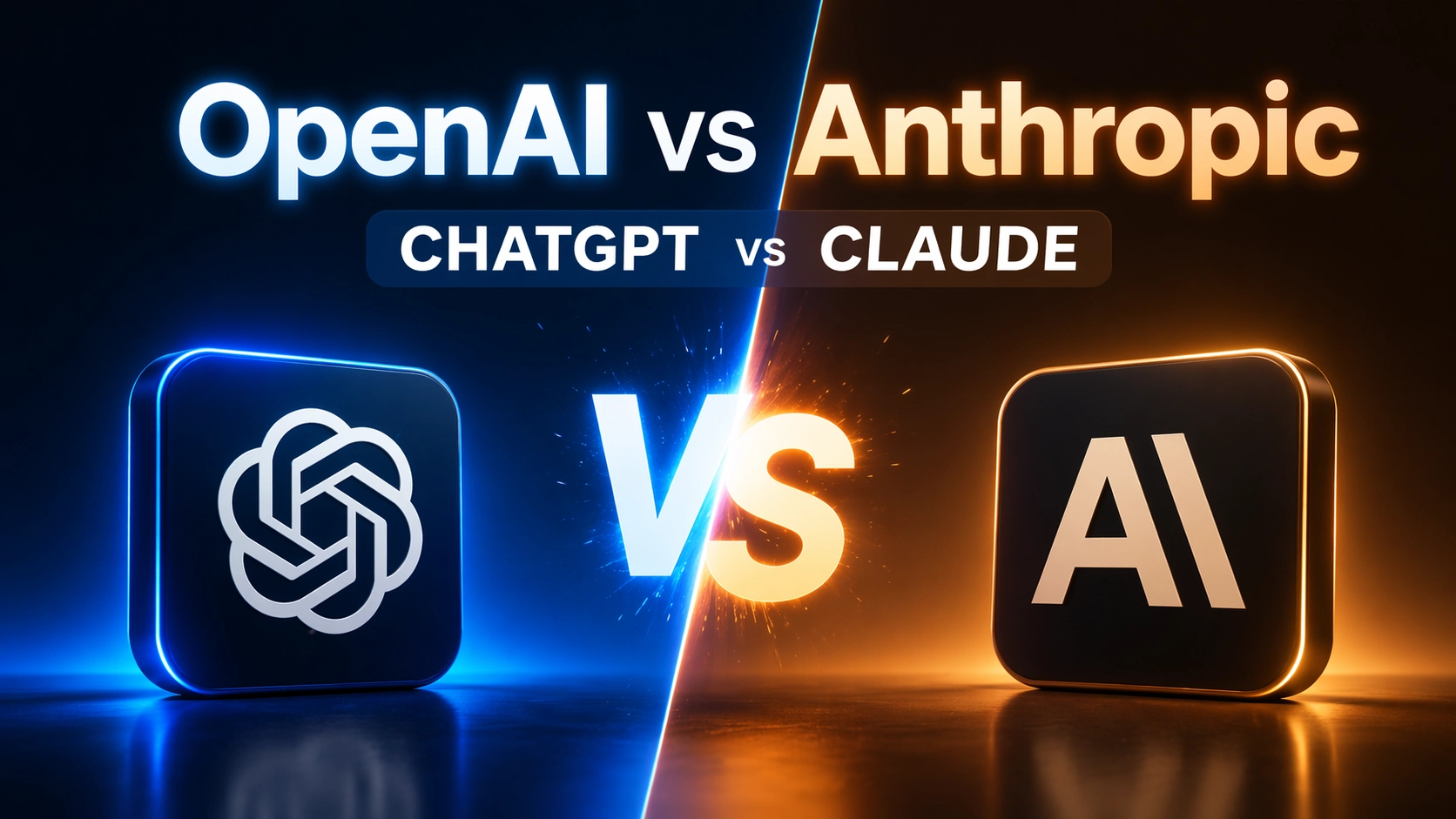
ChatGPT vs Anthropic: The AI Battle That Will Shape the Future of Technology
Introduction: Two AI Giants, One Race to Define Intelligence
Imagine waking up in 2030 and asking your AI assistant to plan your entire day. It checks your calendar, books your travel, analyses your finances, creates a business strategy, writes your emails, and even helps you make important decisions. The question is: which AI will be powering that future?
Over the last few years, artificial intelligence has moved from being a futuristic concept to becoming a daily productivity tool. Two names have emerged as major players in this AI revolution: ChatGPT by OpenAI and Claude by Anthropic.
Both companies are competing to build the next generation of artificial intelligence, but their approaches are surprisingly different. OpenAI focuses on creating highly capable AI systems that can perform a wide range of tasks, while Anthropic emphasizes safety, reliability, and creating AI that behaves in a more predictable way.
The competition between ChatGPT and Anthropic is not just a battle between two companies. It represents a bigger question:
Should the future of AI be defined by maximum intelligence, or by maximum trust?
The Rise of ChatGPT: How OpenAI Changed the AI Industry
Before ChatGPT became a household name, artificial intelligence was mostly limited to research labs, recommendation algorithms, and specialized business applications. Most people interacted with AI without even realizing it.
Then, in November 2022, OpenAI launched ChatGPT, and everything changed.
For the first time, millions of people could communicate with an AI system using simple natural language. Students used it for learning, professionals used it for writing and research, developers used it for coding, and businesses started exploring AI-powered automation.
A marketing manager who previously spent five hours creating a campaign proposal could now use ChatGPT to generate ideas, analyse competitors, and create a first draft within minutes.
A small business owner who could not afford a consultant could suddenly access strategic advice from an AI assistant.
This was the moment when AI moved from being a technology experiment to a mainstream productivity tool.
OpenAI’s biggest advantage has always been its ability to create general-purpose AI. ChatGPT can write articles, generate images, analyse data, help with coding, summarize documents, translate languages, and support creative thinking.
Its popularity created a massive AI ecosystem, attracting developers, companies, and millions of users worldwide.
Anthropic: The Company Building AI With Safety at Its Core
While OpenAI gained global attention, another AI company was quietly building its own vision of artificial intelligence.
Founded in 2021 by former OpenAI researchers, Anthropic introduced Claude, an AI assistant designed around a principle called Constitutional AI.
The idea behind Constitutional AI is simple: instead of training AI only to produce useful answers, the system should also follow certain principles that encourage safer and more responsible behavior.
Think of it like teaching a person not only how to become intelligent but also how to make responsible decisions.
For example, if an AI assistant is asked to provide information about a sensitive topic, Anthropic’s approach focuses on creating responses that are helpful while reducing harmful outcomes.
Claude quickly gained attention because of its ability to handle long documents, analyze complex information, and provide thoughtful responses.
Businesses especially became interested in Claude because many organizations need AI systems that can work with large amounts of internal data while maintaining reliability.
ChatGPT vs Claude: Different Philosophies Behind Similar Technology
At first glance, ChatGPT and Claude may look similar. Both can answer questions, write content, analyse information, and assist users.
But their philosophies are different.
OpenAI’s approach can be described as:
“Build the most capable AI and continuously improve it.”
Anthropic’s approach focuses more on:
“Build powerful AI that remains safe, understandable, and aligned with human values.”
This difference influences how each AI behaves.
For example, imagine a company wants to use AI to analyse thousands of customer reviews.
ChatGPT might excel at quickly identifying trends, creating marketing ideas, and generating customer insights.
Claude might stand out when handling extremely long documents, understanding detailed reports, and maintaining consistency across large amounts of information.
Both systems are powerful, but their strengths often appear in different situations.
Performance Comparison: Which AI Is More Powerful?
The AI industry changes extremely quickly, with new versions and updates released regularly. Performance depends on the specific model version, task, and user requirements.
However, some general differences have become noticeable.
ChatGPT has built a reputation for versatility.
A content creator can use ChatGPT to develop YouTube scripts, Instagram captions, SEO articles, and marketing campaigns.
A software developer can use it for debugging code and explaining technical concepts.
A student can use it as a personal tutor.
Its biggest strength is flexibility.
ChatGPT feels like a digital Swiss Army knife — one tool capable of handling many different jobs.
Claude, on the other hand, has become known for strong reasoning abilities and long-context understanding.
Imagine a lawyer uploading hundreds of pages of legal documents and asking AI to identify important clauses.
Or a researcher analysing a large academic paper collection.
Claude’s ability to process and understand large amounts of information has made it attractive for professional and enterprise users.
A Real-World Example: A Marketing Team Using AI
Imagine a global fashion company launching a new sustainable clothing line.
The marketing team needs:
The team could use ChatGPT to brainstorm campaign concepts, create advertisements, and generate creative storytelling ideas.
For example:
“Create a luxury fashion campaign targeting environmentally conscious millennials.”
Within seconds, ChatGPT could provide multiple campaign directions, slogans, and content ideas.
Now imagine the company has thousands of customer reviews and market research reports.
Claude could analyse those large documents to identify customer emotions, common complaints, and purchasing patterns.
The future may not be about choosing one AI over another.
The future could involve businesses using different AI models for different purposes.
AI Safety: Why Anthropic’s Approach Matters
As AI becomes more powerful, safety becomes one of the biggest discussions in technology.
A highly intelligent AI system can create enormous benefits, but it can also create risks if it provides inaccurate information, generates harmful content, or makes unreliable decisions.
Anthropic believes that AI systems should have stronger built-in principles guiding their behavior.
This approach has attracted attention from companies that prioritize reliability and responsible AI adoption.
Industries like healthcare, finance, and law require AI systems that are not only intelligent but also trustworthy.
A mistake from an AI assistant in entertainment content may be inconvenient.
A mistake in medical advice or financial analysis could have serious consequences.
This is why AI safety is becoming just as important as AI capability.
Business Impact: How Companies Are Choosing Between ChatGPT and Claude
Businesses are increasingly integrating AI into daily operations.
Customer service teams use AI assistants to respond faster.
Marketing teams use AI for content creation.
Developers use AI for programming assistance.
Executives use AI for research and decision-making.
Companies choosing between ChatGPT and Claude often consider their specific needs.
A startup creating social media content and marketing campaigns may prefer ChatGPT because of its creative flexibility.
A research organization managing large documents may prefer Claude because of its analytical capabilities.
Large enterprises may even use both.
The future of business AI may not be a single winner dominating the market. Instead, companies may build AI strategies using multiple specialized tools.
The Future of AI: Will ChatGPT or Anthropic Win?
Predicting the winner of the AI race is difficult because technology changes rapidly.
Today’s leader may not remain tomorrow’s leader.
The history of technology shows that dominance is rarely permanent.
Companies like Nokia, BlackBerry, and Yahoo once dominated their industries but lost their position because technology evolved.
The AI industry is still in its early stages.
OpenAI has a massive advantage because of ChatGPT’s popularity, brand recognition, and large user base.
Anthropic has gained respect because of its focus on safety, reasoning, and enterprise applications.
The winner may not simply be the company with the smartest AI.
The winner could be the company that creates the strongest ecosystem, earns user trust, and solves real-world problems.
Final Thoughts: The AI Future Is Bigger Than One Company
The competition between ChatGPT and Anthropic represents something much bigger than a technology rivalry.
It represents two different visions of the future.
One vision focuses on creating AI that can do almost anything.
Another focuses on creating AI that humans can confidently depend on.
The truth is that both approaches are necessary.
Humanity needs powerful AI systems that improve productivity, creativity, and innovation.
But humanity also needs AI systems that are responsible, transparent, and trustworthy.
The next decade will likely be defined by artificial intelligence, and companies like OpenAI and Anthropic will play a major role in shaping that future.

Software Developer & Writer
Hey, I'm Diva, a developer and writer blending code and creativity. I'm driven by a deep curiosity and a relentless pursuit of excellence. Join me as I craft digital solutions and captivating stories.

Leave A Comment