
7 Gadgets That Are Quietly Changing the Way We Look After Our Health
Technology is no longer something we use only for work, entertainment, or staying connected. It has gradually moved into one of the most personal parts of our lives: our health. From tracking sleep while we are unconscious to reminding us to move after hours at a desk, modern gadgets are making everyday wellness more measurable, visible, and easier to manage.
What makes this shift interesting is that many of these devices do not look like traditional medical equipment. A smartwatch can look like an ordinary accessory. A smart ring can pass for jewellery. Wireless earbuds can be used for music while quietly offering features designed around hearing and wellness. Together, these products represent a growing category of consumer health technology that helps people understand their daily habits.
Of course, these gadgets are not substitutes for doctors, medical examinations, or professional advice. Their real value lies elsewhere: they can help users notice patterns, build healthier routines, and become more aware of what is happening inside their everyday lives.
Here are seven types of health-focused gadgets changing the way people approach personal wellness.
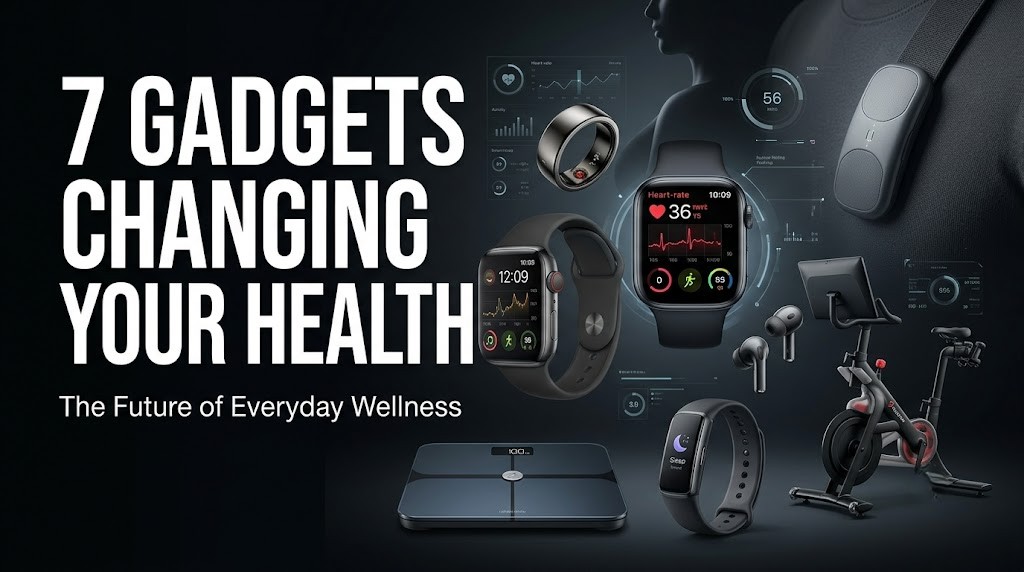
The smartwatch has evolved far beyond simply displaying notifications and counting steps. Today’s advanced smartwatches can monitor a wide range of health and fitness measurements, including heart rate, activity levels, sleep patterns, workout performance and, on certain models and in supported regions, additional health-related measurements.
The biggest change is not necessarily the number of sensors inside the watch. It is the way the information is presented. Instead of relying entirely on how active we think we have been, users can look at trends across days and weeks. A person might discover that their sleep becomes shorter during particularly stressful periods or that their activity drops dramatically on days spent working from home.
This makes smartwatches particularly interesting for people searching for wearable technology for tracking daily health and fitness habits. The gadget turns otherwise invisible behaviours into information that can be reviewed and understood.
The technology is also becoming increasingly integrated into exercise routines. Running, cycling, swimming, strength training and walking can all be recorded, allowing users to compare performance over time. For someone trying to establish a consistent routine, that feedback can provide useful context without requiring complicated equipment.
Not everyone wants to wear a watch all day. This is where smart rings have started attracting attention.
Devices such as the Oura Ring and Samsung Galaxy Ring place sensors into a much smaller form factor, allowing users to collect health and wellness data without wearing a conventional smartwatch. Depending on the device, features can include sleep tracking, heart-rate monitoring, activity measurement, temperature-related sensing and recovery insights.
The appeal is partly psychological. A ring feels less like a piece of technology and more like something you simply wear. That makes it particularly suitable for people who want discreet wearable devices for sleep and wellness tracking.
Sleep is one of the areas where smart rings have become especially popular. Instead of focusing exclusively on exercise, these devices encourage users to think about recovery as part of overall health. The message is simple: working harder is not necessarily the same thing as recovering better.
For people who already use a smartwatch during the day, a smart ring can also offer another approach to continuous tracking. However, the usefulness of any wearable ultimately depends on how accurately its measurements reflect the individual and how responsibly the information is interpreted.
The traditional bathroom scale gives you one number. Smart scales attempt to provide a broader picture.
Modern connected scales can measure body weight and, depending on the model, estimate additional metrics such as body composition. Information can then be transferred to a smartphone app, allowing users to observe changes over time rather than focusing on a single day’s reading.
That distinction matters. Body weight naturally fluctuates due to hydration, meals, exercise and other factors. Looking at longer-term trends can therefore be more informative than reacting to every individual measurement.
Smart scales have become particularly relevant to people interested in smart home health devices for monitoring weight and body composition. Instead of keeping a handwritten record, users can automatically collect their measurements and view them alongside other lifestyle information.
However, body-composition readings from consumer scales are estimates rather than definitive clinical measurements. They can be useful for observing trends, but they should not be treated as a medical diagnosis.
The bigger innovation is arguably the connected ecosystem. When a scale communicates with a health app, weight becomes one piece of a larger personal wellness picture.
For years, fitness technology largely celebrated movement. More steps. More kilometres. More calories burned.
That philosophy is gradually changing.
Sleep-tracking technology has helped bring attention to the other half of the equation: recovery. Smartwatches, rings and dedicated sleep devices can estimate sleep duration and provide information about sleep patterns. Some products also monitor factors such as movement and heart-rate changes during the night.
This has created a growing market for wearable gadgets that monitor sleep quality and recovery patterns.
The interesting part is how people use the information. Someone may notice that late-night screen time corresponds with shorter sleep, while another person might discover that their sleep schedule becomes inconsistent when they travel. The data does not automatically explain why something happened, but it can highlight patterns worth paying attention to.
At the same time, consumers should avoid becoming obsessed with achieving a supposedly perfect sleep score. Sleep is complicated, and consumer devices estimate rather than directly measure every aspect of sleep physiology.
The most useful role for sleep technology may therefore be simple awareness: helping people recognise when their routines are changing.
Wireless earbuds have become one of the most common pieces of personal technology, but their potential is expanding beyond audio entertainment.
Some newer earbuds and related audio devices include features designed around hearing health, accessibility and environmental awareness. Depending on the product and region, technology can assist with hearing-related functions, conversation awareness or personalised audio experiences.
This is significant because earbuds are already part of people’s everyday routines. Instead of asking consumers to purchase a completely separate health device, technology companies can incorporate useful features into something people already carry.
The development is particularly relevant to the growing field of consumer audio technology designed to support hearing awareness and accessibility.
However, hearing-related features should not be confused with comprehensive medical assessment. If someone experiences persistent hearing difficulties, professional evaluation remains important.
The larger trend is clear: everyday electronics are increasingly being designed with wellness and accessibility in mind.
Modern work has created a strange contradiction. We have more digital tools than ever, yet many people spend large portions of the day sitting in front of a screen.
This has created demand for technology that encourages better movement habits.
Posture-focused wearables and sensors can be designed to monitor body position and provide feedback when a user repeatedly adopts a particular posture. Rather than physically forcing the body into a position, many devices work through reminders and behavioural feedback.
That makes them interesting examples of wearable technology for improving posture while working at a computer.
The most useful approach is not to treat a gadget as a replacement for movement. A posture sensor cannot compensate for sitting continuously for hours. Instead, it can serve as a reminder to adjust position, stand up, stretch or change activities.
In that sense, the technology is less about correcting the body and more about correcting our awareness.
The final major shift is happening inside the home gym.
Connected treadmills, exercise bikes, rowing machines and strength-training systems can combine physical exercise with software. Instead of simply completing a workout, users can access performance metrics, guided sessions, training programmes and progress information through connected platforms.
This represents a broader move toward smart home fitness equipment with personalised workout tracking.
The advantage is convenience. People who do not have time to travel to a gym can bring structured workouts into their homes. Data can also make exercise more measurable. Users may be able to see improvements in pace, distance, resistance, heart rate or workout consistency.
But technology does not automatically make exercise effective. The quality of the workout still depends on consistency, appropriate intensity, technique and individual circumstances.
What connected fitness equipment does particularly well is reduce friction. When the workout, tracking and guidance are integrated into one experience, starting a session can become easier.
The Bigger Shift: From Fitness Tracking to Everyday Health Awareness
The most important development across these seven gadgets is not any individual sensor or feature. It is the movement from occasional health measurement toward continuous personal wellness tracking.
A smartwatch measures activity. A ring focuses heavily on recovery and sleep. A smart scale tracks changes in body measurements. Earbuds can incorporate hearing-related functions. Posture devices encourage better habits, while connected fitness machines turn exercise into a measurable digital experience.
Individually, these gadgets provide pieces of information. Together, they represent a new philosophy of consumer technology: your everyday behaviour can become data that helps you understand your routines.
But more data does not automatically mean better health. The real value comes from knowing what information matters and avoiding unnecessary anxiety over every fluctuation. A device may identify a pattern, but it cannot always explain its cause. And a wellness score should never replace professional medical advice when a genuine health concern exists.
The future of health technology will likely be less about owning a drawer full of gadgets and more about creating connected ecosystems that make useful information easier to understand.
The smartphone became the centre of our digital lives. Wearable and connected health technology is increasingly becoming the layer that connects that digital world with our physical routines.
And perhaps that is the most interesting change of all: technology is no longer simply helping us do more. It is increasingly helping us understand how we live.

Software Developer & Writer
Hey, I'm Diva, a developer and writer blending code and creativity. I'm driven by a deep curiosity and a relentless pursuit of excellence. Join me as I craft digital solutions and captivating stories.



Leave A Comment