
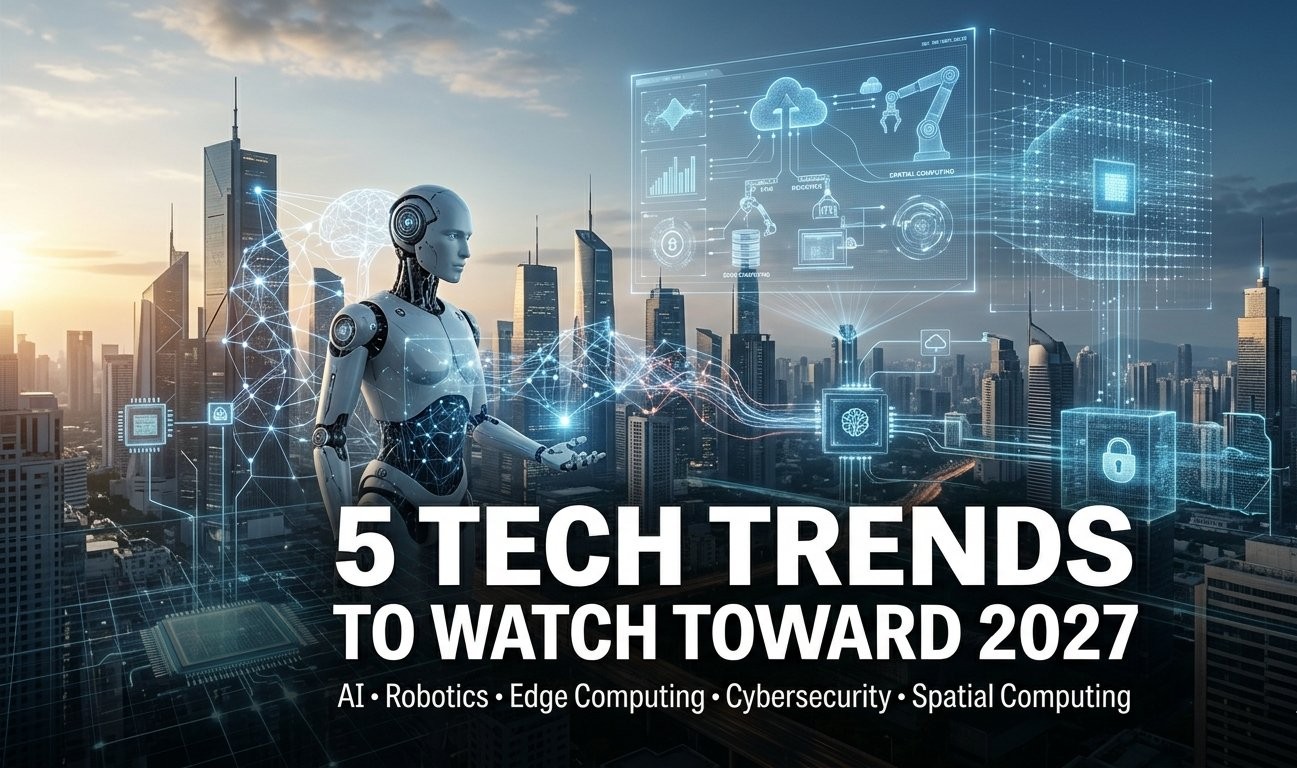
5 Technology Trends That Could Redefine the Road to 2027
Technology is entering a phase where innovation is no longer limited to launching a new device, app, or software platform. The bigger shift is happening underneath the products people already use. Artificial intelligence is becoming more autonomous, computing is moving closer to where data is created, digital experiences are becoming increasingly personalized, and the boundary between physical and digital environments continues to blur.
As we move toward 2027, several emerging technologies are likely to influence how businesses operate, how consumers interact with digital products, and how organizations think about data, security, automation, and connectivity. Some of these developments are already visible today, while others are still evolving rapidly.
Here are five technology trends to watch as we move toward 2027 and why they matter beyond the current hype cycle.
The first major shift to watch is the evolution of artificial intelligence from a system that responds to instructions into one that can increasingly plan and execute multi-step tasks.
Today’s generative AI tools are already capable of writing content, analysing documents, creating images, summarizing information, generating software code, and answering complex questions. The next stage is more autonomous AI systems, often described as AI agents or agentic AI, that can work toward a defined objective rather than simply responding to individual prompts.
Instead of asking an AI assistant to draft an email and then separately asking it to organize information from a spreadsheet, an agent could potentially interpret a broader objective, determine the steps required, use connected software tools, and complete parts of the workflow with limited human intervention. This could reshape everything from customer service and marketing operations to software development, research, finance, and administrative work.
For businesses, the attraction is not simply faster content generation. It is the possibility of automating entire workflows. An AI system could monitor incoming information, identify a relevant event, analyse its potential impact, prepare a response, and send the result through an approved workflow.
However, greater autonomy also introduces greater responsibility. Organizations will need stronger permission systems, monitoring, human oversight, data controls, and methods for evaluating whether an AI agent has completed a task correctly.
The important trend heading toward 2027, therefore, may not be “AI can answer questions.” It could increasingly become “AI can get things done.”
Artificial intelligence is no longer restricted to screens. A major emerging direction is the integration of AI with machines, robotics, vehicles, factories, warehouses, and other physical environments.
This concept is sometimes referred to as physical AI systems that combine artificial intelligence with sensors, robotics, computer vision, spatial understanding, and real-world decision-making.
The implications are significant. A warehouse robot, for example, needs more than the ability to recognize an object. It needs to understand its surroundings, navigate physical space, respond to changing conditions, and interact safely with other machines and people. Similar principles apply to autonomous vehicles, industrial robots, agricultural equipment, and increasingly sophisticated consumer robotics.
Manufacturing is one area where this transformation could be particularly important. AI-powered machines can analyse visual information, identify defects, optimize production processes, and respond to operational changes. Meanwhile, advances in robotics are making machines more adaptable to environments that previously required significant human intervention.
Consumer technology could also become increasingly physical. Smart home systems, personal robots, AI-powered appliances, and intelligent mobility products may gradually become more capable of understanding their surroundings and responding to natural human instructions.
The road to 2027 may therefore see AI become less about a chatbot sitting inside a browser and more about intelligence embedded into the physical world.
That shift could create new opportunities, but it will also make safety, reliability, privacy, and human-machine interaction increasingly important.
The amount of data generated by connected devices is growing rapidly. Smartphones, cameras, vehicles, industrial equipment, wearables, smart appliances, and other connected products continuously produce information. Sending all of that data to distant cloud data centers is not always the most efficient approach.
This is where edge computing becomes increasingly relevant.
Instead of processing every piece of information in a centralized cloud environment, edge computing moves some processing closer to the device or location where the data is generated. The result can be faster response times, reduced bandwidth requirements, and improved performance for applications that need near-real-time decisions.
Consider technologies such as autonomous driving, industrial automation, smart security systems, augmented reality, and connected healthcare devices. In these environments, even small delays can matter. An application that needs an immediate response may benefit from processing information locally rather than waiting for data to travel to a remote server and return.
The rise of AI is also increasing the importance of edge computing. As more devices gain AI capabilities, companies are exploring ways to run AI models directly on smartphones, computers, cameras, vehicles, and other hardware.
This could lead to a future where some AI processing happens directly on your device rather than entirely in the cloud. That could have advantages for responsiveness and, depending on implementation, privacy because certain information can remain local.
The combination of AI chips, edge computing, and increasingly capable devices could quietly transform everyday technology. Users may not even notice the infrastructure behind it; they will simply experience applications that feel faster, more intelligent, and more responsive.
As artificial intelligence becomes more capable, cybersecurity is entering a new phase. AI can help organizations detect suspicious behavior, analyse large quantities of security data, identify anomalies, automate parts of incident response, and strengthen threat detection.
At the same time, the same technology can potentially make cyberattacks more scalable and sophisticated.
That creates an unusual technology race: AI will increasingly be used to defend digital systems while also changing the threat landscape those systems need to defend against.
Traditional cybersecurity approaches often rely on predefined rules, known signatures, and human analysts examining alerts. AI-powered systems can potentially analyse behavioral patterns and identify unusual activity across enormous volumes of information.
For businesses operating complex digital environments, this could become particularly valuable. Security teams already face huge quantities of alerts, logs, emails, network activity, and application data. AI can help prioritize signals that deserve human attention rather than treating every alert equally.
But organizations cannot simply assume that adding AI automatically makes a system secure. AI models themselves can introduce new risks, including data exposure, manipulation, incorrect decisions, and vulnerabilities in connected systems.
As companies deploy more AI agents and autonomous software, identity and access management could become even more important. Organizations will need to determine not only who has access to a system, but also which AI systems can access what information and what actions they are permitted to take.
By 2027, cybersecurity may increasingly involve protecting not just people and computers, but an expanding ecosystem of autonomous digital actors.
Another technology trend worth watching is the continued development of spatial computing, where digital information becomes more closely integrated with the physical environment.
Virtual reality, augmented reality, mixed reality, spatial interfaces, and advanced wearable devices are contributing to this broader shift. Instead of interacting with digital information exclusively through a traditional screen, users can increasingly interact with digital objects in three-dimensional space.
The technology still faces challenges, including hardware costs, battery life, comfort, software ecosystems, and the question of which experiences genuinely benefit from spatial interfaces. But its potential applications extend far beyond entertainment.
In education, spatial experiences could help learners visualize complex scientific or engineering concepts. In healthcare, three-dimensional visualization could support certain forms of training and planning. In manufacturing, workers could access contextual instructions while interacting with physical equipment. Retailers could experiment with virtual product visualization, while architects and designers can work with three-dimensional environments before construction begins.
The most interesting development may be the convergence of spatial computing with AI.
Imagine an intelligent digital assistant that does not simply provide information in a chat window but understands the environment around you and presents relevant information in context. Instead of searching for instructions on a screen, a worker could potentially receive visual guidance positioned around the equipment they are using.
This represents a broader movement toward more natural human-computer interaction. The screen may remain important, but it could increasingly become one interface among many.
The Bigger Technology Story Heading Into 2027
These five trends agentic AI, physical AI, edge computing, AI-driven cybersecurity, and spatial computing may appear to belong to different parts of the technology industry. In reality, they are increasingly connected.
AI requires powerful computing infrastructure. Edge computing can bring that intelligence closer to users and machines. Robotics can give AI a physical presence. Cybersecurity becomes essential as autonomous systems gain access to more information and applications. Spatial computing can provide new ways for humans to interact with increasingly intelligent digital systems.
The result is a technology landscape that is becoming more interconnected and less dependent on individual products.
The biggest change heading toward 2027 may therefore not be one particular gadget or software platform. It could be the gradual transition from technology that waits for people to operate it toward technology that increasingly understands context, anticipates needs, and participates in completing tasks.
For consumers, this could mean more personalized and responsive digital experiences. For businesses, it could mean redesigned workflows, new operating models, and increased investment in AI infrastructure and cybersecurity. For technology professionals, it could create demand for skills that combine AI, data, software, security, robotics, and human-cantered design.
The technology industry has always moved through cycles of excitement and disappointment. Not every emerging technology will develop at the speed its early announcements suggest, and some ideas will inevitably remain niche. But the underlying direction is clear: computing is becoming more intelligent, more connected, more autonomous, and increasingly integrated into the physical world.
And as 2027 approaches, that transformation may become much harder to ignore.

Software Developer & Writer
Hey, I'm Diva, a developer and writer blending code and creativity. I'm driven by a deep curiosity and a relentless pursuit of excellence. Join me as I craft digital solutions and captivating stories.



Leave A Comment