
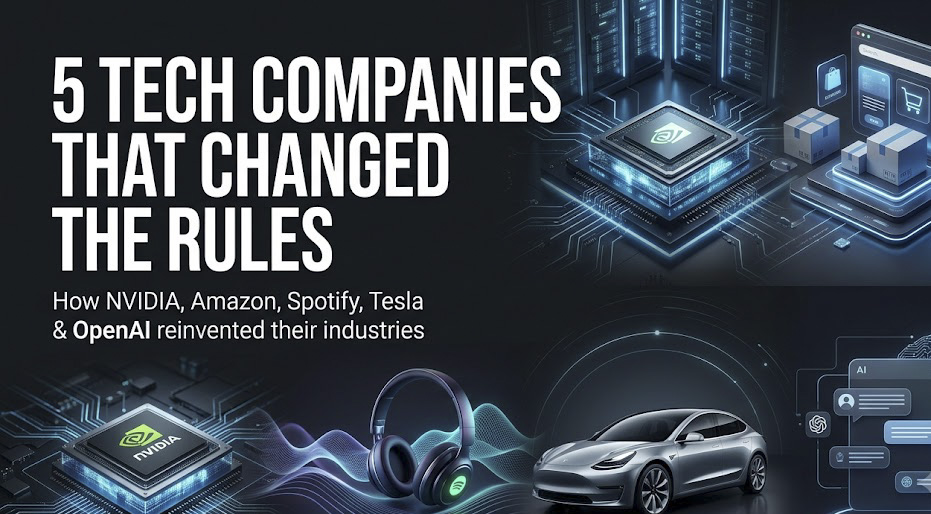
5 Tech Companies That Changed the Rules of Their Industries
Technology has never been short of innovation. What separates an interesting invention from a category-defining breakthrough is what happens after the product reaches people. The most influential technology companies do not simply introduce another device, platform or service into an existing market. They change the habits around it, reshape consumer expectations and force an entire industry to rethink what is possible.
Some of these companies succeeded by making complicated technology feel effortless. Others turned previously expensive services into everyday products, transformed entertainment into an on-demand experience or made artificial intelligence accessible to millions of people. Their influence can often be measured not by one particular product, but by how many competitors eventually started behaving differently because of them.
Here are five technology companies that changed the rules of their industries—and, in the process, changed the way people interact with technology itself.
NVIDIA: From Graphics Specialist to the Engine Behind the AI Era
For years, graphics processing units were primarily associated with gaming, visual effects and computer graphics. NVIDIA helped change that perception by demonstrating that the parallel-processing capabilities of GPUs could become enormously valuable beyond graphics.
The company’s early success was built around gaming hardware, but its long-term significance came from recognising that GPUs could handle certain computational workloads differently from traditional CPUs. As machine learning and artificial intelligence expanded, this architecture became increasingly important for training and running sophisticated AI systems.
What makes NVIDIA’s transformation particularly interesting is that the company did not suddenly become an AI company overnight. It spent years building a software and hardware ecosystem around GPU computing. CUDA, its parallel computing platform, became an important part of that ecosystem, allowing developers and researchers to use NVIDIA hardware for workloads far beyond traditional graphics.
The AI boom dramatically accelerated this strategy. As companies began investing in generative AI, large language models and advanced computing infrastructure, demand for specialised computing hardware surged. NVIDIA consequently moved from being primarily associated with gaming graphics to becoming one of the most important technology companies in the modern AI infrastructure stack.
Its story illustrates a powerful technology principle: sometimes the biggest category transformation comes from discovering a completely different use for technology that already exists.
NVIDIA did not simply make faster graphics cards. It helped establish the idea that the same underlying computing architecture could power an entirely new generation of applications.
Amazon: Turning the Internet Into a Shopping Habit
Online shopping existed before Amazon, but Amazon helped transform it from an emerging internet activity into a normal part of everyday consumer behaviour.
When Amazon began as an online bookstore in the 1990s, the idea of purchasing books through a website was still relatively unfamiliar to mainstream consumers. The company’s long-term ambition, however, extended far beyond books. It built infrastructure, logistics, recommendations and fulfilment capabilities that could support an enormous range of products.
The critical innovation was not simply having more products available online. Amazon increasingly made online shopping feel convenient enough to become habitual. Search, personalised recommendations, customer reviews, one-click purchasing, delivery tracking and increasingly fast fulfilment all reduced friction between wanting something and receiving it.
That philosophy eventually extended into Amazon Prime, which changed consumer expectations around delivery and digital services. What began as a shipping-focused membership evolved into a broader ecosystem involving entertainment, digital content and other benefits.
Amazon also transformed the technology industry itself through Amazon Web Services. AWS demonstrated that computing infrastructure could be consumed as an on-demand service rather than requiring every company to build and maintain its own physical infrastructure at scale.
That created a second category transformation hidden inside the first. Amazon went from selling products through the internet to providing some of the infrastructure on which the internet economy operates.
The Amazon story is therefore less about e-commerce alone and more about removing friction. Whether the customer is ordering a household product or a developer is deploying an application, the underlying philosophy is remarkably similar: make access easier, faster and more scalable.
Spotify: Rebuilding Music Around Access
The digital music revolution had already begun before Spotify appeared. MP3 files, downloads and piracy had disrupted the traditional music business, while consumers were gradually moving away from physical formats.
Spotify approached the problem from a different direction. Instead of making consumers think primarily about owning music, it built its service around access.
The shift sounds simple today, but it represented a major change in the relationship between listeners and music. A person no longer needed to maintain a carefully managed collection of individual files. A vast catalogue could sit inside an application and become accessible through search, playlists and recommendations.
Spotify’s influence also came from its discovery experience. Music streaming could have been little more than a giant digital catalogue, but recommendation algorithms, personalised playlists and features such as Discover Weekly turned the service into something closer to a personal music guide.
The platform also changed how artists and audiences interact. Songs can spread internationally without following the traditional physical distribution model, while playlists and algorithmic recommendations can influence what listeners encounter next.
Perhaps the most significant transformation is the expectation Spotify helped establish: music should be available immediately, across devices, with minimal friction.
The broader technology lesson is powerful. When a product moves from ownership to access, the business model changes—but so does consumer behaviour. Spotify helped demonstrate how technology could turn an enormous library of content into a continuously personalised experience.
Tesla: Making Software Part of the Car
The automobile industry has always been deeply connected to mechanical engineering. Engines, transmissions, suspension systems and manufacturing have traditionally defined much of the conversation around vehicle innovation.
Tesla helped shift attention toward another layer of the automobile: software.
Electric vehicles were not invented by Tesla, and the company did not create the concept of autonomous driving. Its contribution was to combine electric powertrains, software, connected features and a technology-oriented brand identity into a consumer proposition that looked very different from the conventional automotive model.
Tesla vehicles were designed around a digital interface, frequent software updates and a connected ecosystem. Features could be modified or improved through software rather than requiring a traditional visit to a dealership for every change.
This approach helped encourage a broader industry conversation about the automobile as a software-enabled product rather than a machine whose capabilities remain largely fixed after purchase.
Tesla also changed the visual and cultural perception of electric vehicles. For years, electric cars were frequently associated with environmental efficiency and practical transportation. Tesla positioned electric performance, acceleration, minimalist design and technology as equally important parts of the proposition.
The result was a different conversation around electric mobility. Consumers could consider an EV not merely because it used less fuel, but because it represented a different kind of driving experience.
Tesla’s impact therefore reaches beyond its vehicles. It contributed to an industry-wide shift toward electrification, connected cars, software-defined features and digital-first user experiences.
OpenAI: Making AI a Consumer Experience
Artificial intelligence had been researched for decades before OpenAI became a household technology name. Machine learning systems were already being used for search, recommendations, translation, fraud detection and many other applications.
What changed dramatically with ChatGPT was the interface between ordinary people and advanced AI.
Instead of requiring specialised technical knowledge, programming skills or access to research environments, generative AI could be experienced through a simple conversational interface. A person could ask a question, request an explanation, generate ideas, analyse information or work with text through natural language.
That simplicity was crucial.
The underlying technology is extraordinarily complex, but the consumer interaction is almost deliberately ordinary: type something and receive a response. This helped turn AI from something many people encountered indirectly into something they could actively experiment with.
The impact extended into education, software development, marketing, customer service, research, design and everyday productivity. Companies began exploring how conversational AI could be integrated into existing workflows, while individuals started treating AI assistants as a new category of digital tool.
OpenAI’s broader significance lies in the interface. The company helped popularise a model in which interacting with sophisticated computing systems does not necessarily require learning the machine’s language. Instead, the machine increasingly adapts to the user’s language.
That represents a meaningful shift in the history of computing.
The graphical user interface made computers easier to navigate visually. Smartphones made computing portable and touch-driven. Conversational AI introduced another possibility: interacting with software through natural language.
The Real Innovation Is Often the New Behaviour
NVIDIA, Amazon, Spotify, Tesla and OpenAI operate in very different parts of the technology ecosystem. One focuses heavily on computing infrastructure, another on commerce and cloud services, another on entertainment, another on mobility and another on artificial intelligence.
Yet their stories share a common thread.
Each company helped move its industry toward a new consumer or business expectation. Computing became increasingly accelerated by specialised AI hardware. Shopping became increasingly instant and personalised. Music became continuously accessible. Cars became increasingly connected and software-driven. AI became something ordinary people could interact with directly.
That is what category reinvention really looks like in technology. It is not necessarily the invention of something that has never existed before. More often, it is the creation of a new combination of technology, experience and behaviour.
The strongest technology companies understand that innovation does not end when a product launches. The real test begins when people start using it. If the product changes what customers expect from every competitor that comes after it, the company has done something much bigger than release a successful product.
It has changed the rules.
And in technology, changing the rules can be far more consequential than simply playing the game better.

Software Developer & Writer
Hey, I'm Diva, a developer and writer blending code and creativity. I'm driven by a deep curiosity and a relentless pursuit of excellence. Join me as I craft digital solutions and captivating stories.




Leave A Comment