
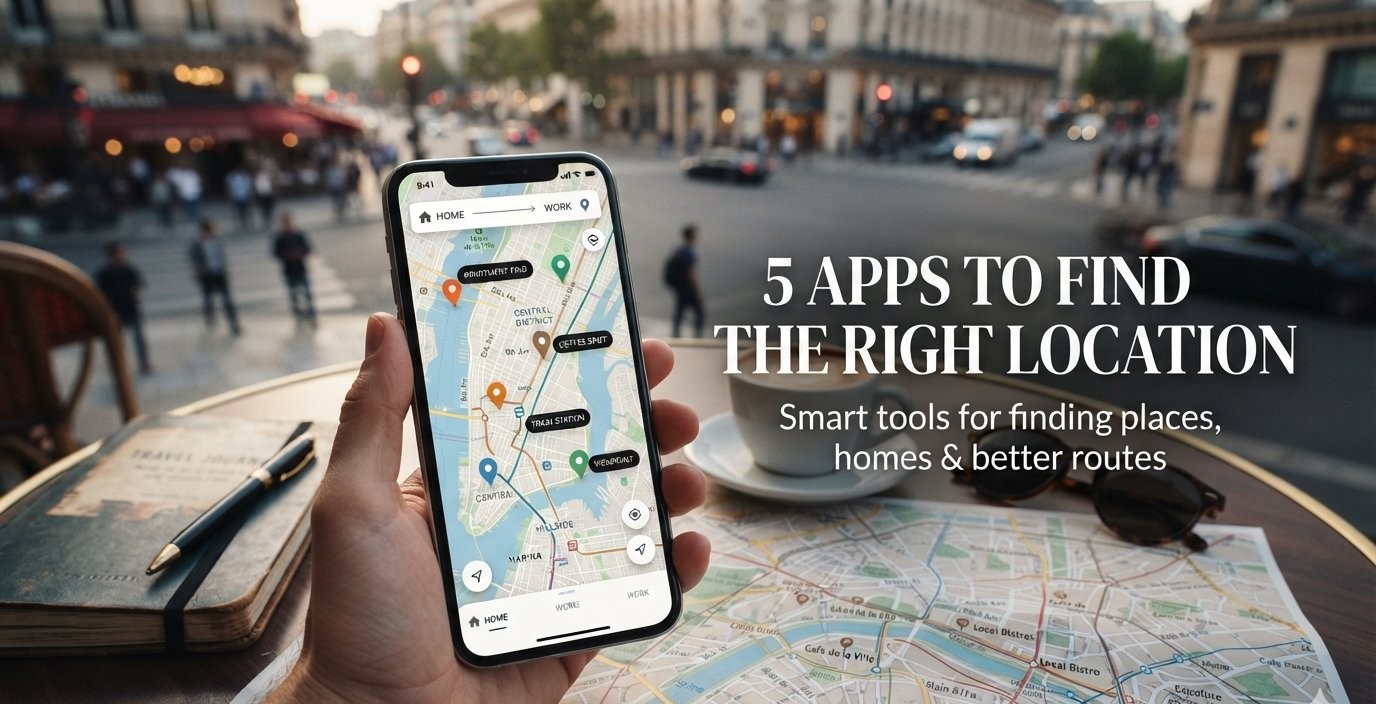
5 Apps That Can Help You Find the Right Location From Everyday Places to Your Next Big Move
Finding the right location is rarely as simple as dropping a pin on a map. Whether you are looking for a new apartment, planning a holiday, searching for a quiet place to work, or trying to understand whether a neighbourhood actually fits your lifestyle, location can influence almost everything that comes after it. Commute times, nearby services, safety, restaurants, public transport, local atmosphere and even the amount of time you spend in your car can all depend on where you choose to be.
The good news is that you no longer have to rely entirely on recommendations from friends or spend hours driving around unfamiliar areas. A growing range of location-based apps can help you explore places, compare neighbourhoods, discover nearby businesses and understand what is around a particular address before you make a decision.
Some are designed primarily for navigation, while others are better suited to discovering restaurants, researching neighbourhoods or finding properties. Used together, these platforms can turn the often-overwhelming process of finding a location into something considerably more informed.
Here are five apps worth knowing if you want to find, explore or evaluate the right location.
When people think about finding a location, Google Maps is usually one of the first apps that comes to mind. But its usefulness goes far beyond getting directions from one destination to another. The platform has gradually become a digital guide to cities, neighbourhoods and businesses, making it one of the most practical tools for researching an unfamiliar location.
You can search for restaurants, supermarkets, cafés, hotels, gyms, hospitals, shopping centres, attractions and countless other places around a specific area. Reviews, photographs, opening hours and business information can give you a better sense of what a neighbourhood is actually like before you visit it. Street View can be particularly useful when you are considering a location from a distance because it allows you to virtually explore surrounding streets.
One of the most useful features is the ability to examine the area surrounding a potential address rather than focusing only on the address itself. A home might look perfect online, for example, but discovering that the nearest supermarket is a 30-minute walk away or that public transportation is inconvenient could change your decision.
Google Maps can therefore work particularly well for people asking questions such as how to find the best neighbourhood for your lifestyle, how to check amenities near a new home, or how to explore an area before moving there.
For everyday location research, its strength is breadth. It gives you an enormous amount of information in one place, although reviews and business listings can change, so important decisions should still involve additional research.
Sometimes the question is not simply, “Is this location good?” It is, “Can I realistically live with this commute every day?”
That is where Waze can become useful. The navigation platform is particularly focused on driving conditions and route information, helping users understand how traffic and road conditions can affect their journey. For people who commute regularly, this distinction matters because a location that appears close on a map may not necessarily be convenient during peak traffic.
Imagine you are choosing between two apartments. One is closer to your office in terms of distance, while another is slightly farther away but has a more practical driving route. Looking only at kilometres or miles might not reveal the full picture. Examining typical routes and traffic patterns can give you another layer of information.
Waze also has a community-driven element, with users contributing information about incidents and road conditions. That can make the experience feel more dynamic than a traditional static map.
It is especially useful for anyone trying to answer how to find a home with a short daily commute, how to compare driving routes before moving, or how to choose a convenient location for work and travel.
Of course, traffic can change depending on the day, weather, events and road closures. Waze should therefore be treated as a planning tool rather than a guarantee of how long every future journey will take.
For people searching for a property, finding the right location often starts before the property itself. A beautiful house at the wrong address can quickly become an inconvenient investment, while a modest property in a highly practical neighbourhood may fit everyday life much better.
Zillow is a well-known real estate platform that allows users to explore properties and housing markets, particularly in the United States. Instead of simply looking at photographs of individual homes, prospective buyers and renters can use property-search tools to investigate different areas and understand what is available within particular price ranges.
This changes the way people approach property hunting. Rather than asking, “Which house should I choose?” you can start by asking, “Which areas make sense for my budget and lifestyle?”
That shift can be important. A neighbourhood may offer access to schools, parks, shopping, restaurants and transport, while another area at a similar price point may provide more space but fewer nearby amenities. Property platforms can help narrow down the search before you spend time scheduling viewings.
For anyone researching how to find the right neighbourhood before buying a house, best apps for finding homes in a specific location, or how to compare properties by neighbourhood, Zillow can be a useful starting point for U.S. property searches.
The important thing is not to judge a neighbourhood exclusively through property listings. Listings tell you about available homes; they do not necessarily tell you what it feels like to spend a Tuesday evening there. Combining property research with maps, local reviews and an in-person visit can create a much fuller picture.
A location is more than an address. It is also the places you visit after you move there.
That is why Yelp can be useful when evaluating a neighbourhood. The platform focuses heavily on local businesses and experiences, giving users access to reviews and information about restaurants, cafés, salons, services and other businesses.
This can help you understand the everyday character of an area. If you are considering moving somewhere, searching around the neighbourhood can reveal whether there are independent cafés nearby, how many restaurants are within walking distance, what local services are available and what people are saying about them.
This is particularly valuable for travellers as well. Someone visiting a city for the first time might not want to stay simply because a hotel has attractive photographs. They may also want to know whether there are restaurants, coffee shops and useful services within easy reach.
Yelp therefore works well as a local discovery app for finding businesses near a specific location. It can supplement map-based research by giving more attention to customer experiences and opinions.
Reviews should still be interpreted carefully. Individual experiences can differ, and highly positive or negative reviews may not represent the entire picture. Looking for recurring themes across multiple reviews is generally more informative than relying on one person’s experience.
If public transportation is an important part of your lifestyle, Citymapper offers a different way to think about location.
Instead of treating the road network as the centre of the journey, Citymapper focuses heavily on getting around urban areas using public transport and other mobility options. For people living in major cities, this can be an important consideration when deciding where to stay, work or live.
Consider two apartments that cost roughly the same. One might be close to a metro station with several connections, while the other requires multiple transfers or a long walk before you reach the nearest major transit route. On paper, both addresses may look equally attractive. In daily life, however, the difference could be significant.
This is why checking transportation accessibility can be an important part of how to choose the right location to live in a city. A neighbourhood with convenient public transport can potentially make commuting, meeting friends, shopping and exploring the city easier.
Citymapper can be especially interesting for international travellers, students, professionals and anyone who prefers navigating large cities without depending entirely on a private vehicle.
Its usefulness depends on whether your city is supported and how comprehensive the local transport data is, but where available, it can add an important mobility-focused perspective to location research.
The Right Location Is About More Than a Pin on a Map
Choosing a location has become an information-gathering exercise. The technology available today means you can investigate an area from multiple perspectives before committing your time or money.
Google Maps can help you understand what surrounds an address. Waze can reveal how driving routes may affect your commute. Zillow can help property seekers investigate homes and neighbourhoods in the U.S. Yelp can show what local businesses and customers reveal about an area. Citymapper can help people understand how practical a neighbourhood may be for public transportation.
But the most useful approach is not necessarily to pick one app and trust it completely. The better strategy is to combine different sources of information.
Suppose you are considering moving to a new neighbourhood. Start by locating potential homes on a property platform. Then open the address in Google Maps and examine nearby supermarkets, healthcare facilities, restaurants, parks and other everyday necessities. If you drive, investigate the commute using Waze. If you depend on public transportation, check the area’s connections through Citymapper. Finally, explore local businesses and reviews to get a sense of what daily life might look like.
This creates a much more realistic picture than a property photograph or map pin alone.
There is also an important distinction between finding a location and finding the right location. The first is primarily a search problem. The second is a lifestyle problem.
The right location depends on what matters to you: commute time, cost, walkability, entertainment, access to nature, public transportation, schools, restaurants, work opportunities or simply the atmosphere of the neighbourhood. Two people can look at the exact same location and reach completely different conclusions because their priorities are different.
That is why location apps are best viewed as research companions rather than decision-makers. They can help you collect information, identify possibilities and spot practical advantages or disadvantages. The final choice still comes down to how those facts fit your own circumstances.
A Smarter Way to Search Before You Settle
The next time you are searching for a new home, planning a trip or simply wondering whether a neighbourhood is worth exploring, do not stop at the first map result.
Look around the location. Check the commute. Explore the transport network. Investigate local businesses. Compare nearby properties. Read recurring customer feedback. And, whenever possible, visit the area yourself at different times of day.
Because the perfect location is rarely the one that looks best on a screen.
It is the one that makes sense when you imagine actually living, working, travelling and spending your everyday life there.

Software Developer & Writer
Hey, I'm Diva, a developer and writer blending code and creativity. I'm driven by a deep curiosity and a relentless pursuit of excellence. Join me as I craft digital solutions and captivating stories.



Leave A Comment