
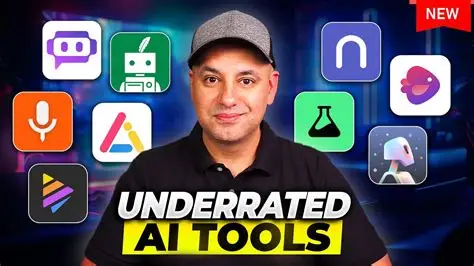
5 Underrated AI Tools You Probably Haven’t Tried Yet — From Nakin AI to Recraft
Artificial intelligence is no longer just about asking a chatbot to write an email, summarize a document, or generate a few ideas. The most interesting developments are happening in specialized AI tools that quietly transform how people work, design, automate tasks, and turn creative concepts into finished projects. While ChatGPT, Gemini, and other mainstream platforms dominate conversations, a new generation of AI-powered tools deserves more attention for solving specific problems with impressive efficiency.
For creators, marketers, entrepreneurs, designers, and professionals building businesses online, discovering the right AI tool can be more valuable than adding another general-purpose assistant to an already crowded collection of apps. Some tools help automate repetitive browser tasks, others turn rough ideas into polished visual assets, and a few make it easier to organize complex information without spending hours on manual work. The real advantage comes from knowing which tool to use for which job.
Five names worth exploring are Nakin AI, Bardeen, PipeDream, Recraft, and Whimsical AI. Each represents a different approach to making artificial intelligence practical, whether the goal is improving productivity, connecting software, creating professional graphics, or visualizing ideas. Rather than treating AI as a novelty, these platforms offer a glimpse into how specialized technology can become part of everyday workflows.
Not every interesting AI product has the visibility of a major technology brand. Emerging and lesser-known platforms can offer alternative ways to approach everyday digital tasks, particularly for people who want to experiment beyond the usual collection of widely discussed AI assistants. Nakin AI is a name to investigate in this growing landscape, especially if you are looking for fresh additions to your AI toolkit.
However, it is important to distinguish an intriguing product name from a verified product capability. Nakin AI is not as readily identifiable as established platforms such as Bardeen or Recraft, so its exact features, official website, and intended audience should be confirmed before describing it as a particular kind of AI assistant. That distinction matters for readers who want useful recommendations rather than a list of unfamiliar names presented without evidence.
The broader lesson is that finding underrated AI tools requires looking beyond popularity and evaluating whether a product genuinely solves a problem. A promising platform should make a task faster, simplify an existing process, or provide a capability that would otherwise require multiple applications. Before adopting any emerging AI product, check its official documentation, pricing, integrations, privacy practices, and recent user feedback. The most valuable discovery is not necessarily the tool with the boldest claims; it is the one that consistently delivers practical results.
Imagine researching potential brand partners, collecting information from websites, updating a spreadsheet, and preparing outreach notes. Each individual task might take only a few minutes, but repeating the same process across dozens or hundreds of prospects quickly becomes exhausting. This is the kind of repetitive digital work that Bardeen is designed to help automate.
Bardeen is an AI-powered workflow automation platform that helps users connect applications and automate browser-based tasks. Instead of manually moving information between different tools, users can create workflows that carry out recurring actions. Depending on the available integration and workflow configuration, this can include gathering information, organizing research, transferring data, and helping sales or marketing teams manage repetitive processes. Its appeal lies in reducing the small, time-consuming activities that interrupt more valuable work.
For a content agency or digital marketing team, Bardeen can be particularly interesting when managing brand research and campaign preparation. A marketer might need to organize information about international fashion labels, technology companies, ecommerce businesses, or potential collaboration partners. With an appropriately configured workflow, automation can reduce manual data handling and make the research process more consistent. Human review remains essential, especially when assessing brand relevance, verifying contact details, or deciding whether a partnership opportunity is genuinely worthwhile.
The biggest benefit is not simply speed. It is the ability to create a more repeatable working process. Rather than starting from scratch every time a task needs to be completed, teams can build workflows that follow the same steps and reduce avoidable errors. Anyone exploring AI automation for marketing, sales prospecting, or everyday productivity should consider Bardeen as a useful place to begin.
Modern businesses rarely operate from a single application. A typical digital workflow might involve a website, a customer relationship management system, an email platform, a database, analytics software, and several marketing tools. Getting these systems to communicate with one another can become complicated, particularly when a team needs a custom process that existing integrations do not fully support. This is where Pipedream enters the conversation.
Pipedream is an integration and workflow automation platform that helps developers connect APIs, applications, and services. It allows users to create workflows that respond to events, move data between systems, and execute code when a particular action occurs. It is especially relevant to people building software products, internal business tools, automated reporting systems, or AI-powered applications that depend on information from multiple services.
Consider an ecommerce brand that wants to connect new customer orders with inventory updates, internal notifications, and reporting tools. Rather than manually transferring information between platforms, a properly designed workflow can trigger actions when an order arrives and pass the necessary data to connected services. Similar workflows can support lead management, content publishing pipelines, customer support processes, and data synchronization. The exact implementation depends on the applications involved, their APIs, and the permissions available.
Pipedream is particularly valuable because it combines integrations with the flexibility of code. No-code automation platforms can be excellent for straightforward tasks, but more technical workflows often require custom logic, conditional steps, or specialized API requests. Pipedream offers a route for developers to build those processes without creating every integration entirely from scratch.
For startups, developers, and technology-focused teams, the platform can reduce the effort involved in connecting separate systems. It is not necessarily the simplest choice for someone who has never worked with APIs, but for people building more sophisticated workflows, it can be a powerful addition to an AI and automation toolkit. Its greatest strength is making the infrastructure behind connected digital experiences easier to assemble and maintain.
AI image generators have made it easier than ever to create attractive visuals, but producing a beautiful image is not always the same as producing a useful design asset. Brands need graphics that follow a visual identity, fit different formats, and remain consistent across advertisements, websites, product pages, and social media campaigns. Recraft stands out because its capabilities are oriented toward design-focused image creation rather than visual experimentation alone.
Recraft is an AI-powered design platform known for generating and editing visual assets, including illustrations, icons, and vector-style graphics. Its tools are relevant to designers and marketers who need more control over the appearance and practical use of generated artwork. Vector-oriented workflows are especially useful when graphics need to be resized or adapted for different placements, although the available export options and editing capabilities depend on the product’s current features and plan.
For a brand building its online presence, the possibilities are easy to imagine. A social media designer could explore visual concepts for a product launch, develop illustrations for an editorial carousel, or create supporting graphics for a website. A startup could experiment with icon styles, while an ecommerce business might use AI-generated visuals to explore campaign directions before investing in a full production process. These applications can make early-stage creative exploration faster and more accessible.
Recraft is also worth considering for creators who care about visual consistency. Instead of relying entirely on generic stock imagery, they can experiment with styles that better reflect a specific campaign or creative direction. The result still requires judgment: generated assets should be checked for accuracy, licensing considerations, brand suitability, and any visual inconsistencies before commercial publication.
For designers, content creators, and businesses that produce graphics regularly, Recraft offers a compelling reason to look beyond general-purpose AI image generation. It helps bring the conversation closer to the realities of design work, where adaptability, consistency, and practical output matter just as much as the initial creative idea.
Some of the most difficult work happens before a project begins. Ideas arrive in fragments, teams disagree about priorities, and complicated processes become harder to explain as more people get involved. Writing everything down can help, but long documents do not always make relationships between ideas easy to understand. Whimsical AI approaches this problem through visual thinking.
Whimsical is a collaborative workspace for creating diagrams, flowcharts, wireframes, mind maps, and other visual documents. Its AI features can help users turn written prompts into structured visual starting points, making it easier to organize thoughts and explore relationships between concepts. Instead of staring at an empty canvas, users can begin with a rough structure and refine it into something more useful.
For a content strategist, this can mean mapping an Instagram carousel from its opening hook to its final call to action. For a product team, it might mean illustrating a customer journey, outlining a new website’s structure, or mapping the steps involved in a software feature. Teachers, founders, researchers, and project managers can also use visual diagrams to make complicated subjects easier to communicate.
One reason this approach is valuable is that visual planning exposes gaps that can remain hidden in ordinary notes. A flowchart might reveal an unnecessary step in a customer onboarding process, while a mind map can show how a broad campaign idea connects to smaller content themes. These diagrams are not substitutes for sound strategy, but they can make reasoning more visible and collaboration more productive.
Whimsical AI is particularly useful for people who think visually or regularly explain complex information to others. It bridges the gap between brainstorming and execution by giving abstract ideas a structure that teams can discuss, edit, and improve. For anyone who spends too much time trying to turn messy notes into a coherent plan, it is an AI-powered workspace worth exploring.
Which of These Underrated AI Tools Is Worth Trying First?
The best tool depends on the problem you want to solve, not the number of features listed on a product page. Bardeen is worth exploring if repetitive browser tasks and information gathering consume too much of your time. Pipedream is a strong candidate for connecting applications and building custom integrations, particularly if you are comfortable with technical workflows. Recraft makes sense for design-oriented image generation, while Whimsical AI is a natural choice for organizing ideas and creating visual plans.
Nakin AI deserves further investigation once its exact product identity and current capabilities have been verified. That extra step is important because AI products evolve rapidly, and unfamiliar names can sometimes refer to different services or newly launched platforms. Before investing time or money, visit the official website and confirm that the tool actually provides the functions you need.
It is also worth remembering that no single AI platform will improve every part of your workflow. A designer may benefit more from a dedicated visual tool than from a complex automation platform, while a developer building integrations may find little reason to adopt an AI diagramming workspace beyond occasional planning. Choosing tools based on real bottlenecks produces better results than collecting applications simply because they are trending.
The Bigger Picture: Specialized AI Tools Are Changing Digital Work
The next phase of AI adoption is not just about finding a smarter chatbot. It is about building a practical ecosystem in which different tools handle different responsibilities. Automation platforms reduce repetitive work, integration services connect digital systems, design applications accelerate creative exploration, and visual workspaces help teams organize complex thinking. Used thoughtfully, these capabilities can make small teams more efficient without requiring them to build every process from the ground up.
For creators and businesses, the opportunity is especially significant. Time saved on manual research can be redirected toward strategy, while faster design exploration can create more room for experimentation. Better integrations can reduce information silos, and clearer visual planning can help teams communicate decisions more effectively. The real value emerges when the tools work together as part of a deliberate process rather than becoming another collection of subscriptions.
Ultimately, underrated AI tools are worth discovering because they solve problems that mainstream conversations often overlook. Bardeen, Pipedream, Recraft, and Whimsical AI each address a distinct part of modern digital work, from automation and integrations to creative production and visual collaboration. Explore them according to your needs, verify their current capabilities, and start with one repetitive task or creative bottleneck you genuinely want to improve. The most useful AI discovery may not be the tool everyone is talking about, but the one that quietly makes your work better every day.

Software Developer & Writer
Hey, I'm Diva, a developer and writer blending code and creativity. I'm driven by a deep curiosity and a relentless pursuit of excellence. Join me as I craft digital solutions and captivating stories.

Leave A Comment