
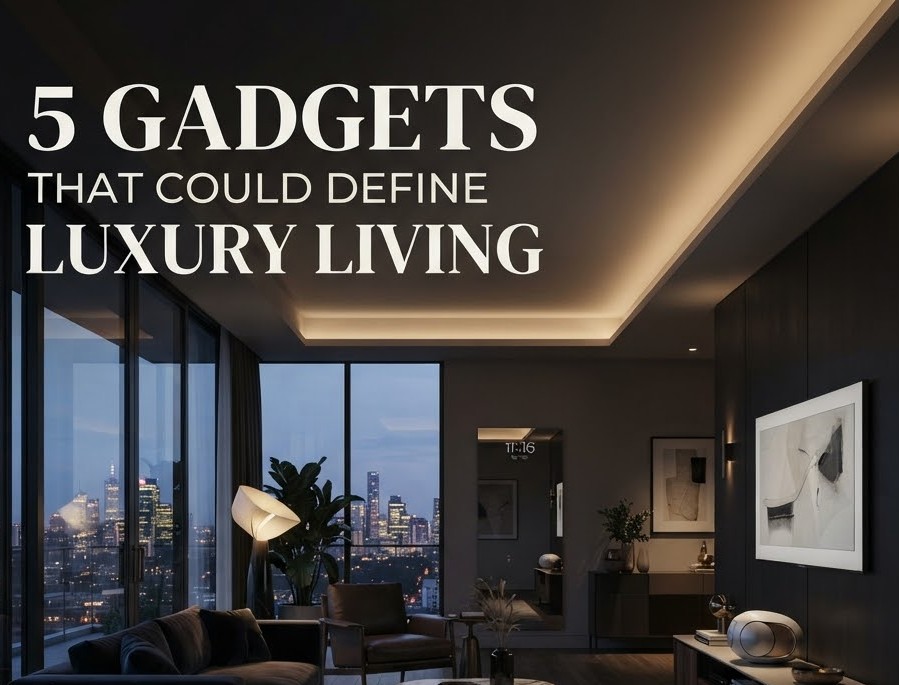
5 Gadgets That Could Define Luxury Living
Luxury is changing its vocabulary.
For decades, luxury living was associated with things that were immediately recognizable: a rare watch, a handcrafted automobile, a penthouse with a panoramic view, or a dining room filled with furniture that looked as expensive as it felt. But technology has quietly introduced another dimension to the conversation.
Today, luxury is increasingly measured by how effortlessly life can move around you.
The most desirable technology is no longer necessarily the loudest, largest or most extravagant. It is technology that anticipates, adapts and disappears into the environment. It creates comfort without demanding attention and personalization without making the home feel like a showroom for electronics.
That shift is giving rise to a new class of luxury gadgets—objects that combine engineering, design and lifestyle in ways that feel almost invisible.
Here are five technologies that could shape the next generation of sophisticated living.
There was a time when buying a bigger television was considered the ultimate home-entertainment upgrade. Today, size alone feels rather ordinary.
The more interesting question is what happens to the screen when nobody is watching it.
New display concepts are challenging the traditional black rectangle that has dominated living rooms for decades. Transparent displays, ultra-thin screens and television designs that blend into walls are creating an entirely different relationship between technology and interior design.
For luxury homeowners, this is more than an engineering achievement. It solves a very specific aesthetic problem.
A beautifully designed living room can take months of planning. Materials, lighting, furniture, artwork and architectural proportions are carefully considered. A giant black screen can disrupt all of that the moment it is switched off.
The disappearing display offers another possibility. Entertainment exists when you want it and retreats when you do not.
Imagine a room designed around a dramatic piece of contemporary art. During the day, the artwork becomes the focal point. In the evening, the same surface transforms into a high-resolution cinema display. Nothing needs to be rearranged. Nothing needs to be carried into the room.
That is a particularly modern form of luxury: one object performing two completely different roles without compromising either.
The future of the television may therefore not be about making screens more noticeable. It may be about making them almost invisible.
Temperature control has traditionally been treated as a household utility. You set the thermostat, the air conditioner responds and everyone accepts whatever temperature the room eventually reaches.
But luxury has always been about personalization—and climate technology is beginning to take that idea seriously.
The next generation of connected climate devices is moving toward highly personalized environments. Instead of treating an entire house as one temperature zone, intelligent systems can respond to different rooms, schedules and preferences.
Your bedroom could have one atmosphere at night. Your home office could maintain another during working hours. The living room could adjust automatically before guests arrive.
The idea becomes particularly interesting when paired with sensors and automation.
Rather than constantly changing settings manually, the environment can respond to occupancy, time of day and individual preferences. Windows, blinds, ventilation and temperature controls can potentially work together rather than operating as isolated systems.
This may sound like a relatively invisible upgrade—and that is precisely the point.
A luxury home should not make you think about whether the room is too warm or too cold. The ideal environment simply feels right.
The ultimate climate gadget may therefore be the one you rarely remember using.
Because when technology becomes truly sophisticated, comfort stops feeling like something you control.
It simply surrounds you.
The refrigerator is not usually the first object that comes to mind when discussing luxury technology.
Yet it could become one of the most interesting.
The traditional refrigerator has remained remarkably unchanged in its fundamental purpose: keep food cold. Smart refrigeration is beginning to expand that role by connecting storage, inventory, shopping and household routines.
Imagine opening your refrigerator and knowing exactly what is inside without having to remember when something was purchased. Imagine receiving an alert when a frequently used ingredient is running low, or having the kitchen automatically adapt its lighting and settings to your daily routine.
The significance is not really the refrigerator itself.
It is the emergence of the intelligent kitchen.
In a truly connected home, appliances no longer need to function independently. The refrigerator can become part of a broader ecosystem involving ovens, coffee machines, lighting, grocery services and home assistants.
For someone who values convenience, that can transform everyday routines.
Breakfast can become almost automatic. Coffee can be prepared according to a morning schedule. The kitchen can shift its lighting from bright daytime illumination to a warmer evening setting. Appliances can communicate rather than requiring constant manual intervention.
And unlike flashy gadgets that quickly become outdated, intelligent appliances are becoming integrated into the architecture of the home itself.
Luxury is increasingly moving from what sits on the kitchen counter to how intelligently the entire kitchen behaves.
There is something fascinating about the bathroom mirror.
It is one of the few objects you interact with every day without thinking about it. You look into it while getting ready, checking your appearance, brushing your teeth or preparing for the day.
Now imagine if that mirror could also become an interface.
Smart mirrors are transforming the traditional bathroom mirror into a connected piece of technology. Depending on the system, they can integrate lighting, entertainment, information and smart-home controls while maintaining the clean appearance expected from a premium interior.
But the real opportunity is personalization.
Your mirror could become the first interface you interact with in the morning. Instead of reaching for your phone immediately, relevant information could appear naturally in your surroundings.
The weather. Your calendar. A morning playlist. Home controls. Lighting preferences.
Suddenly, the bathroom is no longer simply a functional space.
It becomes the first chapter of the day.
This also fits into a much broader luxury trend: the transformation of the home into a private wellness environment.
Luxury bathrooms are increasingly influenced by spa design, with sophisticated showers, ambient lighting, heated surfaces and wellness-focused technology. A smart mirror fits naturally into that evolution because it combines functionality with an experience that feels personal.
The mirror does not need to scream “technology.”
In fact, the most luxurious version might look almost completely ordinary.
Until you need it to do something extraordinary.
If there is one technology that could fundamentally change luxury living, it may not be a physical gadget at all.
It could be an intelligent home assistant capable of coordinating the environment around you.
Think of it as a private digital concierge for the house.
Instead of controlling individual devices separately, you interact with the home itself. A simple command could prepare the living room for a film, adjust the lighting, lower the blinds, set the temperature and activate the entertainment system.
Another command could prepare the house for bedtime.
The lights gradually dim. The temperature changes. Security systems activate. Doors are checked. Entertainment devices switch off.
The experience begins to resemble something traditionally associated with luxury hotels: personalized service that happens without you having to ask twice.
The difference is that this service exists inside your own home.
As artificial intelligence becomes increasingly integrated into consumer technology, the smart home could evolve beyond responding to commands. It could learn patterns and recognize routines.
Your home might understand that Friday evenings usually mean dinner with friends. It might recognize when you return from travel. It might adjust the environment based on the time of day or your established preferences.
The goal should not be to make the house feel robotic.
It should make the house feel more intuitive.
That distinction could define the next era of luxury technology.
When Technology Becomes Invisible
The fascinating thing about these five gadgets is that none of them represents luxury simply because they are technologically advanced.
Their appeal comes from something more sophisticated: they remove effort.
That is increasingly what modern luxury represents.
Consider the evolution of other luxury industries. High-end automobiles are no longer judged only by leather seats and powerful engines. They are increasingly defined by intelligent assistance, personalized interiors, immersive sound and seamless connectivity.
Luxury hotels are no longer competing only through chandeliers and marble lobbies. They compete through personalized experiences, intuitive service and technology that anticipates what guests need.
The luxury home is following the same trajectory.
The expensive object is becoming less important than the experience it creates.
A television that disappears can protect the beauty of an interior.
A climate system can make every room feel individually considered.
An intelligent kitchen can eliminate mundane decisions.
A connected mirror can simplify the morning routine.
An AI-powered home can coordinate everything quietly in the background.
None of these experiences needs to feel spectacular.
That is precisely why they feel luxurious.
The New Status Symbol Is Control
There is another subtle change taking place.
Luxury has historically been about ownership. The rarest car. The largest home. The most exclusive watch.
Technology is introducing another kind of status: control over your environment.
The ability to personalize your home down to the smallest detail can become more valuable than simply filling it with expensive objects.
What temperature do you prefer when you sleep?
What lighting makes you feel relaxed?
What music should play when you arrive home?
How should the house prepare itself when you leave?
Which rooms should feel energetic in the morning and intimate in the evening?
These details may seem insignificant individually, but together they create something extremely personal.
Your home stops being a collection of expensive products.
It becomes an environment designed around you.
And perhaps that is where luxury technology is heading.
Not toward homes that constantly remind you how advanced they are, but toward homes that quietly understand how you live.
The Future Will Be Less About Gadgets
The irony of luxury technology is that its ultimate success may mean becoming almost invisible.
We may eventually stop talking about smart refrigerators, smart mirrors, smart lighting and intelligent climate systems because they will simply be part of the home.
Just as electricity disappeared into walls, tomorrow’s technology may disappear into architecture.
The luxury living room will not necessarily have more screens. It may have fewer.
The kitchen may not have more appliances. It may have appliances that communicate better.
The bedroom may not have more controls. It may require almost none.
And the smartest house may be the one where you rarely need to touch anything at all.
Because the future of luxury isn’t necessarily about having more technology.
It is about having technology that understands when to stay out of the way.
“The highest form of luxury is not technology you can see. It is technology you can feel—and never have to think about.”

Software Developer & Writer
Hey, I'm Diva, a developer and writer blending code and creativity. I'm driven by a deep curiosity and a relentless pursuit of excellence. Join me as I craft digital solutions and captivating stories.




Leave A Comment