
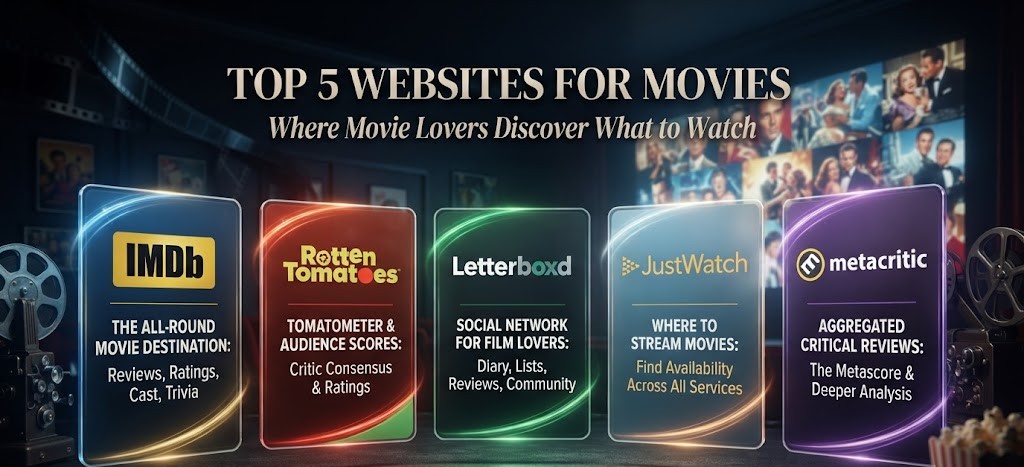
Top 5 Websites for Movies: Where Movie Lovers Go to Discover, Watch and Explore
Movies have become easier to access than ever, but that does not necessarily make choosing what to watch easier. With thousands of films spread across streaming platforms, digital stores, television services and rental libraries, finding the right movie can sometimes take more time than actually watching it. A good movie website can solve that problem by bringing discovery, ratings, reviews, cast information and viewing options into one place.
The best movie websites are not simply online databases. They have developed into destinations for people who want to know what is worth watching, understand a film before pressing play, discover something unexpected or keep track of the movies they have already seen. Some are built around professional reviews, while others rely heavily on audience ratings and community discussion. Others are particularly useful for finding where a movie is available to stream.
For international movie audiences, five platforms consistently stand out for their usefulness and distinctive approach: IMDb, Rotten Tomatoes, Letterboxd, JustWatch and Metacritic. Each serves a slightly different purpose, which means the best choice depends on what you want from your movie search.
IMDb remains one of the most recognizable names in online movie discovery. Its strength is breadth. Whether you are looking for information about a major Hollywood release, an independent film, an older classic or an international production, IMDb generally provides a substantial amount of information in one place.
The platform goes far beyond basic movie ratings. Users can explore cast and crew details, release information, genres, trailers, photographs, user reviews, trivia and related titles. Its large database also makes it particularly useful when a movie has caught your attention but you cannot remember the actor, director or exact title.
IMDb’s rating system is another reason it remains popular. Millions of users contribute ratings, creating an audience-driven score that can provide a quick indication of how a movie has been received. Of course, a rating should not be treated as an absolute measure of quality. Personal taste varies considerably, and highly rated movies can still leave some viewers cold. Nevertheless, IMDb is useful as a starting point before deciding what to watch.
Another advantage is its connection to the wider entertainment industry. The platform covers television series, actors, filmmakers and upcoming projects alongside movies. For someone who wants more than a simple watchlist, IMDb can function almost like a digital encyclopedia for entertainment.
Best for: Movie information, cast research, audience ratings, film discovery and entertainment databases.
Rotten Tomatoes approaches movies from a different angle. Rather than simply presenting one overall rating, the platform is famous for separating professional critics from audience reactions.
Its recognizable Tomatometer has become part of modern movie culture. A high percentage indicates that a large proportion of professional reviews are positive, while the audience score gives viewers another perspective. This distinction is useful because critics and general audiences do not always agree.
A movie can receive strong reviews from critics but divide audiences, or it can become a crowd favorite despite receiving a less enthusiastic critical response. Looking at both scores can therefore tell you more than relying on one number alone.
Rotten Tomatoes is particularly useful when deciding whether a newly released movie deserves your time. Instead of reading dozens of individual reviews, viewers can quickly understand the overall critical conversation surrounding a title. The platform also provides reviews, trailers, movie details and information about upcoming releases.
However, the percentage should be interpreted carefully. A high Tomatometer does not necessarily mean that every critic gave the film a perfect score. It reflects the proportion of positive reviews. That distinction is important when comparing movies.
For casual viewers, the platform works best as a fast decision-making tool. You can search for a movie, compare its critic and audience reception, and then decide whether to investigate further.
Best for: Critics’ opinions, audience reactions, new releases and quick movie comparisons.
Letterboxd has built a particularly strong identity among people who treat movies as more than passive entertainment. Rather than functioning primarily as a database, Letterboxd combines film discovery with social interaction and personal tracking.
Users can keep a diary of the movies they watch, create watchlists, rate films and write reviews. They can also follow other movie lovers and discover films through their activity. This gives the platform a more personal and conversational character than traditional movie databases.
One of Letterboxd’s biggest strengths is discovery. Sometimes the best recommendation does not come from a professional critic or an algorithm suggesting a blockbuster. It comes from seeing someone with similar taste rave about an obscure thriller, foreign-language drama or forgotten comedy.
The platform has also become known for its short, witty and highly personal reviews. Some users write serious film criticism, while others turn a movie reaction into a humorous one-line observation. That mixture has helped Letterboxd develop a distinct internet culture around cinema.
Its lists are equally valuable. Users can create collections around almost any theme, from essential films by a particular director to the best psychological thrillers or movies set in specific countries. For people trying to move beyond mainstream releases, these lists can become a surprisingly effective source of inspiration.
Letterboxd is therefore less about asking, “What movie has the highest score?” and more about asking, “What are people who love movies actually watching?”
Best for: Film enthusiasts, personal watchlists, reviews, movie communities and discovering less obvious films.
JustWatch solves a very practical problem: Where can I actually watch this movie?
Finding a movie is one thing. Finding it on a streaming service you already subscribe to is another. JustWatch is designed around that gap. The platform helps users search across streaming services and identify where a particular movie or television show is available.
This makes it especially useful in today’s fragmented streaming market. A film may be available on one service in the United States, another service in the United Kingdom and a completely different platform in another country. Availability can also change over time as licensing agreements expire and titles move between services.
Instead of checking multiple platforms individually, users can search for a movie and compare its availability. Depending on the market and title, the results can include subscription streaming, rental, purchase and other viewing options.
The platform is also useful for discovering what has recently arrived on streaming services. If you are looking for something new to watch rather than a specific movie, browsing streaming catalogs through a single interface can save considerable time.
For international audiences, this is particularly valuable because streaming libraries differ significantly between countries. The same title may be easy to find in one region and surprisingly difficult to locate in another.
JustWatch does not necessarily replace movie-review platforms. Its real strength is what happens after you decide what you want to watch: it helps you figure out where to find it.
Best for: Streaming availability, rental options, digital purchases and comparing streaming platforms.
Metacritic is another major review-aggregation platform, but its scoring approach gives it a somewhat different identity from Rotten Tomatoes.
Metacritic collects professional reviews and converts them into a weighted Metascore. This provides viewers with a consolidated picture of critical opinion rather than requiring them to read every publication individually.
The platform is particularly useful for people who want a more nuanced view of critical reception. A movie’s Metascore is accompanied by individual reviews and commentary from different publications, allowing users to investigate why critics responded positively or negatively.
Metacritic also covers much more than movies. Its database includes television, music and video games, making it useful for people who follow entertainment across multiple formats.
One interesting feature of Metacritic is the ability to compare critical response with user opinions. When the professional score and user score are dramatically different, that gap can itself become useful information. It may indicate that a movie appeals strongly to a particular audience even though critics were less impressed, or that expectations among viewers were higher than the professional reviews suggested.
For someone who likes to understand the wider critical conversation before watching a film, Metacritic provides more context than simply looking at a single star rating.
Best for: Professional reviews, aggregated scores, critical comparisons and broader entertainment coverage.
Which Movie Website Should You Use?
There is no single winner because these websites are designed around different movie-watching habits.
If you want one comprehensive movie database, IMDb is probably the most practical starting point. Its combination of ratings, cast information, trivia and entertainment coverage makes it useful for almost any type of movie research.
If your main concern is what critics and audiences think, Rotten Tomatoes is a natural choice. Its two-score approach makes it easy to spot movies that are broadly loved, critically divisive or unexpectedly popular with audiences.
For people who genuinely enjoy talking about cinema, Letterboxd offers something different. Its social element, personal diaries and user-created lists make discovering movies feel much more personal.
If your biggest question is where to watch, JustWatch is arguably the most useful of the five. It addresses the practical side of streaming in an industry where content is spread across an ever-growing number of services.
And if you want to understand professional critical opinion in greater depth, Metacritic provides a useful aggregate score alongside individual reviews.
Why Movie Websites Still Matter in the Streaming Era
Streaming platforms have transformed the way people watch movies, but they have also created a new problem: choice overload.
Netflix, Prime Video, Disney+, Max, Apple TV and other services all have extensive libraries, yet their recommendations are usually designed around what keeps you engaged on that particular platform. A movie website can provide a broader perspective.
That independence is important. Instead of asking one streaming service what you should watch, you can compare audience ratings, professional reviews, personal recommendations and availability across different sources.
Movie websites also help preserve context around films. A streaming thumbnail might tell you the title, genre and perhaps a few actors. A dedicated movie platform can tell you who directed it, how critics responded, what audiences thought, what else those actors have appeared in and where the movie can currently be watched.
For serious movie fans, that information can turn a random evening of scrolling into genuine film discovery.
The Bottom Line
The best movie website depends on what you want from your movie experience. IMDb is the strongest all-purpose option, Rotten Tomatoes is ideal for comparing critics and audiences, Letterboxd is built for film communities and personal discovery, JustWatch is excellent for finding streaming availability, and Metacritic offers a broader view of professional reviews.
You do not necessarily have to choose only one. In fact, using them together can be more useful. You might discover a movie on Letterboxd, check its IMDb details, compare its Rotten Tomatoes and Metacritic reception, and finally use JustWatch to find where it is available.
That combination gives you something a single streaming platform cannot: discovery, context, opinion and access in one movie-search journey.

Software Developer & Writer
Hey, I'm Diva, a developer and writer blending code and creativity. I'm driven by a deep curiosity and a relentless pursuit of excellence. Join me as I craft digital solutions and captivating stories.


Leave A Comment