
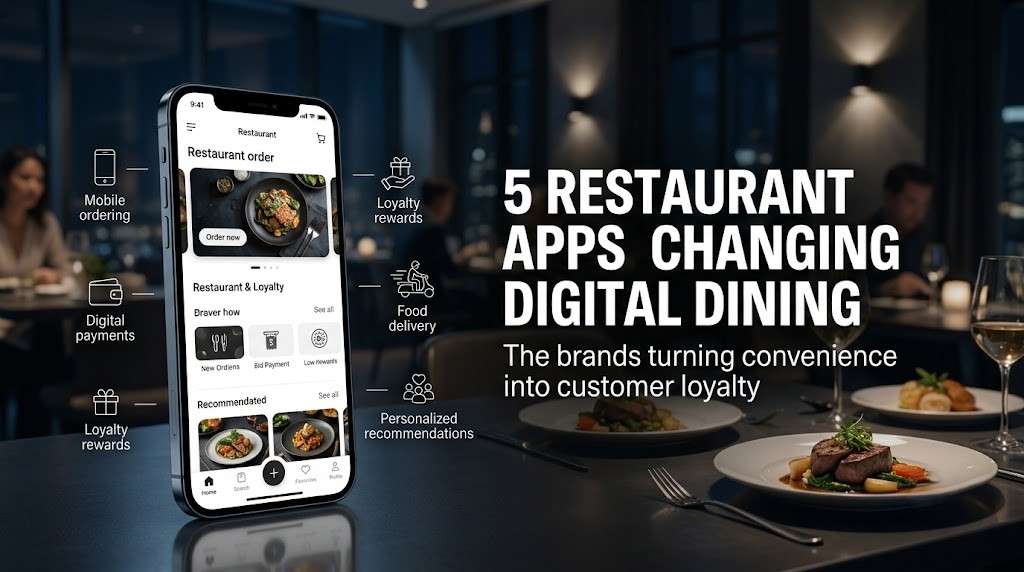
The 5 Restaurant Brands Turning Their Apps Into Digital Dining Powerhouses
What if the smartest restaurant in the room isn’t the one with the longest menu, the trendiest interiors, or even the most talked-about food—but the one with the best app?
That question is becoming increasingly relevant as the restaurant industry moves beyond simply serving food. Today, the strongest restaurant brands are building digital ecosystems around the meal itself. The app is no longer just a place to browse a menu or place an order. It can remember what you like, predict when you might order, reward you for coming back, remove friction from payment, and quietly turn a one-time customer into a regular.
For consumers, this can feel almost invisible. You open an app, see an offer that actually interests you, reorder your usual meal in seconds, collect rewards without thinking about them, and pay without reaching for your wallet. For the brand, however, every one of those moments is part of a carefully designed customer journey.
That is what makes restaurant technology so interesting. The competition is no longer happening only in kitchens and dining rooms. It is happening inside smartphones, loyalty programs, personalized recommendations, mobile ordering systems, and digital payment experiences.
Here are five restaurant brands that understand that shift particularly well—and have turned their apps into powerful engines for customer engagement, retention, and growth.
Starbucks is one of the clearest examples of how a restaurant app can become much more than a digital menu.
The genius of the Starbucks app is not simply that customers can order coffee ahead of time. It is the way ordering, payments, loyalty, personalization, and rewards are connected into one continuous experience. A customer can discover an offer, place an order, earn rewards, pay digitally, and return later with a reason to engage again.
That creates something more valuable than convenience: habit.
Imagine a customer opening the app on a Monday morning. Their preferred drink is already familiar. Their payment information is saved. Their rewards progress is visible. Ordering requires very little thought. The entire experience is designed to remove small moments of friction that might otherwise interrupt the purchase.
This is where restaurant loyalty programs become particularly powerful. Instead of asking customers to consciously decide whether they want to remain loyal, Starbucks builds loyalty into the process of buying coffee.
The broader lesson for restaurant brands is significant. A successful loyalty app should not feel like a digital punch card. It should make the next purchase easier, more relevant, and slightly more rewarding than the last one.
Starbucks effectively turned its app into part ordering platform, part payment wallet, and part behavioral engine—making digital convenience an important part of the brand experience.
McDonald’s has one of the biggest restaurant footprints in the world, but its digital strategy shows that scale alone is not enough anymore.
The McDonald’s app has increasingly become a gateway to personalized offers, mobile ordering, rewards, delivery, and digital engagement. Instead of simply competing on the price of a meal, the brand can use its digital ecosystem to give customers a reason to open the app in the first place.
And that matters.
Think about the difference between a customer deciding, “I want McDonald’s,” and a customer receiving an app offer that makes McDonald’s suddenly more attractive. The second experience changes the decision-making process before the customer even reaches the restaurant.
Digital promotions can create urgency. Rewards can encourage repeat visits. Mobile ordering can reduce waiting. Saved preferences can make future purchases easier. Each feature may look relatively simple on its own, but together they create a highly connected customer journey.
This is one of the most important developments in restaurant marketing: apps are increasingly becoming demand-generation tools rather than passive ordering channels.
McDonald’s demonstrates how a global fast-food brand can use digital technology to make an enormous physical network feel more personalized. The restaurant may be standardized across thousands of locations, but the customer’s digital experience can still feel increasingly individual.
The result is a powerful combination: global scale with personalized digital engagement.
If there is one restaurant category where convenience can directly influence the purchase decision, it is pizza delivery.
Domino’s understood this early.
Instead of treating technology as something separate from the food business, Domino’s built digital ordering into the core of its customer experience. The goal was simple: make getting a pizza feel almost effortless.
Over time, digital ordering, order tracking, saved preferences, promotions, delivery updates, and multiple ordering channels helped transform the experience from “call a pizza restaurant” into a streamlined digital transaction.
That distinction matters because convenience is not merely a technical feature. It can become a competitive advantage.
When a customer is hungry, they are rarely looking for a complicated purchasing journey. They want to choose, order, pay, and know when the food is arriving. Every unnecessary step creates an opportunity for them to abandon the purchase or choose another brand.
Domino’s has consistently leaned into this reality.
Its digital experience demonstrates an important principle of restaurant technology: sometimes the best customer experience is the one the customer barely notices. When the interface works well, ordering becomes almost automatic.
The food remains the product, but the technology determines how easily customers can reach it.
Chipotle offers another interesting example because its digital experience has to solve a slightly different problem.
Unlike a traditional fixed-menu restaurant, Chipotle’s ordering experience revolves around customization. Customers build meals according to their preferences, which means the digital experience needs to make personalization feel simple rather than overwhelming.
The app helps turn that complexity into a structured journey.
Customers can customize meals, save preferences, order ahead, collect rewards, and interact with the brand without needing to repeat the same decisions every time. That may sound like a small convenience, but repeated convenience is exactly what creates digital loyalty.
There is also a deeper marketing lesson here.
Personalization works best when it removes effort rather than simply adding more recommendations. Customers do not necessarily want technology to tell them everything they might like. Often, they simply want the brand to remember what they already like.
That distinction is increasingly important as restaurant brands compete for attention.
Chipotle’s digital strategy shows how personalization can work alongside operational efficiency. Mobile ordering can help customers move through the purchasing process while allowing the brand to maintain a consistent experience across digital and physical channels.
In other words, the app becomes a bridge between the customer’s preferences and the restaurant’s operations.
Panera Bread takes the idea of restaurant loyalty and pushes it toward a broader digital relationship.
Its app experience combines ordering, rewards, personalization, digital payments, and customer convenience in a way that encourages customers to interact with the brand beyond a single transaction.
That is the real opportunity behind restaurant apps.
A traditional restaurant transaction has a clear beginning and end: the customer arrives, orders, eats, pays, and leaves. A digital ecosystem can stretch that relationship across the entire customer journey.
The customer might see a personalized promotion in the morning, browse the menu during lunch, place a mobile order, earn rewards from the purchase, and receive another reason to return later. Suddenly, the relationship is no longer limited to the few minutes spent inside the restaurant.
For restaurant marketers, this changes the economics of customer retention.
Instead of constantly spending to acquire completely new customers, brands can use digital engagement to increase frequency among people who already know and trust them. The app becomes a retention mechanism, a communication channel, and a source of customer insight at the same time.
That is why the best restaurant apps are not really about apps.
They are about relationships.
The Real Competition Is Happening After the Customer Leaves
The most interesting thing about these restaurant brands is that none of them are relying on technology simply because it looks innovative.
Their strongest digital features solve real customer problems.
Starbucks makes repeat purchases feel habitual. McDonald’s uses digital offers to influence purchase behavior. Domino’s focuses relentlessly on convenience. Chipotle makes customization easier. Panera uses digital engagement to strengthen the relationship beyond a single meal.
Different strategies, but the same underlying idea: reduce friction while increasing reasons to return.
This is where restaurant apps become powerful growth engines.
A good app can collect behavioral signals, improve personalization, strengthen loyalty, increase ordering frequency, support promotions, and create a direct communication channel between the brand and customer. Instead of depending entirely on third-party delivery platforms, restaurant brands can build a direct digital relationship with their own audiences.
And that relationship is becoming increasingly valuable.
Why Restaurant Apps Are Becoming a Competitive Advantage
The future of restaurant technology is unlikely to be defined by one revolutionary feature. It will be defined by how well brands connect dozens of small digital experiences.
A fast checkout matters.
A relevant offer matters.
A remembered order matters.
A useful loyalty program matters.
A frictionless pickup experience matters.
But when these elements work together, they create something much bigger: a customer journey designed around convenience and repetition.
This is also why restaurant loyalty programs are evolving. The strongest programs are moving away from simply giving customers points and toward creating personalized ecosystems where rewards, offers, ordering, payments, and recommendations work together.
The winning restaurant may therefore not be the one with the most advanced technology.
It may simply be the one that uses technology to understand its customers better than everyone else.
Because in the next phase of digital dining, customers will not necessarily remember which restaurant had the most sophisticated app.
They will remember which one made ordering feel effortless.
And that could be the most important technology advantage of all.
The Takeaway
Restaurant technology is no longer sitting behind the scenes. It is becoming part of the brand itself.
The best restaurant apps are quietly changing consumer behavior by making ordering easier, loyalty more rewarding, payments faster, and experiences more personalized. Starbucks, McDonald’s, Domino’s, Chipotle, and Panera show five different approaches to the same opportunity: turn a transaction into an ongoing digital relationship.
The question for restaurant brands is no longer, “Do we need an app?”
The better question is:
“What reason are we giving customers to open it again tomorrow?”

Software Developer & Writer
Hey, I'm Diva, a developer and writer blending code and creativity. I'm driven by a deep curiosity and a relentless pursuit of excellence. Join me as I craft digital solutions and captivating stories.

Leave A Comment