
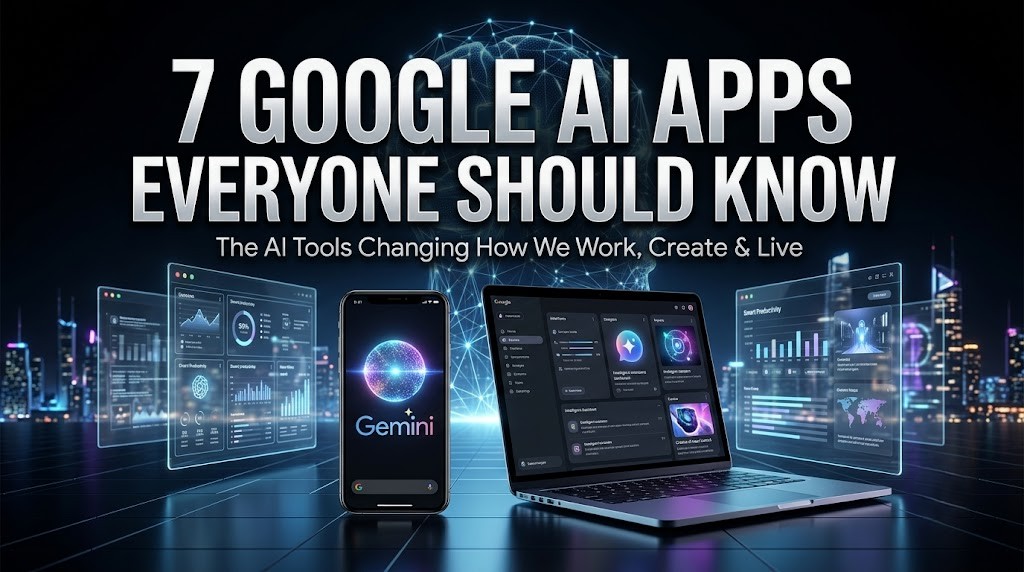
7 Google AI Apps Everyone Should Know: The Future of Smarter Digital Living
Artificial intelligence has moved beyond being a futuristic concept. Today, AI is quietly becoming part of our everyday routines helping us write better, organise our work, create stunning visuals, analyse information, and even learn new skills. Among the companies leading this transformation, Google has built one of the most powerful AI ecosystems in the world, combining advanced machine learning with its widely used digital services.
From professionals and entrepreneurs to students and creators, Google AI applications are changing the way people interact with technology. These tools are designed not just for automation but for enhancing creativity, productivity, and decision-making.
With Google’s latest AI advancements powered by models like Gemini, the company is competing at the highest level of artificial intelligence innovation alongside brands such as OpenAI, Microsoft, and Anthropic. Whether you are managing a business, creating content, designing campaigns, or simply looking for a smarter digital assistant, these Google AI apps are worth knowing.
Here are seven Google AI applications that represent the future of intelligent technology.
Google Gemini has become the centrepiece of Google’s AI ecosystem. Designed as an advanced AI assistant, Gemini helps users write, research, brainstorm ideas, analyse documents, generate images, and solve complex problems through natural conversations.
Unlike traditional search engines that simply provide links, Gemini focuses on understanding context and delivering personalised responses. Professionals can use it for creating business strategies, preparing presentations, summarising reports, and analysing data, while students can use it as a learning companion.
For content creators and marketers, Gemini offers opportunities to speed up creative workflows. A social media manager can use it to generate campaign ideas, create content calendars, analyse audience trends, and develop brand storytelling concepts.
Google has also integrated Gemini into premium experiences through Google Gemini Advanced, giving users access to more powerful AI capabilities. This positions Google directly against premium AI platforms like OpenAI ChatGPT Plus and Microsoft Copilot.
For modern professionals, Gemini is becoming less like a simple chatbot and more like a personal digital strategist.
Research is one of the most time-consuming activities in the digital world. Google’s NotebookLM introduces a completely different approach by allowing users to upload their own documents and interact with them using AI.
Instead of searching across the internet, NotebookLM focuses on understanding your personal sources. Users can upload PDFs, research papers, meeting notes, business documents, and reports, then ask questions based on that information.
This makes it extremely valuable for researchers, analysts, entrepreneurs, and students who regularly work with large amounts of information.
Imagine a marketing professional analysing a 100-page consumer behaviour report. Instead of manually reading every section, NotebookLM can help identify key insights, summarise important findings, and generate strategic recommendations.
For businesses, this technology represents the next generation of knowledge management. Companies can transform internal documents into intelligent databases where employees can quickly access information.
NotebookLM reflects a broader AI trend where technology is moving from simple information retrieval toward personalised intelligence.
Behind every successful AI application is experimentation and innovation. Google AI Studio provides developers, startups, and technology enthusiasts with a platform to explore Google’s advanced AI models.
Built around Gemini models, Google AI Studio allows users to test prompts, build AI-powered applications, and experiment with generative AI technology.
For startups, this opens opportunities to create innovative products without developing artificial intelligence systems from scratch. Businesses can build AI assistants, automated customer support systems, personalised recommendation engines, and intelligent productivity tools.
Companies across industries from e-commerce and healthcare to finance and education are exploring AI solutions to improve customer experiences.
The rise of platforms like Google AI Studio shows how AI development is becoming more accessible. Advanced technology that once required huge research teams is now available to individual creators and smaller companies.
Google Photos has evolved far beyond a simple photo storage application. With AI-powered features, it has become an intelligent memory management platform.
Using artificial intelligence, Google Photos can automatically organise images, recognise people and locations, enhance photo quality, remove unwanted objects, and create personalised memories.
Features like AI editing tools allow users to transform ordinary photographs into professional-looking images. The technology behind these features demonstrates how AI is becoming integrated into everyday consumer experiences.
Premium smartphone brands such as Google Pixel have heavily promoted AI photography capabilities, competing with luxury smartphone makers like Apple and Samsung Electronics.
For travel creators, photographers, and social media users, AI-powered editing has changed the creative process. Professional-level image enhancement is no longer limited to expensive software; it is available directly from a smartphone.
The future of photography is not just about capturing moments but intelligently improving them.
Language has always been one of the biggest challenges in global communication. Google Translate, powered by advanced AI and machine learning, has transformed how people connect across cultures.
The application now supports real-time translation, image translation, voice conversations, and increasingly accurate language understanding.
For international businesses, this technology creates new opportunities. A global e-commerce brand can communicate with customers from different countries more effectively. Travellers can explore new destinations without worrying about language barriers.
Luxury travel companies, international retailers, and global brands are increasingly using AI translation technologies to create personalised customer experiences.
As businesses expand globally, AI-powered language tools will become essential for creating seamless international communication.
The workplace is undergoing one of the biggest transformations in history. Google has integrated AI into its productivity ecosystem through Gemini for Workspace, bringing artificial intelligence into tools like Gmail, Docs, Sheets, and Meet.
Professionals can use AI to draft emails, summarise conversations, create reports, analyse spreadsheets, and generate presentations.
For executives and business teams, this means less time spent on repetitive administrative work and more time focused on strategy and creativity.
Marketing teams can generate campaign ideas, finance teams can analyse reports faster, and managers can summarise meetings automatically.
Competitors such as Microsoft Copilot are following a similar path, showing that AI-powered workplaces are becoming the new standard.
The future office will not replace human creativity but will amplify human capabilities through intelligent collaboration.
Before Gemini became Google’s flagship AI assistant, Google introduced Bard as its experimental conversational AI platform.
Although Bard has now evolved into Gemini, its development marked an important milestone in Google’s AI journey. It represented the company’s move from traditional search-based experiences toward conversational artificial intelligence.
This transition reflects a major shift in the technology industry. Users are no longer only searching for information; they are interacting with AI systems that understand intent, context, and personal preferences.
The evolution from Bard to Gemini shows Google’s ambition to create AI experiences across every part of digital life.
From smartphones and search to productivity tools and creative platforms, Google is building an interconnected AI ecosystem.
The Future of Google AI: More Personal, More Intelligent, More Powerful
Artificial intelligence is entering a new phase where technology is becoming increasingly personalised. Instead of using separate applications for different tasks, users will interact with intelligent systems that understand their needs and preferences.
Google’s AI ecosystem represents this future. Whether through Gemini assisting with daily tasks, NotebookLM improving research, or AI-powered photography enhancing creativity, these applications demonstrate how artificial intelligence is becoming an everyday companion.
For businesses, creators, and professionals, learning how to use these tools is no longer optional. AI literacy is becoming one of the most valuable digital skills in the modern economy.
The competition between Google, OpenAI, Microsoft, and other technology leaders will continue to accelerate innovation. But the biggest winners will be users who understand how to combine human creativity with artificial intelligence.
The future of technology is not simply about smarter machines. It is about creating smarter experiences that help people achieve more.

Software Developer & Writer
Hey, I'm Diva, a developer and writer blending code and creativity. I'm driven by a deep curiosity and a relentless pursuit of excellence. Join me as I craft digital solutions and captivating stories.

Leave A Comment