
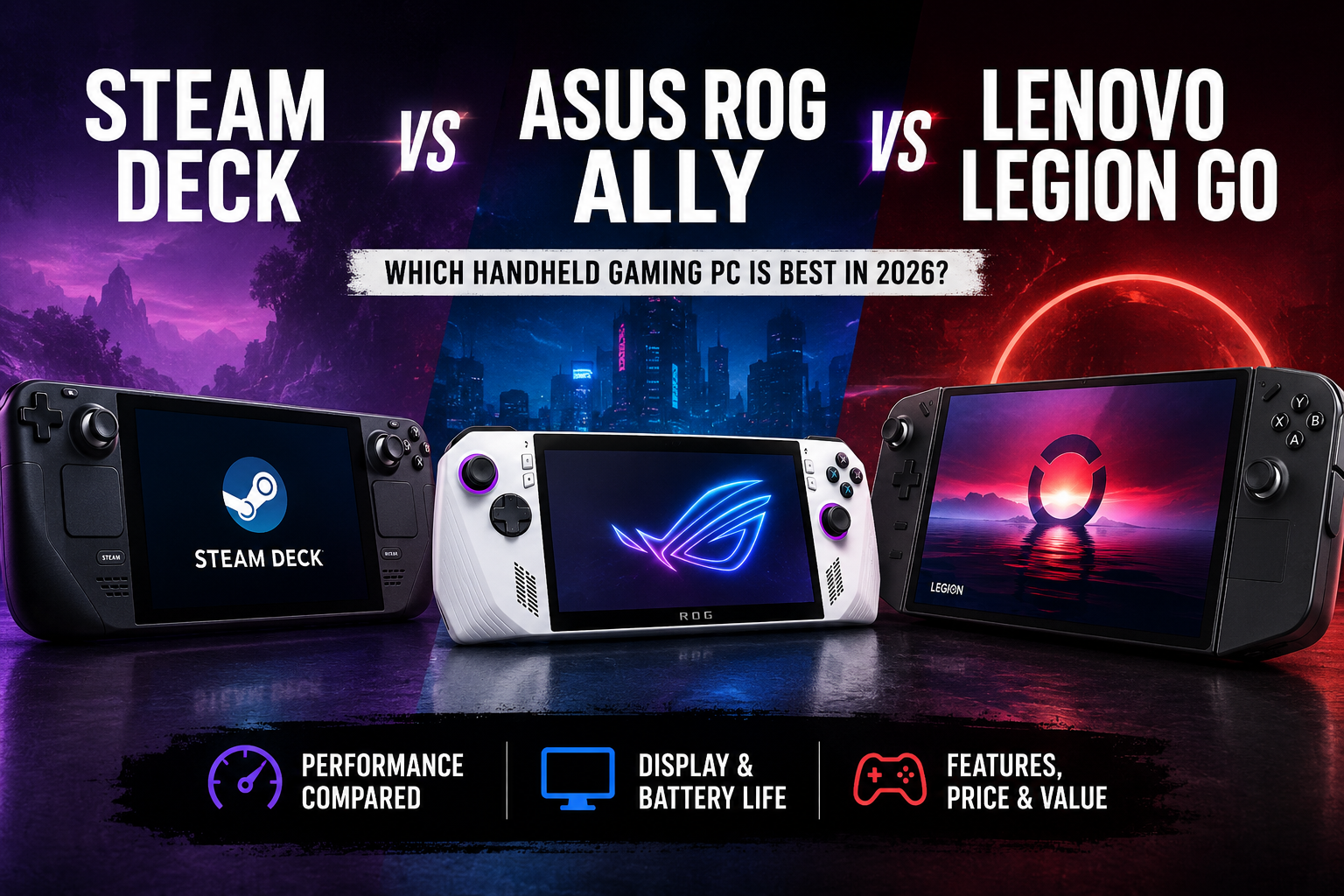
Steam Deck vs ASUS ROG Ally vs Lenovo Legion Go: Which Handheld Gaming PC Is Worth Buying in 2026?
The handheld gaming market has evolved dramatically over the last few years, giving gamers more freedom than ever to enjoy AAA titles away from a traditional gaming setup. What was once a niche category has become one of the fastest-growing segments in gaming, thanks to powerful portable devices that deliver PC-quality performance in a compact form factor. Three names dominate this space today: the Steam Deck, the ASUS ROG Ally, and the Lenovo Legion Go.
Each device approaches portable gaming differently. Valve focuses on delivering a seamless Steam experience with Linux-based optimization, ASUS aims for raw Windows gaming performance with premium hardware, while Lenovo combines powerful specifications with innovative features like detachable controllers and an oversized display. Choosing between them is no longer a simple matter of comparing specifications it depends on how and where you play, the games you enjoy, and the overall experience you expect.
If you’re wondering which handheld gaming PC deserves your money in 2026, this detailed comparison explores performance, design, display, battery life, software, pricing, and overall value to help you make the right decision.
The Rise of Handheld Gaming PCs
Portable gaming has come a long way from dedicated handheld consoles. Modern handheld gaming PCs can run demanding titles like Cyberpunk 2077, Elden Ring, Forza Horizon 5, Red Dead Redemption 2, and Baldur’s Gate 3 while giving players access to extensive PC game libraries.
The growing popularity of cloud gaming, faster SSD storage, AMD’s efficient processors, and improved battery technologies has allowed manufacturers to build devices that balance portability with desktop-level capabilities. Whether you’re traveling, commuting, or simply relaxing on the couch, these handheld PCs offer flexibility that traditional gaming systems cannot match.
Steam Deck: The Best Value for Steam Gamers
Valve’s Steam Deck changed the gaming landscape by making PC gaming truly portable. Instead of chasing the highest benchmark scores, Valve designed a device that prioritizes affordability, software optimization, and ease of use.
Powered by a custom AMD APU, the Steam Deck comfortably handles thousands of games available on Steam. Valve’s SteamOS is specifically optimized for gaming, resulting in smooth navigation, fast game launching, and minimal background processes that often consume resources on Windows.
One of the Steam Deck’s greatest strengths is its Verified Program, which clearly identifies games that work perfectly on the handheld. This removes much of the guesswork often associated with PC gaming.
The device also features responsive thumbsticks, trackpads, customizable controls, and excellent ergonomics that make long gaming sessions comfortable. These additions are particularly useful for strategy games, simulation titles, and older PC games originally designed for mouse and keyboard.
Although its hardware isn’t the most powerful among modern handhelds, the Steam Deck consistently delivers impressive real-world gaming performance because its operating system is optimized specifically for the hardware.
ASUS ROG Ally: Built for Maximum Performance
The ASUS ROG Ally targets gamers who want desktop-class performance in a portable package. Running full Windows, the Ally supports nearly every major gaming platform, including Steam, Xbox Game Pass, Epic Games Store, EA App, Ubisoft Connect, Battle.net, and GOG.
This flexibility makes it one of the most versatile handheld gaming PCs currently available.
Powered by AMD’s Ryzen Z1 Extreme processor in its premium configuration, the ROG Ally offers impressive frame rates in modern AAA games. Titles that require additional graphical horsepower often perform better on the Ally than on competing handhelds, particularly when connected to external power.
Its Full HD display with a 120Hz refresh rate is another standout feature. Fast-paced shooters, racing games, and competitive multiplayer titles benefit greatly from smoother animations and reduced motion blur.
Windows compatibility also means users can install productivity software, emulators, media applications, and virtually any PC program. However, this flexibility comes with trade-offs. Windows is not specifically designed for handheld devices, and navigating updates, drivers, and background applications can occasionally interrupt the gaming experience.
Lenovo Legion Go: The Most Innovative Handheld
Lenovo entered the handheld gaming market with an ambitious approach. Rather than simply matching existing competitors, the Legion Go introduced features that significantly differentiate it from both the Steam Deck and ROG Ally.
Its massive 8.8-inch QHD+ display is one of the largest available on any gaming handheld. The larger screen provides greater immersion while improving readability in strategy games, RPGs, and productivity applications.
Perhaps its most unique feature is the detachable controller system, drawing inspiration from hybrid gaming consoles while maintaining full PC functionality. The right controller can even transform into an FPS mouse mode, providing greater precision in shooter games.
Powered by AMD’s Ryzen Z1 Extreme processor, the Legion Go offers performance comparable to the ROG Ally while adding extra versatility through its flexible hardware design.
Its integrated kickstand also allows tabletop gaming without additional accessories, making it particularly appealing for travelers or players who enjoy multiplayer gaming on the go.
Performance Comparison
Performance remains one of the biggest deciding factors for any gaming handheld.
The Steam Deck delivers reliable frame rates across thousands of Steam titles thanks to aggressive software optimization. Although it cannot match newer processors in raw benchmarks, many games still perform surprisingly well because SteamOS minimizes unnecessary resource usage.
The ASUS ROG Ally takes the lead in raw gaming power. Modern AAA games often achieve higher frame rates, especially at lower graphical settings where the Ryzen Z1 Extreme processor truly shines. Games such as Forza Horizon 5, Resident Evil 4 Remake, and Cyberpunk 2077 generally perform better on the Ally than on the Steam Deck.
The Lenovo Legion Go closely matches the Ally in computational power, as both devices share similar AMD architecture. Differences mainly come down to thermal management and software optimization rather than hardware capability.
For gamers focused purely on performance, the ROG Ally and Legion Go hold a noticeable advantage over the Steam Deck.
Display Quality
Display quality plays an important role in the overall gaming experience.
The Steam Deck features a capable display that prioritizes battery efficiency and affordability. While colors are respectable, it lacks the high refresh rate and sharper resolution found on premium competitors.
The ASUS ROG Ally’s Full HD 120Hz display offers excellent brightness, vibrant colors, and exceptionally smooth gameplay. Fast-moving games feel noticeably more responsive, making it one of the best screens in the handheld gaming market.
The Lenovo Legion Go arguably offers the most immersive viewing experience thanks to its large 8.8-inch QHD+ display. The higher resolution produces sharper visuals, making open-world games, RPGs, and strategy titles particularly enjoyable.
Battery Life
Battery life continues to be one of the biggest challenges for handheld gaming PCs.
The Steam Deck generally delivers the most balanced battery performance because SteamOS efficiently manages power consumption. Indie games and less demanding titles can often provide several hours of uninterrupted gameplay.
The ASUS ROG Ally offers impressive performance but consumes more power during demanding games. High-performance settings reduce battery life considerably, making access to a charger beneficial for longer gaming sessions.
The Lenovo Legion Go faces similar challenges. Its larger display naturally requires additional power, although users can adjust refresh rates and performance settings to improve endurance.
In real-world usage, battery life largely depends on the type of games being played rather than the handheld itself.
Software Experience
Software can make or break a handheld gaming experience.
SteamOS remains one of Valve’s greatest achievements. Its gaming-focused interface feels intuitive, quick, and polished. Updates are frequent, game compatibility continues to improve, and the overall experience resembles a dedicated gaming console rather than a traditional PC.
The ASUS ROG Ally and Lenovo Legion Go both rely on Windows, offering unmatched software compatibility. Every major PC gaming launcher works without modification, and users gain access to productivity applications, streaming software, and emulation tools.
However, Windows occasionally introduces frustrations such as system updates, notifications, background tasks, and interface scaling issues that are less common on SteamOS.
Design and Comfort
Comfort becomes increasingly important during extended gaming sessions.
The Steam Deck features deep grips and balanced weight distribution, making it surprisingly comfortable despite its larger body.
The ASUS ROG Ally is lighter and easier to carry, making it an excellent companion for travelers and commuters who prioritize portability.
The Lenovo Legion Go is the largest of the three. While its detachable controllers and kickstand improve versatility, its size may not suit users seeking maximum portability.
Pricing and Overall Value
Price plays a significant role in determining overall value.
The Steam Deck remains the most affordable option while still offering an outstanding gaming experience. For players primarily invested in Steam’s ecosystem, it represents one of the best values in gaming hardware.
The ASUS ROG Ally commands a higher price but rewards buyers with significantly stronger hardware, a premium display, and broader compatibility through Windows.
The Lenovo Legion Go typically sits in the premium segment, justifying its price with innovative hardware features, a larger display, and flexible gameplay options.
Which Handheld Gaming PC Should You Buy?
Choosing between these three excellent devices depends entirely on your gaming priorities.
If you want the best balance of price, software optimization, and ease of use, the Steam Deck remains an outstanding choice. Its console-like interface, excellent ergonomics, and deep Steam integration make it ideal for players who value simplicity and reliability.
If your goal is maximum gaming performance and unrestricted access to every major PC gaming platform, the ASUS ROG Ally stands out as the most powerful and versatile option. It is especially attractive for competitive gamers and Xbox Game Pass subscribers.
If you value innovation, a larger display, detachable controllers, and a unique hybrid experience, the Lenovo Legion Go offers features unavailable on any competing handheld. It combines strong performance with exceptional versatility, making it a compelling choice for gamers who enjoy experimenting with different play styles.
Final Verdict
The competition between the Steam Deck, ASUS ROG Ally, and Lenovo Legion Go highlights how far portable PC gaming has progressed. Rather than one device dominating every category, each excels in different areas. The Steam Deck delivers unmatched value and an exceptional software experience, the ASUS ROG Ally leads in raw gaming performance and Windows compatibility, while the Lenovo Legion Go pushes innovation with its expansive display and detachable controllers.
Ultimately, the best handheld gaming PC is the one that aligns with your gaming habits. Casual Steam users will appreciate the Steam Deck’s streamlined approach, performance enthusiasts will gravitate toward the ROG Ally, and players seeking versatility and immersive hardware will find the Legion Go difficult to overlook. Regardless of your choice, today’s handheld gaming PCs prove that high-quality PC gaming is no longer confined to a desk—it can travel wherever you do.

Software Developer & Writer
Hey, I'm Diva, a developer and writer blending code and creativity. I'm driven by a deep curiosity and a relentless pursuit of excellence. Join me as I craft digital solutions and captivating stories.



Leave A Comment