
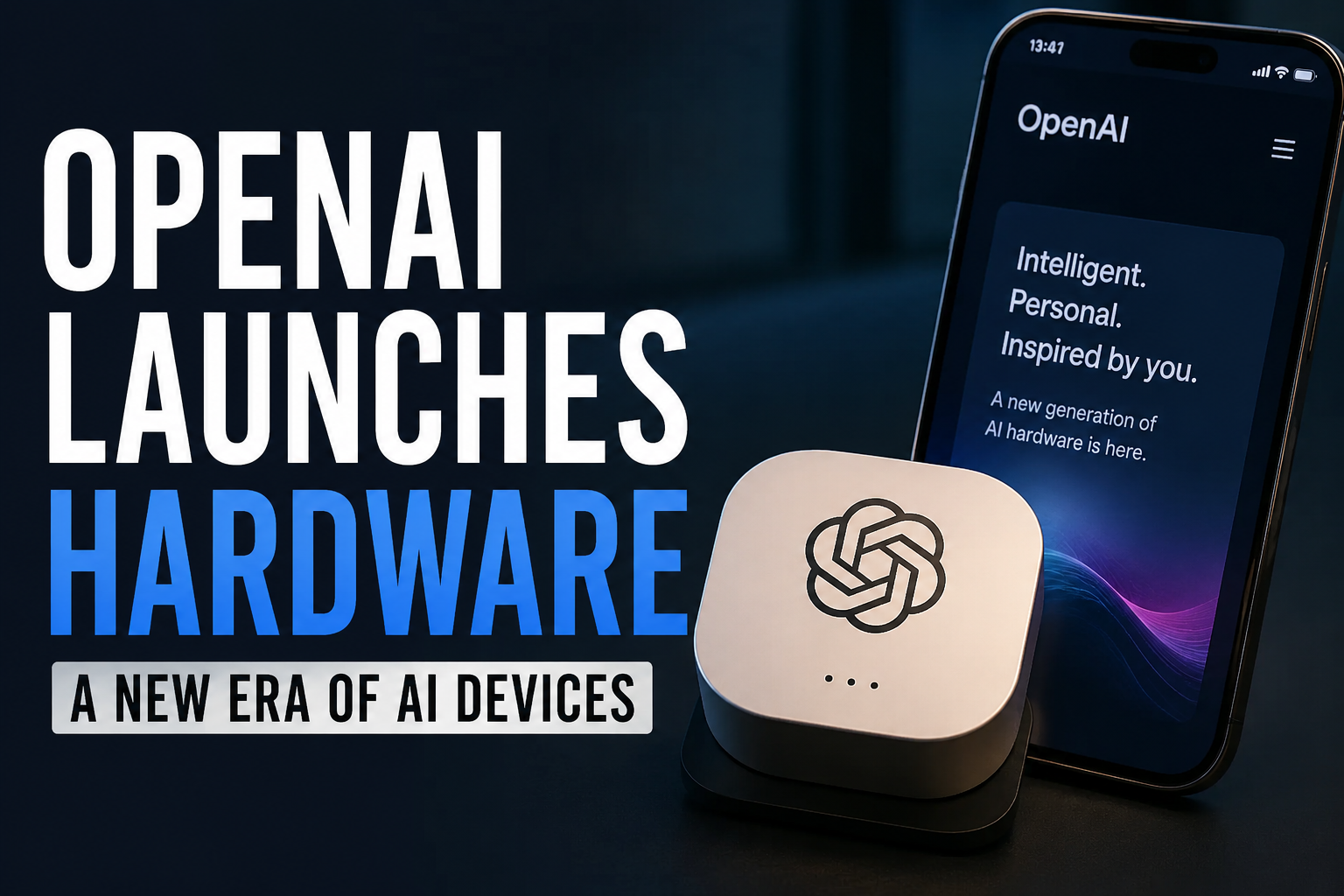
OpenAI’s Hardware Revolution: A New Era Beyond ChatGPT
OpenAI has already transformed the way people interact with artificial intelligence through ChatGPT, image generation, and advanced reasoning models. Now, the company is preparing for its biggest leap yet—moving beyond software into hardware. While OpenAI has become synonymous with cutting-edge AI, its latest vision suggests that the future of artificial intelligence will not be limited to apps, websites, or smartphones. Instead, AI could soon exist in dedicated devices built specifically for natural, intelligent interactions.
The announcement of OpenAI’s partnership with legendary designer Jony Ive marked one of the most significant developments in the technology industry. Rather than creating another smartphone or wearable, OpenAI aims to rethink how humans interact with computers altogether. This ambitious move has sparked discussions across the tech world, with many experts comparing it to Apple’s revolutionary introduction of the iPhone.
As artificial intelligence becomes increasingly integrated into daily life, purpose-built hardware may represent the next major evolution. Here’s everything currently known about OpenAI’s hardware ambitions and why they matter.
Why OpenAI Is Entering the Hardware Market
For years, artificial intelligence has depended on existing devices such as smartphones, laptops, and tablets. Although these platforms provide immense computing power, they were never designed with AI as their primary function. Most interactions still rely on typing, tapping, and navigating traditional interfaces.
OpenAI believes AI deserves a new category of hardware that places conversation, context, and intelligence at its core. Instead of opening multiple applications to complete tasks, future AI devices may understand user intent instantly, execute complex requests, and communicate naturally throughout the day.
This approach represents a shift away from screen-focused computing toward AI-first experiences. Rather than asking users to adapt to technology, OpenAI wants technology to adapt to human behavior.
The company’s long-term vision aligns with the broader industry trend of ambient computing, where artificial intelligence quietly assists users without demanding constant attention.
The Partnership with Jony Ive
One of the biggest reasons OpenAI’s hardware project generated global attention is the involvement of Sir Jony Ive, the designer responsible for some of Apple’s most iconic products.
Jony Ive played a central role in designing the iPhone, iMac, iPod, Apple Watch, and MacBook. His minimalist design philosophy helped define modern consumer electronics for more than two decades.
In 2025, OpenAI announced that it would acquire Ive’s AI hardware startup, io, in a deal valued at approximately $6.5 billion. The acquisition brought together a team of world-class designers, engineers, and product specialists dedicated to building a new generation of AI devices.
Sam Altman and Jony Ive have described their collaboration as an opportunity to create products that feel fundamentally different from today’s computers. Rather than simply adding AI features to existing hardware, they intend to design devices around artificial intelligence from the ground up.
What Kind of Hardware Is OpenAI Building?
OpenAI has intentionally remained secretive about its first hardware product. However, several clues shared by executives and industry analysts provide insight into what users might expect.
Instead of launching another smartphone, OpenAI appears to be developing an entirely new product category. Reports suggest the device may emphasize natural conversation, voice interaction, contextual awareness, and intelligent assistance rather than traditional touchscreens.
The goal is not to replace smartphones overnight but to create a companion device that reduces dependence on conventional apps and interfaces.
Possible capabilities could include:
Although none of these features have been officially confirmed, they align closely with OpenAI’s broader AI roadmap.
Why Existing AI Gadgets Have Struggled
The AI hardware market is still in its infancy. Several companies have already attempted to introduce AI-first devices, but most have struggled to achieve mainstream success.
Products like the Humane AI Pin and Rabbit R1 generated significant excitement before launch. However, many reviewers criticized their limited functionality, slow performance, and reliance on cloud connectivity.
These products highlighted an important lesson: consumers do not want AI hardware simply because it contains artificial intelligence. The device must solve real problems better than existing smartphones.
OpenAI appears determined to learn from these shortcomings. Instead of rushing to market, the company is investing heavily in research, product design, and user experience before releasing its first consumer hardware.
How OpenAI Hardware Could Change Everyday Life
If OpenAI succeeds, AI hardware could fundamentally change how people interact with technology.
Imagine waking up and speaking naturally to your AI assistant without unlocking a phone. The device already understands your calendar, traffic conditions, unread emails, weather forecast, and daily priorities.
Rather than asking separate questions, you could simply say:
“Help me prepare for today’s meetings.”
The AI could summarize documents, schedule transportation, recommend presentation updates, and even remind you about follow-up emails—all within a single conversation.
Students might use AI devices for tutoring and research assistance. Professionals could automate repetitive work. Travelers could receive instant translation and navigation support without switching between apps.
This represents a more proactive form of artificial intelligence that continuously assists users instead of waiting for commands.
Integration with the OpenAI Ecosystem
One of OpenAI’s greatest strengths is its rapidly expanding AI ecosystem.
ChatGPT has evolved from a conversational chatbot into a platform capable of coding, reasoning, image generation, document analysis, and real-time web browsing. Future hardware will likely integrate these capabilities into a single seamless experience.
Instead of downloading multiple applications, users could rely on one intelligent assistant capable of managing dozens of tasks simultaneously.
Potential integrations may include:
Such integration could create one of the most comprehensive AI ecosystems ever developed.
The Role of AI Chips and Advanced Computing
Modern AI requires enormous computational power.
Running advanced language models demands specialized processors capable of handling billions of calculations every second. While cloud computing currently performs most AI workloads, future devices may combine on-device processing with cloud-based intelligence.
This hybrid approach offers several advantages.
Local AI processing can improve privacy, reduce response times, and allow basic functions to continue even with limited internet connectivity.
Cloud infrastructure, meanwhile, enables larger reasoning models and continuous updates without requiring hardware replacements.
Balancing these two approaches will likely become one of OpenAI’s biggest engineering challenges.
Competition Is Heating Up
OpenAI is entering one of the most competitive technology markets in history.
Major technology companies are investing billions into AI hardware and intelligent assistants.
Apple continues integrating Apple Intelligence across its ecosystem.
Google is expanding Gemini across Android devices.
Microsoft is introducing AI-powered Copilot+ PCs.
Meta is investing heavily in AI-powered smart glasses and wearable devices.
Amazon continues developing Alexa into a more conversational assistant.
OpenAI’s challenge is not merely creating another AI gadget—it must introduce something compelling enough to convince consumers to adopt an entirely new way of interacting with technology.
Privacy and Security Will Be Critical
An AI-first device capable of understanding conversations, locations, schedules, and personal habits inevitably raises privacy concerns.
Consumers increasingly expect transparency regarding how companies collect, store, and process their data.
OpenAI will likely need robust privacy protections, user controls, encryption, and clear policies governing AI interactions.
Building trust may become just as important as building advanced technology.
Companies that successfully balance innovation with privacy will likely enjoy stronger long-term adoption.
Challenges OpenAI Must Overcome
Despite enormous excitement, OpenAI faces several obstacles before its hardware can become mainstream.
First, consumers already own powerful smartphones capable of running advanced AI applications.
Second, manufacturing consumer electronics requires expertise far beyond software development. Supply chains, component sourcing, quality control, and global distribution present significant operational challenges.
Third, pricing will play a major role. If AI hardware costs substantially more than existing devices without delivering obvious benefits, adoption may remain limited.
Finally, OpenAI must ensure its hardware delivers consistent real-world value rather than becoming another experimental gadget.
What We Can Expect in the Coming Years
Although OpenAI has not officially revealed its first consumer product, industry expectations remain high.
Many analysts believe the company is taking a long-term approach rather than chasing quick releases. This strategy reflects lessons learned from earlier AI hardware failures.
Future devices could gradually evolve from companion assistants into entirely new computing platforms capable of replacing many smartphone interactions.
As generative AI becomes more capable, hardware specifically designed around conversational intelligence may unlock experiences impossible on today’s devices.
The collaboration between Sam Altman, Jony Ive, and OpenAI’s engineering teams represents one of the most ambitious technology projects currently underway.
Final Thoughts
OpenAI’s move into hardware signals a significant shift in the evolution of artificial intelligence. Instead of treating AI as another application running on existing devices, the company wants to build products where intelligence is the foundation of the entire experience.
While many details remain under wraps, OpenAI’s partnership with Jony Ive demonstrates its commitment to creating premium, thoughtfully designed consumer technology. If successful, the company’s first AI device could redefine how people communicate with computers, manage daily tasks, and interact with digital services.
The journey from software to hardware is never easy, especially in a market dominated by established giants. Yet OpenAI has repeatedly shown its ability to challenge industry norms. Whether its first AI device becomes the next revolutionary platform or simply another step in AI’s evolution, one thing is clear: the future of computing is moving toward more natural, intelligent, and human-cantered experiences.
For consumers, developers, and businesses alike, OpenAI’s hardware ambitions represent more than a new gadget they offer a glimpse into the next chapter of artificial intelligence.

Software Developer & Writer
Hey, I'm Diva, a developer and writer blending code and creativity. I'm driven by a deep curiosity and a relentless pursuit of excellence. Join me as I craft digital solutions and captivating stories.


Leave A Comment