
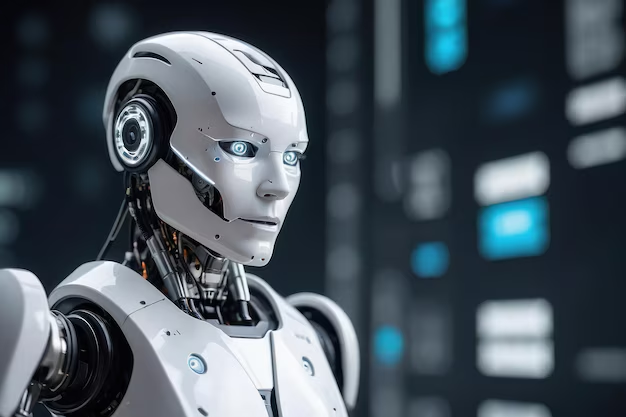
Humanoid Robots Might Be the Next AI Bubble: Hype, Reality, and What Comes Next
Introduction
Artificial intelligence has dominated headlines, boardrooms, and investment portfolios over the last few years. From generative AI chatbots and image generators to AI-powered enterprise software, the technology has attracted record-breaking funding and unprecedented public attention. Now, another trend is rapidly gaining momentum: humanoid robots.
Technology giants, venture capital firms, and ambitious startups are investing billions of dollars into machines designed to walk, talk, lift objects, and perform tasks alongside humans. Companies are unveiling increasingly sophisticated humanoid robots capable of warehouse operations, manufacturing assistance, customer service, and even household chores. Promotional videos often showcase robots performing impressive demonstrations, creating the impression that a robotic workforce is just around the corner.
However, history teaches us that every major technological breakthrough is often accompanied by excessive optimism. The internet, cryptocurrency, the metaverse, and even autonomous vehicles experienced periods were expectations significantly outpaced reality. This has led many analysts to ask an important question: Could humanoid robots become the next AI bubble?
While the technology holds enormous long-term promise, there are valid reasons to believe that current excitement may be running ahead of commercial reality. Understanding both the opportunities and the limitations is essential for investors, businesses, and consumers navigating this rapidly evolving industry.
Why Humanoid Robots Are Suddenly Everywhere
Several factors have converged to accelerate interest in humanoid robotics.
The biggest catalyst is the remarkable progress in artificial intelligence. Modern large language models allow robots to understand natural language, interpret instructions, and make decisions more effectively than earlier generations of machines. Instead of relying entirely on pre-programmed routines, robots can increasingly adapt to changing environments.
At the same time, advances in computer vision, battery technology, electric motors, and sensor systems have dramatically improved robotic capabilities. Components that were once prohibitively expensive have become more affordable, allowing startups to build sophisticated prototypes faster than ever before.
Another major driver is the global labour shortage. Manufacturing plants, logistics centers, healthcare facilities, and warehouses across many developed economies struggle to recruit workers for repetitive or physically demanding jobs. Humanoid robots promise a solution by handling tasks that are dangerous, repetitive, or difficult to staff.
Investors also see humanoid robots as the next logical extension of AI. After software transformed digital work, many believe robotics could transform physical labor, creating an entirely new trillion-dollar industry.
Why Investors Are Betting Big
Capital is flowing into humanoid robotics at an extraordinary pace.
Major technology companies are investing heavily in robotics research, while venture capital firms continue funding startups focused on developing general-purpose humanoid robots. Automotive manufacturers are also entering the race, leveraging their expertise in electric motors, batteries, sensors, and automated manufacturing.
The excitement is understandable. If humanoid robots become capable of performing a wide variety of jobs, the potential market could be enormous. Every warehouse, factory, hospital, hotel, retail store, and even household could eventually become a customer.
Unlike industrial robots, which are designed for specific repetitive tasks, humanoid robots aim to work in environments already built for humans. They can theoretically use existing tools, navigate staircases, open doors, and interact naturally with people without requiring expensive infrastructure changes.
That vision is incredibly attractive to investors because it suggests an opportunity far larger than today’s industrial robotics market.
The Bubble Warning Signs
Despite growing enthusiasm, several indicators suggest the market could be entering speculative territory.
First, valuations of robotics startups have risen dramatically despite limited commercial deployments. Many companies are valued based on future expectations rather than current revenue.
Second, promotional demonstrations often present carefully controlled environments. Robots may appear highly capable in videos, but performing consistently in unpredictable real-world settings remains a significant engineering challenge.
Third, media coverage frequently focuses on breakthrough announcements while paying less attention to technical limitations, deployment costs, maintenance requirements, and operational failures.
This pattern closely resembles previous technology investment cycles, where compelling demonstrations generated excitement long before practical commercialization.
The Engineering Challenges Remain Massive
Building a humanoid robot is one of the most difficult engineering problems in modern technology.
Walking on uneven terrain, maintaining balance, recognizing objects, manipulating fragile items, understanding spoken instructions, avoiding obstacles, and safely interacting with humans all require incredibly sophisticated hardware and software working together seamlessly.
Even small mistakes can have serious consequences. A chatbot generating an incorrect answer is inconvenient. A robot carrying heavy equipment that loses balance could become a safety hazard.
Energy consumption also remains a major obstacle. Many humanoid robots have limited operating times before requiring recharging, making continuous industrial deployment difficult.
Reliability presents another challenge. Businesses expect equipment to operate for thousands of hours with minimal downtime. Achieving that level of durability in complex humanoid machines remains a work in progress.
Cost Is Still a Major Barrier
One of the biggest questions surrounding humanoid robots is economic viability.
Today’s advanced humanoid robots can cost tens of thousands—or even hundreds of thousands of dollars to develop and manufacture. Beyond the purchase price, organizations must also consider maintenance, software updates, repairs, insurance, employee training, and system integration.
For many businesses, hiring human workers is currently more affordable and flexible.
Even if robot prices fall significantly over the next decade, widespread adoption will depend on whether companies can achieve a positive return on investment.
Until operating costs become competitive with human labour across multiple industries, large-scale deployment is likely to remain limited.
Lessons from Previous Technology Bubbles
Technology history provides valuable perspective.
During the dot-com boom, investors believed every internet company would become the next global giant. While the internet ultimately transformed the world, thousands of companies disappeared because expectations exceeded realistic business models.
Similarly, cryptocurrency experienced explosive investment driven by ambitious promises, followed by significant market corrections.
The metaverse generated enormous excitement as companies predicted virtual worlds would redefine work and entertainment. Although virtual reality continues to evolve, adoption has been slower than many forecasts suggested.
Autonomous vehicles followed a comparable trajectory. Predictions that fully self-driving cars would dominate roads within a few years proved overly optimistic due to complex technical, regulatory, and safety challenges.
Humanoid robotics may follow a similar pattern. The technology itself could eventually become transformative, while many current companies and valuations fail to meet inflated expectations.
Industries Most Likely to Benefit First
Rather than replacing every worker, humanoid robots will likely succeed first in specialized environments where repetitive physical tasks dominate.
Manufacturing facilities could deploy robots for assembly support, material handling, and quality inspection. Warehouses may use humanoid machines for picking, sorting, inventory movement, and logistics operations.
Healthcare represents another promising sector. Robots could assist medical staff with transporting supplies, delivering medications, disinfecting facilities, or helping patients with limited mobility under human supervision.
Retail businesses might eventually use humanoid robots for inventory management, shelf scanning, and customer assistance, although widespread consumer acceptance remains uncertain.
These focused applications appear far more realistic than visions of fully autonomous household robots replacing domestic workers anytime soon.
The Role of Artificial Intelligence
Artificial intelligence is undeniably making humanoid robots smarter.
Large language models improve communication, allowing robots to understand conversational instructions. Computer vision enables object recognition and environmental awareness. Reinforcement learning helps robots improve performance through repeated practice.
However, intelligence alone does not solve physical challenges.
A robot may understand how to fold laundry, but physically manipulating soft fabrics consistently is an entirely different problem. Similarly, recognizing a coffee cup is easier than safely picking it up from a cluttered table without dropping it.
This distinction between digital intelligence and physical capability is often overlooked in public discussions.
Regulatory and Ethical Questions
As humanoid robots become more capable, governments and regulators will face important policy decisions.
Workplace safety standards will need updating to address human-robot collaboration. Questions surrounding liability, cybersecurity, privacy, and data protection will become increasingly important.
Ethical concerns also deserve attention. If robots eventually replace significant numbers of workers, societies must consider workforce transition strategies, retraining programs, and economic adaptation.
Public trust will play a critical role in adoption. Businesses and consumers must feel confident that robots operate safely, securely, and transparently before widespread deployment becomes possible.
Could the Bubble Burst?
It is entirely possible that today’s enthusiasm cools significantly over the next few years.
If companies struggle to meet ambitious production targets, investors may become less optimistic. Delays in commercialization, higher-than-expected costs, slower customer adoption, or disappointing financial performance could trigger market corrections.
That would not necessarily mean humanoid robotics has failed.
Technology bubbles often accelerate innovation by attracting talent, funding, and public attention. Even after speculative investments decline, surviving companies continue developing valuable technologies that eventually reshape industries.
The internet survived the dot-com crash. Electric vehicles continued advancing despite years of scepticism. Artificial intelligence itself experienced multiple “AI winters” before recent breakthroughs reignited global interest.
Humanoid robotics could experience a similar cycle.
The Long-Term Outlook
The long-term potential for humanoid robots remains substantial.
Demographic changes, aging populations, labour shortages, and advances in AI create genuine demand for intelligent physical automation. As hardware improves and manufacturing scales, robot prices will likely decline while capabilities increase.
Rather than replacing humans entirely, the most realistic future involves collaboration. Robots may perform repetitive, dangerous, or physically demanding work while humans focus on creativity, problem-solving, interpersonal communication, and strategic decision-making.
Businesses that adopt robotics thoughtfully may achieve higher productivity without eliminating the need for skilled human employees.
The transition, however, is likely to unfold over decades rather than a few years.
Conclusion
Humanoid robots represent one of the most exciting frontiers in modern technology. Advances in artificial intelligence, robotics engineering, and automation have brought machines closer than ever to working alongside humans in real-world environments.
Yet excitement should be balanced with realism. Significant technical, economic, regulatory, and operational challenges remain before humanoid robots become commonplace across industries. Current investment levels and market expectations may reflect optimism that exceeds near-term commercial capabilities, raising legitimate concerns about the formation of another technology bubble.
History shows that transformative technologies often pass through periods of excessive hype before reaching sustainable growth. If humanoid robotics follows that familiar path, the industry may experience setbacks, corrections, and failed ventures along the way. However, those obstacles are unlikely to erase the underlying potential of intelligent machines capable of assisting people in meaningful ways.
The real question is not whether humanoid robots will influence the future—they almost certainly will. The more important question is how quickly that future arrives and which companies successfully bridge the gap between impressive demonstrations and scalable, profitable, real-world deployment. Investors, businesses, and consumers who distinguish genuine technological progress from speculative hype will be better positioned to benefit from the next chapter of the AI revolution.

Software Developer & Writer
Hey, I'm Diva, a developer and writer blending code and creativity. I'm driven by a deep curiosity and a relentless pursuit of excellence. Join me as I craft digital solutions and captivating stories.




Leave A Comment