
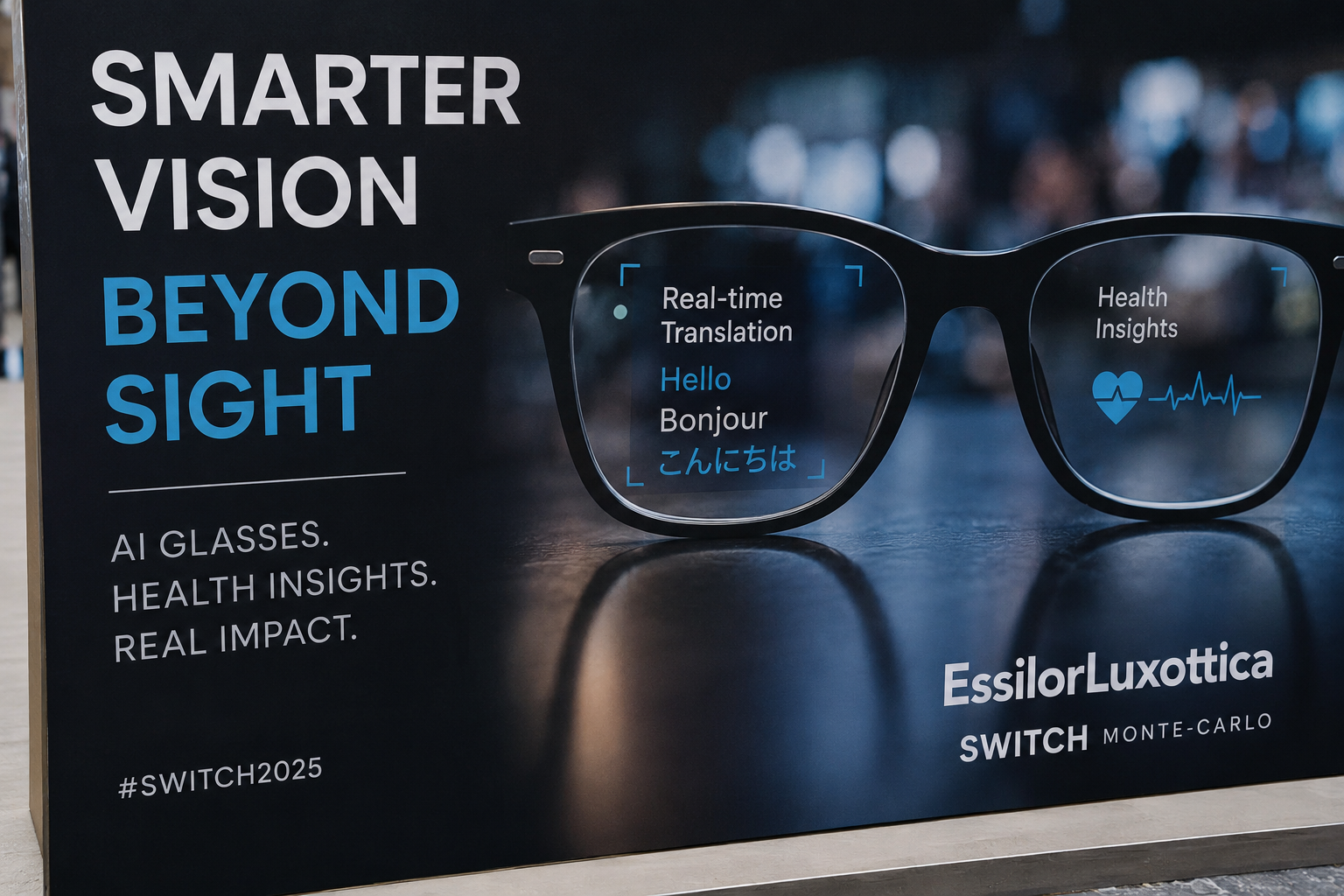
The Future of Smart Eyewear: How AI Glasses and Advanced Eye Exams Are Transforming Vision Care
The Next Revolution in Eyewear Has Already Begun
Imagine walking through the streets of Tokyo, Paris, or São Paulo while your glasses instantly translate conversations in real time. Picture attending an international business meeting where language barriers disappear with a simple glance. Now imagine visiting your optometrist for a routine eye examination, only to discover that the same test can detect early warning signs of diabetes, cardiovascular disease, or other systemic health conditions before noticeable symptoms appear.
This is no longer science fiction. It is the direction in which the global optical industry is rapidly moving.
Many of these groundbreaking innovations were showcased at SWITCH Monte-Carlo, an exclusive event organized by EssilorLuxottica that brought together optical professionals, technology leaders, healthcare experts, and industry innovators. The event highlighted how artificial intelligence, connected eyewear, smart diagnostics, and digital healthcare are reshaping the future of vision care.
As technology becomes increasingly integrated into everyday life, eyewear is evolving beyond vision correction into an intelligent platform capable of improving communication, health monitoring, productivity, and overall quality of life.
Eyewear Is Becoming Smarter Than Ever
For decades, glasses served one primary purpose: helping people see clearly. While lens technology has continuously improved, today’s innovations are transforming eyewear into wearable computing devices.
Modern smart glasses combine advanced optics with artificial intelligence, voice assistants, microphones, cameras, and cloud connectivity. Instead of simply correcting vision, they assist users throughout the day by providing information, navigation, translation, and communication without requiring them to constantly check their smartphones.
This evolution represents one of the most significant technological shifts in the optical industry, opening new opportunities for consumers, healthcare providers, and technology companies alike.
Real-Time Language Translation Is Changing Global Communication
One of the most exciting developments presented at SWITCH Monte-Carlo is the growing capability of AI-powered smart glasses to translate spoken languages almost instantly.
Rather than pulling out a smartphone or using a translation app, users can receive live translated captions directly through their eyewear while conversations continue naturally. This creates a more fluid and immersive communication experience during travel, business meetings, education, and multicultural interactions.
As global mobility increases and remote collaboration becomes the norm, language translation integrated into eyewear could dramatically reduce communication barriers across industries.
For international travelers, digital nomads, multinational companies, and students, this innovation represents a major leap toward effortless global communication.
AI Is Transforming Eye Care
Artificial intelligence is also redefining how eye examinations are performed.
Modern diagnostic systems can analyse retinal images, corneal scans, and other ocular measurements with remarkable speed and precision. AI algorithms help eye care professionals identify subtle abnormalities that may otherwise be difficult to detect during routine examinations.
Instead of replacing clinicians, AI acts as a powerful assistant by improving diagnostic accuracy, prioritizing high-risk cases, and supporting earlier intervention.
This combination of human expertise and intelligent technology has the potential to improve patient outcomes while making eye care more efficient and accessible.
Your Eyes Reveal More About Your Health Than You Think
One of the most remarkable concepts discussed throughout the event is that the eyes can provide valuable insights into overall health.
The retina contains tiny blood vessels and nerve tissues that often reflect changes occurring throughout the body. Because these structures can be observed non-invasively, eye examinations may help identify early signs of systemic diseases.
Researchers continue exploring how advanced retinal imaging and AI analysis may assist in detecting conditions such as:
While eye exams are not intended to replace traditional medical testing, they may become an important screening tool that enables earlier diagnosis and timely treatment.
The future of preventive healthcare could begin with a visit to the optometrist.
Preventive Healthcare Starts with Early Detection
Healthcare systems worldwide are increasingly focusing on prevention rather than treatment after symptoms develop.
Early diagnosis often leads to better outcomes, lower healthcare costs, and improved quality of life. This is where advanced optical technologies could make a meaningful difference.
AI-assisted eye examinations may help identify health risks before patients experience noticeable symptoms, encouraging earlier referrals to specialists and faster medical intervention.
This proactive approach aligns with the growing emphasis on personalized healthcare and continuous health monitoring.
Smart Glasses Are Becoming Everyday Digital Assistants
The next generation of smart eyewear extends far beyond translation capabilities.
Manufacturers are developing glasses capable of delivering navigation instructions, managing notifications, providing voice assistance, capturing photos, controlling music, and integrating seamlessly with smartphones and wearable ecosystems.
Instead of distracting users with screens, smart glasses present information in a natural and unobtrusive manner, allowing people to stay connected while remaining engaged with the world around them.
This hands-free experience could become especially valuable for professionals working in logistics, healthcare, manufacturing, education, retail, and field services.
AI and Personalized Vision Solutions
Artificial intelligence is also enabling greater personalization within the optical industry.
Advanced analytics can recommend customized lenses based on lifestyle, occupation, digital device usage, and visual behavior. Eye care professionals can deliver more tailored recommendations, improving both comfort and long-term visual performance.
Personalization is becoming a defining trend across healthcare, and vision care is no exception.
As AI continues learning from larger datasets, consumers can expect increasingly individualized solutions designed around their unique needs.
Sustainability Is Becoming a Core Industry Priority
Innovation at SWITCH Monte-Carlo also reflected the growing importance of environmental responsibility.
Consumers increasingly expect brands to reduce waste, improve supply chain transparency, and develop sustainable products without compromising quality.
The optical industry is responding through initiatives involving recycled materials, environmentally responsible manufacturing processes, reduced packaging, and longer-lasting product designs.
Sustainability is no longer viewed as a separate initiative but as an essential component of future innovation.
Digital Health Ecosystems Are Expanding
Connected eyewear represents just one part of a much larger digital healthcare ecosystem.
Future vision care may integrate cloud-based patient records, remote consultations, wearable health devices, AI diagnostics, and predictive analytics into a seamless healthcare experience.
Patients could receive continuous monitoring, personalized recommendations, automated reminders, and improved coordination between eye care professionals and general healthcare providers.
This interconnected approach supports better long-term health management while improving convenience for patients.
What This Means for Consumers
For everyday consumers, these innovations promise a future where eyewear becomes significantly more valuable than traditional glasses.
Benefits may include improved accessibility through live translation, enhanced productivity via hands-free information, earlier disease detection, personalized vision correction, and smarter healthcare experiences.
Rather than purchasing glasses solely to improve eyesight, consumers may increasingly view them as intelligent health and communication devices.
This shift has the potential to redefine expectations across the global eyewear market.
The Optical Industry Is Entering a New Era
The technologies showcased at SWITCH Monte-Carlo demonstrate that the future of vision care extends far beyond sharper eyesight.
Artificial intelligence, smart eyewear, digital diagnostics, and preventive healthcare are converging to create an entirely new generation of optical solutions that improve both vision and overall wellbeing.
As innovation accelerates, collaboration between technology companies, healthcare providers, researchers, and optical manufacturers will play a critical role in bringing these advancements to consumers worldwide.
The coming years are likely to reshape not only how people see the world but also how they communicate, monitor their health, and interact with digital information.
Final Thoughts
SWITCH Monte-Carlo offered a compelling glimpse into the future of the optical industry, where glasses become intelligent companions capable of translating languages, supporting daily productivity, and contributing to early disease detection. As artificial intelligence continues advancing and healthcare becomes increasingly connected, eyewear is poised to become one of the most transformative wearable technologies of the decade.
The future of vision is no longer limited to seeing clearly. It is about seeing smarter, living healthier, and staying connected in ways that were once unimaginable.
.

Software Developer & Writer
Hey, I'm Diva, a developer and writer blending code and creativity. I'm driven by a deep curiosity and a relentless pursuit of excellence. Join me as I craft digital solutions and captivating stories.




Leave A Comment