
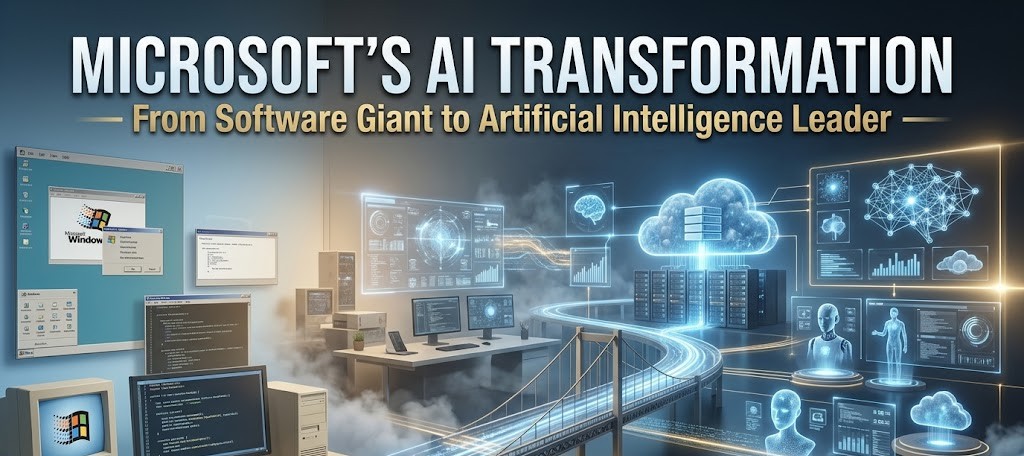
Microsoft’s Transformation from Software Company to AI Leader: How a Legacy Giant Became the Powerhouse of Artificial Intelligence
Introduction: The Reinvention of a Technology Giant
For decades, Microsoft was known primarily as the world’s leading software company, dominating the personal computing era with products like Windows and Microsoft Office. Its success was built around operating systems, productivity software, and enterprise solutions that became essential tools for businesses and individuals worldwide. However, as technology evolved, the company faced a major challenge: remaining relevant in a world moving beyond traditional software.
Today, Microsoft is no longer viewed only as a software provider. It has transformed itself into one of the most influential artificial intelligence companies globally, investing billions of dollars into AI research, infrastructure, and partnerships. Through cloud computing, generative AI, and strategic acquisitions, Microsoft has positioned itself at the center of the AI revolution.
This transformation did not happen overnight. It represents years of strategic changes, leadership decisions, and a shift from selling software products to building intelligent platforms that power businesses, developers, and consumers worldwide.
The Beginning: Microsoft’s Dominance in the Software Era
Founded in 1975, Microsoft became one of the defining companies of the personal computer revolution. The company’s operating system, Windows, became the foundation of millions of computers worldwide, creating an ecosystem that connected users, businesses, and developers.
The launch of Microsoft Office further strengthened the company’s position. Applications such as Word, Excel, and PowerPoint became industry standards, making Microsoft one of the most valuable technology companies in the world.
During this period, Microsoft’s business model was centered around licensing software. Companies and consumers purchased operating systems and applications, creating a highly profitable software empire. However, the technology landscape began changing rapidly with the rise of cloud computing, smartphones, mobile applications, and artificial intelligence.
The traditional software model was no longer enough. Microsoft needed to evolve from a company selling software products into a company providing intelligent technology platforms.
Satya Nadella’s Leadership and Microsoft’s Cultural Shift
A major turning point in Microsoft’s transformation came in 2014 when Satya Nadella became the company’s CEO. Under his leadership, Microsoft began moving away from a Windows-first strategy and focused on cloud computing, collaboration tools, and artificial intelligence.
Nadella introduced a new philosophy cantered around innovation, openness, and continuous learning. Instead of protecting older products, Microsoft started embracing emerging technologies and competing in new markets.
One of the biggest cultural changes was Microsoft’s approach toward collaboration. The company became more open to partnerships, including working with platforms that were previously considered competitors. This shift helped Microsoft expand its influence beyond its traditional ecosystem.
The transformation also changed how Microsoft viewed software. Rather than treating software as a standalone product, the company began seeing it as a service that could continuously improve through cloud technology and AI capabilities.
The Rise of Microsoft Azure: Building the Foundation for AI
The transition into artificial intelligence required massive computing power, and Microsoft’s cloud platform became the foundation for this transformation. Microsoft Azure grew into one of the world’s largest cloud computing platforms, competing directly with Amazon Web Services and Google Cloud.
Azure provided the infrastructure needed to train and operate advanced AI models. Artificial intelligence requires enormous amounts of computing resources, data processing capabilities, and specialized hardware. By investing heavily in cloud infrastructure, Microsoft created the technological backbone necessary for the AI era.
Businesses across industries began using Azure for machine learning, data analytics, automation, and digital transformation. This positioned Microsoft not only as a software company but also as a critical technology partner for organizations adopting artificial intelligence.
The company’s cloud-first strategy became one of the most important decisions behind its AI leadership.
Microsoft and OpenAI: A Partnership That Changed the AI Landscape
Microsoft’s relationship with OpenAI became one of the most significant developments in the technology industry. Beginning with a major investment in OpenAI, Microsoft became a key partner in developing and commercializing advanced AI technologies.
The partnership gained worldwide attention with the introduction of ChatGPT, a generative AI chatbot capable of understanding and producing human-like text. The popularity of ChatGPT accelerated global interest in artificial intelligence and pushed major technology companies to invest heavily in AI development.
Microsoft integrated OpenAI’s models into many of its products and services, creating a new generation of AI-powered tools. Instead of keeping AI research separate, Microsoft focused on bringing artificial intelligence directly into everyday workflows.
This strategy helped the company move from being an observer of the AI revolution to becoming one of its primary drivers.
Copilot: Bringing Artificial Intelligence into Everyday Work
One of Microsoft’s biggest AI initiatives is Microsoft Copilot, an AI assistant designed to improve productivity across its ecosystem.
Copilot represents a major shift in how people interact with software. Traditionally, users operated applications through menus, commands, and manual processes. AI assistants introduce a more natural way of working, allowing users to communicate with software through conversations and instructions.
Integrated across products such as Microsoft 365, Windows, and developer tools, Copilot helps users write documents, analyse information, create presentations, summarize content, and automate repetitive tasks.
For businesses, AI-powered productivity tools represent a major opportunity. Companies can reduce time spent on routine activities and allow employees to focus on higher-value tasks. Microsoft’s strategy is to make AI a daily workplace assistant rather than a separate technology used only by specialists.
AI Integration Across Microsoft’s Product Ecosystem
Microsoft’s greatest advantage in the AI race is its massive existing ecosystem. Millions of businesses already depend on Microsoft products, giving the company a direct path to introduce AI technologies at scale.
Microsoft has integrated AI into multiple areas, including productivity software, cybersecurity, cloud services, gaming, and software development.
In enterprise environments, AI helps organizations analyse data, improve decision-making, automate processes, and enhance customer experiences. In software development, AI-powered tools assist programmers by generating code, identifying errors, and improving productivity.
The company’s AI approach is not limited to creating standalone applications. Instead, Microsoft aims to make artificial intelligence a fundamental layer across all its products.
Transforming Business Through Enterprise AI Solutions
Microsoft’s AI transformation is strongly focused on businesses. Enterprises are increasingly looking for ways to use artificial intelligence to improve efficiency, reduce operational costs, and create new digital experiences.
Through Azure AI services, Microsoft provides organizations with tools for building customized AI applications. Companies can use machine learning models, data platforms, and automation technologies to solve industry-specific challenges.
Industries such as healthcare, finance, retail, manufacturing, and education are exploring AI-powered solutions to improve services and decision-making.
Microsoft’s enterprise advantage comes from combining AI capabilities with security, compliance, and existing business software. This makes AI adoption easier for organizations that already rely on Microsoft technologies.
Microsoft’s Role in the Generative AI Revolution
Generative AI has changed how the world views artificial intelligence. Unlike traditional AI systems designed for specific tasks, generative AI can create content, understand context, and assist with complex workflows.
Microsoft has become one of the strongest players in this space by combining AI models, cloud infrastructure, and productivity platforms.
The company’s approach focuses on making generative AI practical and accessible. Instead of presenting AI as a futuristic concept, Microsoft is integrating it into tools people already use every day.
This strategy has helped accelerate AI adoption among businesses and individuals, making Microsoft a central force in the current technology transformation.
Challenges in Microsoft’s AI Journey
Despite its success, Microsoft’s AI transformation comes with significant challenges. Artificial intelligence development requires enormous investments in computing infrastructure, research, and talent.
Competition is also increasing. Companies such as Google, Amazon, and emerging AI startups are investing heavily in AI technologies.
Microsoft must also address concerns related to AI safety, data privacy, cybersecurity, and responsible AI development. As AI becomes more powerful, companies face increasing pressure to ensure these technologies are used ethically.
Additionally, integrating AI into existing products requires continuous improvement. Users expect AI tools to be accurate, reliable, and valuable in real-world situations.
The Future: Microsoft as an AI-First Company
Microsoft’s journey from a software company to an AI leader represents one of the biggest transformations in modern technology history. The company successfully moved beyond its traditional identity and positioned itself at the center of a new computing era.
The future of Microsoft will likely be defined by artificial intelligence becoming deeply integrated into everyday experiences. From workplace productivity and cloud computing to cybersecurity and software development, AI will continue shaping the company’s direction.
Microsoft’s success demonstrates that even established technology companies can reinvent themselves when they adapt to changing markets. By combining its software expertise, cloud infrastructure, and AI investments, Microsoft has created a powerful foundation for the future.
The company that once defined the personal computer era is now helping define the artificial intelligence era.
Conclusion: The New Identity of Microsoft
Microsoft’s transformation from a software company into an AI leader is a story of strategic reinvention. Through cloud computing, artificial intelligence research, partnerships, and product innovation, the company has successfully adapted to a rapidly changing technology landscape.
Its journey shows that long-term success in technology requires more than protecting existing businesses. It requires constant innovation, willingness to change, and the ability to anticipate the next major shift.
As artificial intelligence continues to reshape industries worldwide, Microsoft is no longer simply a company that creates software. It has become a global AI platform provider, shaping how people and businesses interact with technology in the future.

Software Developer & Writer
Hey, I'm Diva, a developer and writer blending code and creativity. I'm driven by a deep curiosity and a relentless pursuit of excellence. Join me as I craft digital solutions and captivating stories.




Leave A Comment