
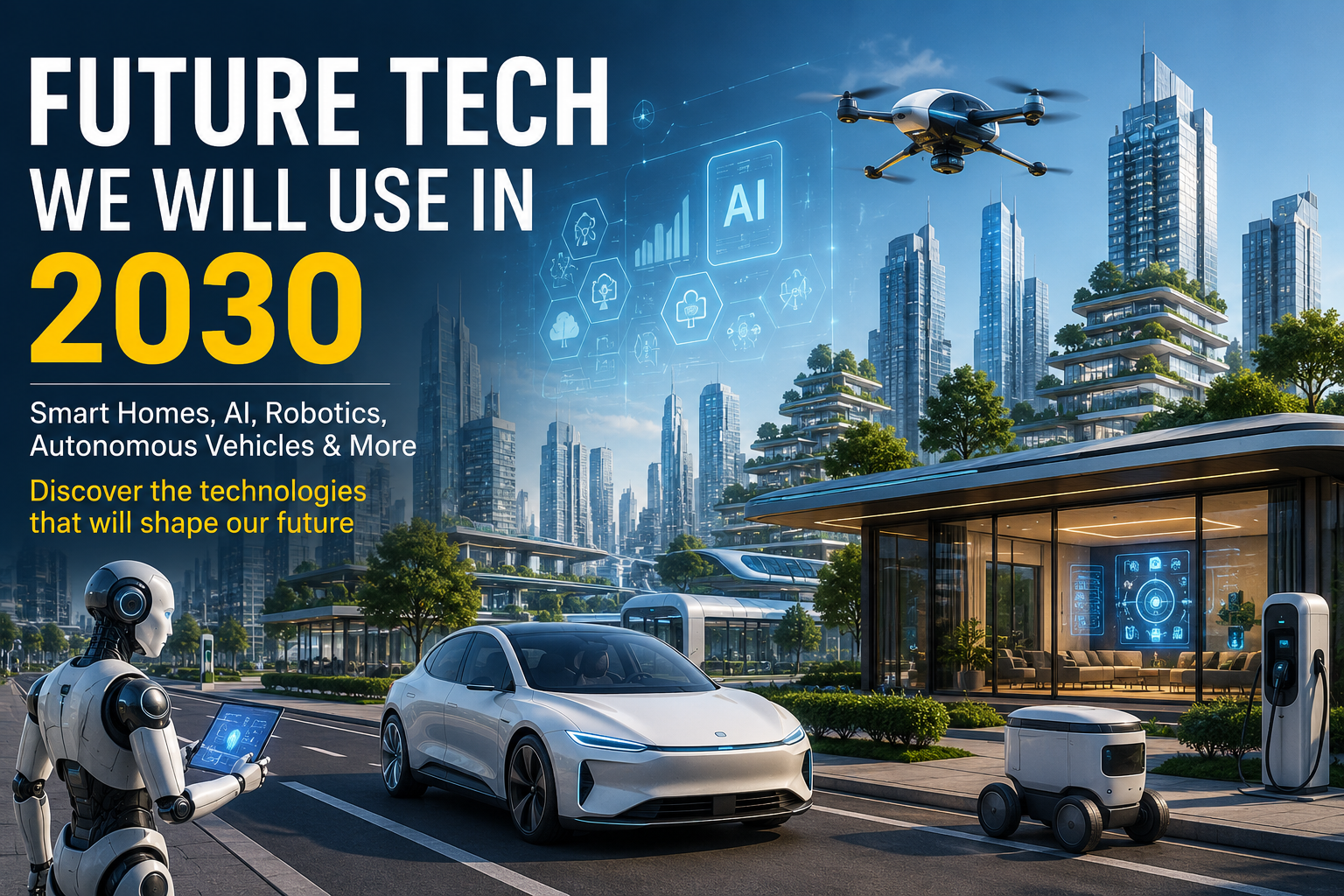
Future Tech We Will Use in 2030: How Innovation Will Transform Everyday Life
Technology has never evolved as quickly as it is today. Over the past decade, we have witnessed the rise of artificial intelligence, electric vehicles, smart homes, blockchain, and advanced robotics. Yet, these innovations are only the beginning. By 2030, technology will become more intelligent, more connected, and more deeply integrated into our daily lives than ever before. Instead of simply making life convenient, future technologies will actively help us make decisions, improve healthcare, transform education, reshape transportation, and even redefine how we work.
The next generation of technology is not about replacing humans but enhancing human capabilities. Artificial intelligence will become a trusted assistant rather than just a chatbot, autonomous systems will reduce repetitive work, and sustainable innovations will help solve pressing environmental challenges. Businesses across industries are investing billions of dollars into research and development, ensuring that many futuristic ideas become everyday realities within this decade.
This article explores the most exciting technologies expected to become mainstream by 2030 and explains how they will change the way people live, work, communicate, and interact with the world.
Artificial Intelligence Will Become a Personal Life Assistant
Artificial intelligence (AI) will undoubtedly be one of the defining technologies of 2030. While today’s AI tools can generate text, images, and code, future AI systems will function more like intelligent personal assistants capable of understanding context, emotions, habits, and long-term goals.
Imagine starting your day with an AI assistant that plans your schedule, books appointments, monitors your health, recommends meals based on nutritional needs, manages your finances, and even negotiates better utility bills automatically. Instead of switching between multiple apps, one intelligent assistant will coordinate almost every digital task.
Businesses will also rely heavily on AI for customer support, data analysis, cybersecurity, product design, and decision-making. Rather than replacing employees, AI will handle repetitive administrative work, allowing professionals to focus on creativity, strategy, and innovation.
Smart Homes Will Think Before You Do
Smart homes are expected to evolve far beyond voice-controlled lights and thermostats. By 2030, connected devices will understand routines and anticipate needs without requiring manual commands.
Your home may automatically adjust room temperatures based on weather forecasts, prepare coffee before you wake up, optimize electricity usage according to energy prices, and detect maintenance issues before they become expensive repairs. Advanced sensors will improve home security by recognizing unusual activity and alerting homeowners instantly.
Kitchen appliances will become more intelligent as refrigerators monitor food freshness, suggest recipes using available ingredients, and even create grocery shopping lists automatically. These connected ecosystems will save time, reduce waste, and improve overall convenience.
Autonomous Vehicles Will Transform Transportation
Self-driving technology has already made significant progress, but by 2030 autonomous transportation is expected to become much more common in many parts of the world.
Driverless taxis, autonomous buses, and delivery vehicles could reduce traffic congestion, lower transportation costs, and improve road safety. Advanced sensors, cameras, radar, and AI-powered navigation systems will enable vehicles to make complex driving decisions in real time.
Electric vehicles will dominate the market alongside autonomous technology. Faster charging infrastructure, improved battery life, and lower manufacturing costs will make electric mobility more affordable and accessible for consumers.
Public transportation systems may also integrate AI to optimize routes, reduce delays, and improve passenger experiences through predictive scheduling.
Healthcare Will Become Predictive Instead of Reactive
Healthcare in 2030 will shift from treating illnesses to preventing them before symptoms appear. Artificial intelligence, wearable devices, biotechnology, and personalized medicine will work together to provide continuous health monitoring.
Smartwatches and wearable sensors will measure heart activity, blood pressure, oxygen levels, glucose, hydration, stress, sleep quality, and other health indicators around the clock. AI systems will analyse this information and warn users about potential medical conditions before they become serious.
Doctors will use AI-powered diagnostic systems to identify diseases more accurately and quickly than traditional methods. Personalized treatments based on an individual’s genetic profile will improve recovery rates while minimizing side effects.
Remote healthcare consultations will become even more advanced through high-definition virtual appointments, allowing patients to receive expert medical advice without traveling long distances.
Quantum Computing Will Solve Impossible Problems
Quantum computing is expected to become one of the most revolutionary technologies by the end of the decade. Unlike traditional computers that process information using binary bits, quantum computers use quantum bits, or qubits, enabling them to solve incredibly complex calculations much faster.
Although quantum computers will not replace personal computers, they will help scientists develop new medicines, improve weather forecasting, optimize supply chains, strengthen cybersecurity, and accelerate scientific discoveries.
Industries such as finance, pharmaceuticals, aerospace, and climate research will benefit tremendously from quantum computing’s enormous processing capabilities.
Extended Reality Will Redefine Digital Experiences
Virtual Reality (VR), Augmented Reality (AR), and Mixed Reality (MR) will merge into immersive Extended Reality (XR) experiences that blur the line between physical and digital environments.
Students may attend interactive virtual classrooms where historical events, scientific concepts, and engineering models can be explored in three-dimensional space. Businesses will conduct virtual meetings that feel nearly identical to face-to-face interactions.
Retail companies will allow customers to try clothes virtually, place furniture inside their homes digitally before purchasing, or test products through immersive simulations.
Entertainment, gaming, education, healthcare, architecture, and tourism are all expected to benefit from increasingly realistic XR technologies.
Robotics Will Become Everyday Helpers
Robots will become far more capable and affordable by 2030. Instead of being limited to factories, robots will assist in homes, hospitals, restaurants, warehouses, and public services.
Domestic robots could clean homes, prepare meals, fold laundry, mow lawns, and assist elderly family members with daily activities. Healthcare robots may support nurses by transporting equipment, delivering medication, and assisting patients with mobility.
In manufacturing, collaborative robots—or cobots—will work alongside humans safely, increasing productivity without replacing skilled workers.
Agricultural robots will monitor crop health, identify pests, and automate harvesting, improving food production while reducing labour shortages.
Sustainable Technology Will Lead Climate Solutions
Climate change will continue driving innovation throughout the decade. Sustainable technologies will focus on reducing emissions, conserving resources, and creating cleaner energy systems.
Solar panels will become more efficient and affordable, while wind energy installations continue expanding worldwide. Green hydrogen could emerge as a cleaner fuel for industries that are difficult to electrify.
Smart energy grids will balance electricity demand automatically, reducing power outages and improving renewable energy usage. Buildings will increasingly feature energy-efficient materials, intelligent climate control systems, and water recycling technologies.
Carbon capture technologies may also become commercially viable, helping industries reduce greenhouse gas emissions significantly.
6G Networks Will Enable Instant Connectivity
While many countries are still expanding 5G infrastructure, researchers are already developing 6G communication technology. By 2030, early adoption of 6G could dramatically improve internet speed, reliability, and network capacity.
Ultra-fast connectivity will enable seamless cloud computing, real-time language translation, autonomous transportation, smart cities, and immersive virtual experiences with virtually no latency.
Factories, hospitals, airports, and entire cities will rely on interconnected devices communicating instantly through advanced wireless networks.
Biotechnology Will Revolutionize Human Health
Biotechnology is expected to make extraordinary progress by 2030. Scientists are developing advanced gene-editing techniques, lab-grown organs, personalized medicines, and regenerative therapies that could dramatically improve healthcare outcomes.
Stem cell research may help repair damaged tissues, while gene therapies could treat inherited diseases that currently have limited treatment options.
Lab-grown meat and alternative protein technologies will also become more widely available, reducing environmental impact while helping meet global food demand.
Biotechnology will play an increasingly important role in agriculture by developing crops that require less water, resist disease, and adapt to changing climate conditions.
Smart Cities Will Improve Urban Living
Cities of the future will use connected technologies to improve transportation, public safety, waste management, water conservation, and energy efficiency.
Traffic signals will automatically adapt to traffic flow, reducing congestion and emissions. Smart waste bins will notify collection services when they need emptying, improving operational efficiency.
Air quality sensors will monitor pollution levels continuously, while intelligent streetlights will adjust brightness according to pedestrian activity, reducing electricity consumption.
Citizens will benefit from integrated digital services that simplify government processes, emergency response, and public transportation.
Cybersecurity Will Become More Intelligent
As technology becomes increasingly connected, cybersecurity will become even more important. AI-powered security systems will detect threats in real time, identify suspicious activities before attacks occur, and respond automatically to emerging cyber risks.
Biometric authentication, including facial recognition, voice identification, fingerprint scanning, and behavioral analysis, will increasingly replace traditional passwords.
Zero-trust security models, encrypted cloud computing, and quantum-resistant encryption technologies will help protect sensitive personal and business information from increasingly sophisticated cybercriminals.
Space Technology Will Enter a New Era
The space industry is expected to expand rapidly by 2030 through reusable rockets, commercial space stations, satellite internet networks, and lunar exploration missions.
Private companies and government agencies will collaborate on missions focused on scientific research, communications, Earth observation, and resource exploration.
Satellite technology will improve internet connectivity in remote areas while supporting disaster management, agriculture, navigation, and environmental monitoring.
Although space tourism will remain expensive, technological advancements may gradually make commercial space travel more accessible over time.
The Future of Work Will Be AI-Powered
The workplace of 2030 will look significantly different from today’s offices. AI-powered collaboration tools, automation software, digital assistants, and virtual workspaces will transform productivity.
Routine administrative tasks such as scheduling meetings, preparing reports, organizing documents, and analysing data will increasingly be automated.
Employees will focus more on strategic thinking, creativity, emotional intelligence, leadership, and innovation skills that remain uniquely human.
Remote work will continue evolving through immersive virtual collaboration platforms, allowing global teams to work together seamlessly regardless of location.
Challenges That Come With Future Technology
Despite its enormous benefits, future technology also presents significant challenges. Privacy concerns will grow as more devices collect personal information. Governments and businesses must establish strong regulations to ensure responsible use of artificial intelligence and data.
Automation may change job markets, requiring workers to develop new skills and embrace lifelong learning. Ethical questions surrounding AI decision-making, biotechnology, facial recognition, and surveillance will require careful consideration.
Cybersecurity threats will continue evolving, making digital protection essential for individuals, organizations, and governments alike.
Successfully navigating these challenges will determine whether technological progress benefits society fairly and responsibly.
Final Thoughts
The technologies expected to shape 2030 are no longer distant science fiction. Many are already being tested, refined, and deployed across industries worldwide. Artificial intelligence, robotics, quantum computing, biotechnology, autonomous transportation, smart cities, sustainable energy, and immersive digital experiences will fundamentally transform how we live and work.
Rather than replacing humanity, these innovations have the potential to solve some of the world’s biggest challenges from improving healthcare and education to addressing climate change and increasing economic productivity. The coming years will reward individuals and businesses that stay informed, adapt to technological change, and embrace continuous learning.
As we move toward 2030, the future will belong to those who understand technology not simply as a collection of tools but as a powerful force that can create smarter cities, healthier communities, stronger economies, and a more connected global society. The future is arriving faster than ever, and the technologies we choose to adopt today will shape the world we experience tomorrow.

Software Developer & Writer
Hey, I'm Diva, a developer and writer blending code and creativity. I'm driven by a deep curiosity and a relentless pursuit of excellence. Join me as I craft digital solutions and captivating stories.


Leave A Comment