
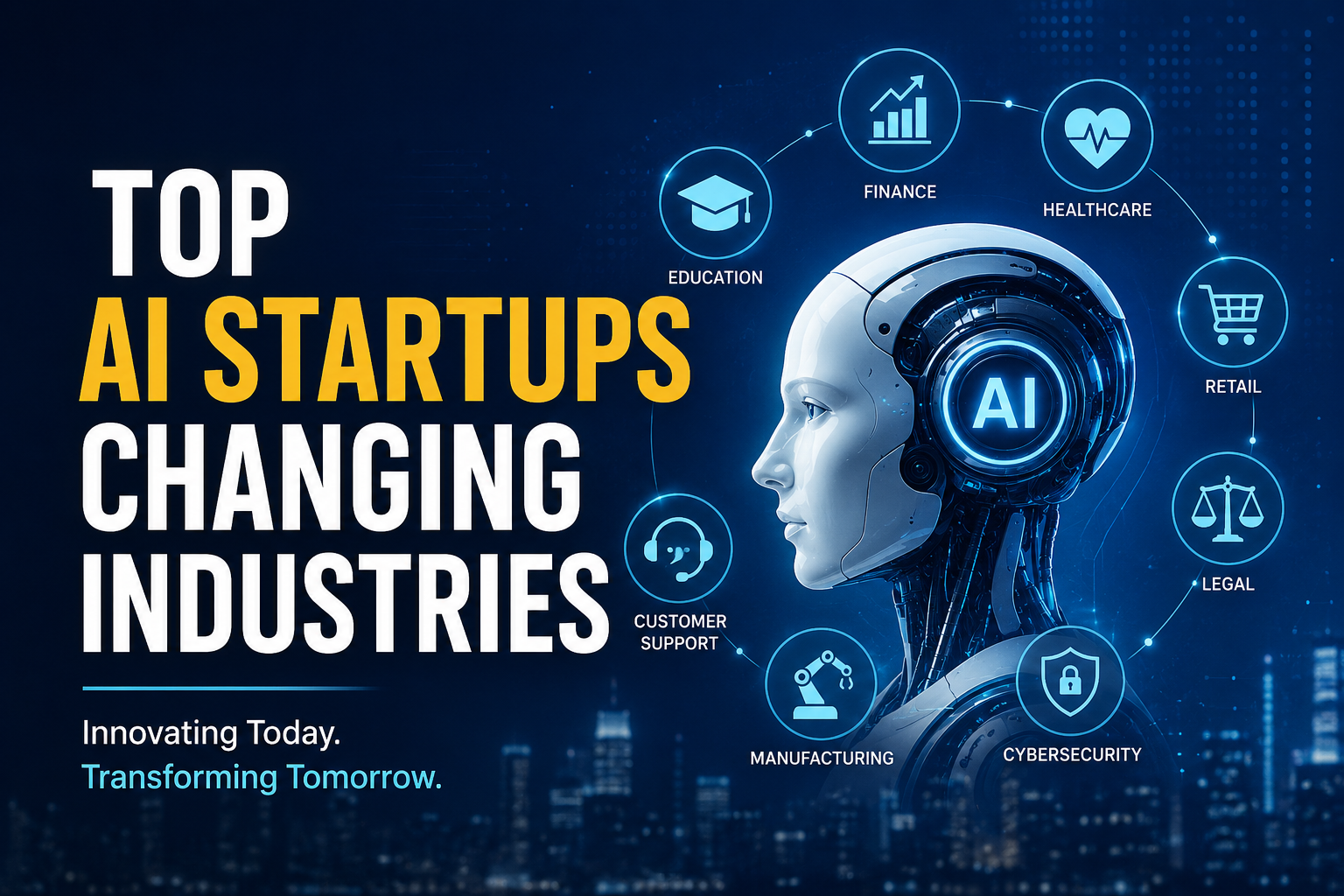
Top AI Startups Changing Industries
Artificial intelligence has evolved from being a futuristic concept into one of the most influential technologies shaping the modern economy. While established technology giants continue to dominate AI research and infrastructure, a new generation of startups is driving innovation at an unprecedented pace. These companies are not only building intelligent software but are also redefining industries such as healthcare, finance, education, cybersecurity, manufacturing, retail, legal services, and customer support.
Unlike traditional software companies, AI startups are focused on solving complex business problems through machine learning, natural language processing, computer vision, and generative AI. Their solutions automate repetitive tasks, improve decision-making, reduce operational costs, and unlock entirely new ways of working. Investors have poured billions of dollars into AI startups over the last few years, recognizing that artificial intelligence is becoming a foundational technology similar to the internet or cloud computing.
As businesses worldwide accelerate digital transformation, AI startups are becoming strategic partners rather than experimental vendors. Here are some of the most influential AI startups that are transforming industries and setting new standards for innovation.
OpenAI: Revolutionizing Human-AI Collaboration
OpenAI has become one of the most recognizable names in artificial intelligence, largely due to the widespread adoption of ChatGPT and its advanced language models. While originally established as a research organization, OpenAI has grown into a leading AI company whose technologies are integrated into countless products and enterprise solutions.
Its models assist with writing, coding, customer support, research, education, and business automation. Organizations are increasingly embedding OpenAI’s APIs into their applications to create intelligent virtual assistants, automate workflows, and enhance productivity.
Beyond conversational AI, OpenAI continues to push the boundaries of multimodal intelligence, enabling systems that understand text, images, audio, and code simultaneously. This capability is expanding the possibilities of AI across industries ranging from education and healthcare to software development and creative media.
Anthropic: Building Safer and More Reliable AI
As artificial intelligence becomes more powerful, concerns around safety, reliability, and responsible deployment continue to grow. Anthropic has positioned itself as one of the leading startups focused on creating AI systems that are helpful, honest, and aligned with human values.
Its AI assistant, Claude, has gained popularity among enterprises for document analysis, coding assistance, research, and business communication. Anthropic places significant emphasis on reducing harmful outputs while maintaining high-quality performance.
Many organizations prefer AI providers that prioritize governance, transparency, and ethical development. As regulations surrounding artificial intelligence continue to evolve globally, Anthropic’s focus on AI safety gives it a strong competitive advantage in enterprise markets.
Perplexity AI: Reinventing Search Through Conversational Intelligence
Traditional search engines often require users to sift through numerous web pages before finding relevant information. Perplexity AI offers a different approach by combining conversational AI with real-time web search to deliver concise, source-backed answers.
The platform enables professionals, researchers, students, and businesses to gather information more efficiently. Rather than displaying only a list of links, Perplexity synthesizes information into coherent responses while providing citations for transparency.
This model represents a significant shift in how people interact with information online. Instead of searching and browsing separately, users engage directly with an intelligent assistant capable of understanding context and follow-up questions.
Cohere: Enterprise AI Built for Businesses
While many AI companies target general consumers, Cohere focuses primarily on enterprise customers. Its large language models are designed specifically for business applications, allowing organizations to build secure AI-powered tools without compromising sensitive information.
Financial institutions, healthcare providers, government agencies, and multinational corporations increasingly rely on enterprise-grade AI platforms that emphasize privacy and regulatory compliance. Cohere addresses these concerns through customizable language models that can operate within secure environments.
The company’s technology powers intelligent search, document summarization, customer support automation, and knowledge management systems, helping organizations unlock value from their internal data.
Mistral AI: Advancing Open and Efficient Language Models
Europe has emerged as an important hub for AI innovation, and Mistral AI has quickly become one of the continent’s fastest-growing startups. The company is recognized for developing high-performance open-weight language models that provide flexibility for developers and enterprises.
Unlike proprietary systems that restrict customization, Mistral’s models allow organizations greater control over deployment, optimization, and integration. This openness appeals to businesses seeking cost-effective AI solutions while maintaining ownership over their infrastructure.
Its rapid growth demonstrates increasing demand for alternatives within the AI ecosystem, particularly among companies looking for transparency, efficiency, and customization.
Harvey: Transforming the Legal Industry
The legal sector has traditionally depended on labour-intensive research and documentation. Harvey is changing this landscape by developing AI specifically for legal professionals.
The platform assists lawyers with contract analysis, legal research, document drafting, compliance reviews, and case preparation. Rather than replacing legal expertise, Harvey enables professionals to complete time-consuming tasks much faster while improving consistency.
Major law firms have adopted AI solutions like Harvey to increase productivity, reduce administrative workloads, and deliver better client service. As legal technology continues to mature, AI is becoming an indispensable tool for modern legal practice.
Sierra: Redefining Customer Experience
Customer service remains one of the largest operational expenses for businesses worldwide. Sierra is helping organizations transform customer interactions through AI-powered conversational agents capable of handling complex support requests.
Unlike traditional chatbots that rely on scripted responses, Sierra’s AI systems engage in natural conversations, understand customer intent, and resolve issues with greater accuracy. These assistants can manage inquiries across websites, mobile applications, and messaging platforms while maintaining brand consistency.
As businesses increasingly prioritize customer experience, intelligent AI agents are becoming an essential component of digital engagement strategies.
Glean: Making Enterprise Knowledge Accessible
Large organizations generate enormous amounts of internal information spread across emails, documents, cloud storage, messaging platforms, and collaboration tools. Finding relevant information quickly remains a major productivity challenge.
Glean addresses this problem through AI-powered enterprise search that connects multiple workplace applications into a unified knowledge platform. Employees can ask questions in natural language and receive accurate answers sourced from company data.
This dramatically reduces time spent searching for information and improves collaboration across departments. As organizations continue adopting hybrid work models, enterprise knowledge management platforms like Glean are becoming increasingly valuable.
Runway: Revolutionizing Creative Content Production
Artificial intelligence is reshaping creative industries, and Runway stands at the forefront of AI-powered media generation. The company develops tools that allow creators to generate videos, edit footage, remove backgrounds, create animations, and produce visual effects using simple text prompts.
These capabilities significantly reduce production time while making professional-quality video creation accessible to smaller businesses and independent creators. Marketing agencies, filmmakers, designers, and content creators are increasingly incorporating AI into their production workflows.
Rather than replacing creativity, Runway enables professionals to experiment with ideas more quickly and focus on storytelling rather than repetitive editing tasks.
Eleven Labs: Transforming Digital Voice Technology
High-quality synthetic voice generation has become increasingly important across entertainment, education, gaming, customer support, and accessibility services. Eleven Labs has emerged as one of the industry’s leading startups specializing in AI-generated speech.
Its technology creates realistic, emotionally expressive voices in multiple languages while preserving natural pronunciation and intonation. Businesses use the platform for audiobook narration, podcast production, localization, virtual assistants, and video voiceovers.
The ability to generate lifelike speech at scale is opening new opportunities for global content distribution and multilingual communication.
Shield AI: Applying Artificial Intelligence to Defense
Artificial intelligence is also transforming defense and autonomous systems. Shield AI develops autonomous software for drones and military aircraft capable of navigating challenging environments without relying entirely on GPS or constant human control.
Its AI systems enable autonomous decision-making during reconnaissance, surveillance, and rescue missions where communication may be limited. While defense applications remain highly specialized, the technologies developed by companies like Shield AI often influence broader robotics and autonomous navigation research.
The startup demonstrates how AI extends far beyond software applications into physical systems operating in complex real-world environments.
Hippocratic AI: Improving Healthcare Through Responsible AI
Healthcare requires extremely high standards of accuracy, safety, and trust. Hippocratic AI focuses on developing specialized AI solutions designed specifically for healthcare professionals and patient support.
Its systems assist with patient communication, administrative tasks, appointment follow-ups, and medical information delivery while emphasizing safety and clinical reliability. By automating routine interactions, healthcare providers can devote more attention to direct patient care.
With aging populations and increasing healthcare demands worldwide, AI-powered healthcare assistants are expected to become an important component of modern medical systems.
Why AI Startups Are Growing So Rapidly
Several factors explain the extraordinary growth of AI startups across industries. Advances in cloud computing have made powerful AI models accessible to companies of all sizes without requiring enormous investments in hardware. At the same time, improvements in computing infrastructure have dramatically reduced the cost of training and deploying sophisticated machine learning systems.
Businesses are also generating vast amounts of data that can be transformed into valuable insights through artificial intelligence. Whether predicting customer behavior, detecting fraud, optimizing supply chains, or automating customer service, AI provides measurable business value across nearly every sector.
Investment trends have further accelerated innovation. Venture capital firms and institutional investors continue funding AI startups aggressively because they view artificial intelligence as one of the most significant technological shifts of the century. This financial support enables startups to attract world-class talent and develop increasingly sophisticated products.
Challenges Facing AI Startups
Despite remarkable growth, AI startups face several important challenges. Competition has intensified as new companies enter the market almost daily. Differentiating products has become increasingly difficult, especially in areas like generative AI where multiple providers offer similar capabilities.
Regulatory uncertainty presents another obstacle. Governments worldwide are introducing policies governing AI transparency, privacy, intellectual property, and accountability. Startups must ensure compliance while continuing to innovate rapidly.
Infrastructure costs also remain substantial. Training advanced language models requires enormous computing resources and specialized hardware, creating financial pressure even for well-funded companies. Additionally, businesses expect AI systems to deliver reliable, accurate, and secure outputs, making continuous model improvement essential.
Finally, user trust remains a critical factor. Organizations adopting AI solutions expect transparency, explainability, and robust data protection. Companies that prioritize responsible AI development are likely to gain long-term competitive advantages.
The Future of AI Innovation
The next phase of AI innovation will likely focus on specialized industry solutions rather than general-purpose tools alone. Instead of building AI that attempts to do everything, startups are increasingly developing domain-specific systems tailored for healthcare, finance, manufacturing, education, law, cybersecurity, and scientific research.
Another emerging trend is the rise of AI agents capable of performing complex multi-step tasks with minimal human intervention. These systems will not only answer questions but also execute workflows, coordinate software applications, analyse documents, schedule meetings, generate reports, and support strategic decision-making.
Collaboration between humans and AI will continue to evolve rather than becoming a replacement for human expertise. Professionals who effectively leverage AI tools will likely achieve greater productivity while focusing their attention on creativity, strategy, relationship-building, and high-value problem-solving.
Conclusion
Artificial intelligence startups are reshaping the global business landscape by solving problems that were previously too expensive, time-consuming, or technically difficult to address. From legal research and healthcare support to enterprise search, creative media, customer service, and intelligent automation, these companies are demonstrating that AI is far more than a technological trendit is becoming an essential business capability.
The startups leading this transformation are distinguished not only by advanced technology but also by their ability to address real-world challenges with practical, scalable solutions. As AI continues to mature, the influence of these companies will extend into virtually every industry, creating new opportunities for businesses, professionals, and consumers alike.
Organizations that embrace responsible AI adoption while staying informed about emerging innovations will be better positioned to compete in an increasingly digital economy. The coming years are likely to witness even greater breakthroughs, with AI startups continuing to redefine how industries operate, innovate, and deliver value on a global scale.

Software Developer & Writer
Hey, I'm Diva, a developer and writer blending code and creativity. I'm driven by a deep curiosity and a relentless pursuit of excellence. Join me as I craft digital solutions and captivating stories.




Leave A Comment